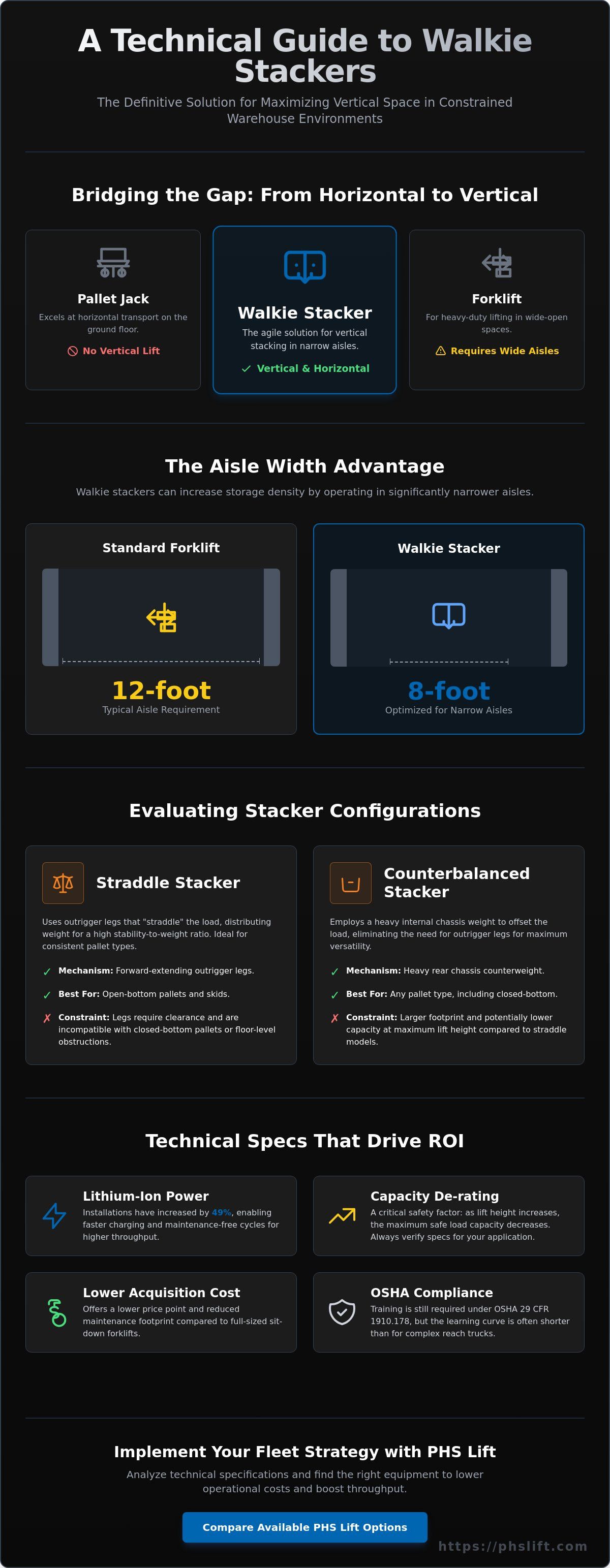
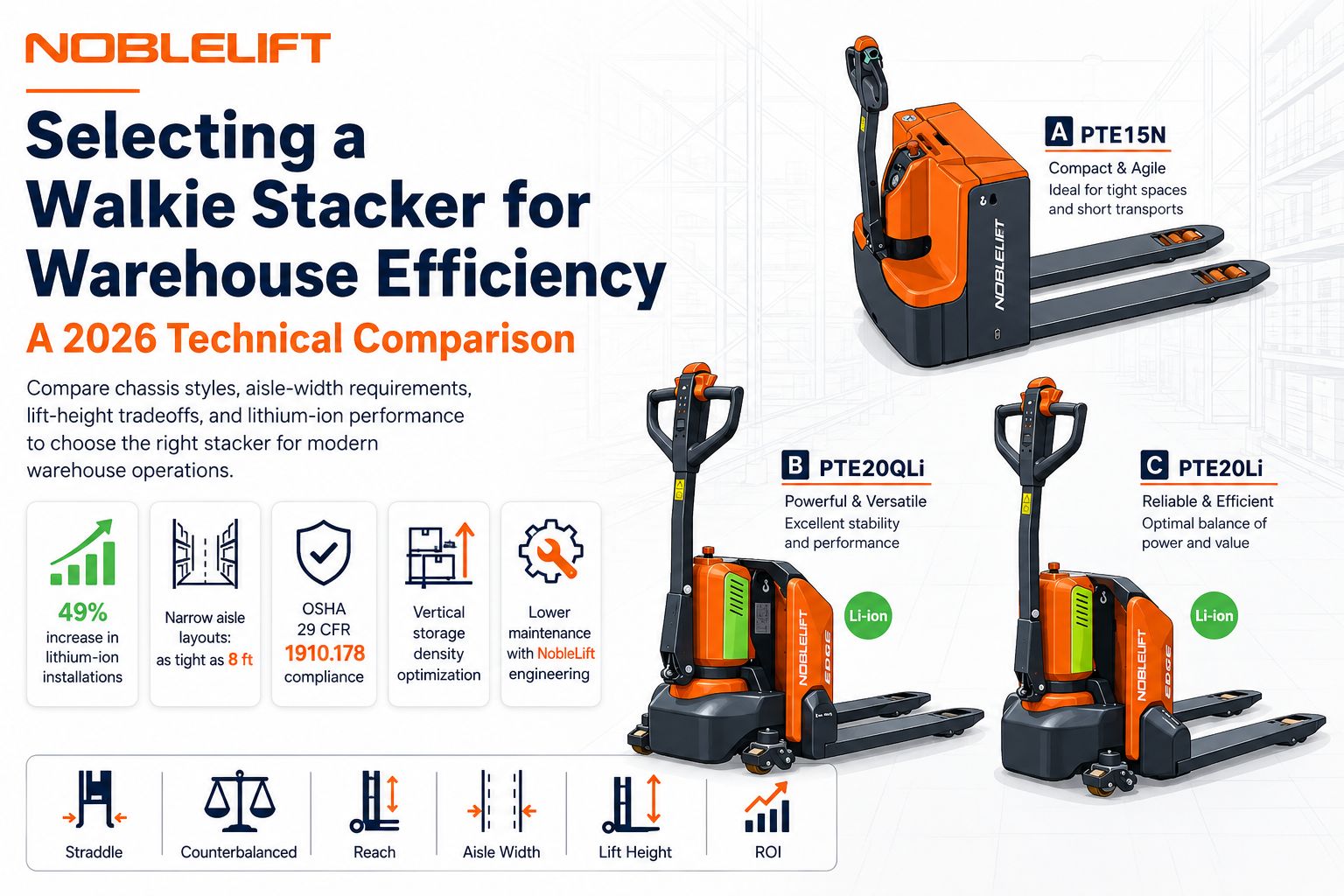
Lithium-ion installations in modern warehouses have increased by 49 percent as operators prioritize faster charging and maintenance-free cycles. For facilities struggling with narrow aisles and vertical storage, the walkie stacker is the definitive solution. It bridges the gap between manual equipment and heavy machinery. This unit provides necessary lift height without the wide turning radius or high operational costs of larger vehicles. You understand that maximizing every square foot is critical, yet manual movement often creates a bottleneck in your workflow.
This guide provides a technical comparison of 2026 configurations to help you justify procurement with performance metrics and application-specific ROI. We will examine aisle width requirements, OSHA 29 CFR 1910.178 certification standards, and the impact of the California Zero-Emission Forklift (ZEF) regulation. You'll learn how to select the right chassis for your specific racking layout to lower long-term operational costs. To see how these specifications translate to your floor, you can compare available PHS Lift options for your next fleet upgrade.
Key Takeaways
- Identify when to deploy a walkie stacker over traditional horizontal transport to maximize vertical density in space-constrained facilities.
- Compare straddle, counterbalanced, and reach configurations to ensure hardware compatibility with your specific pallet designs and racking.
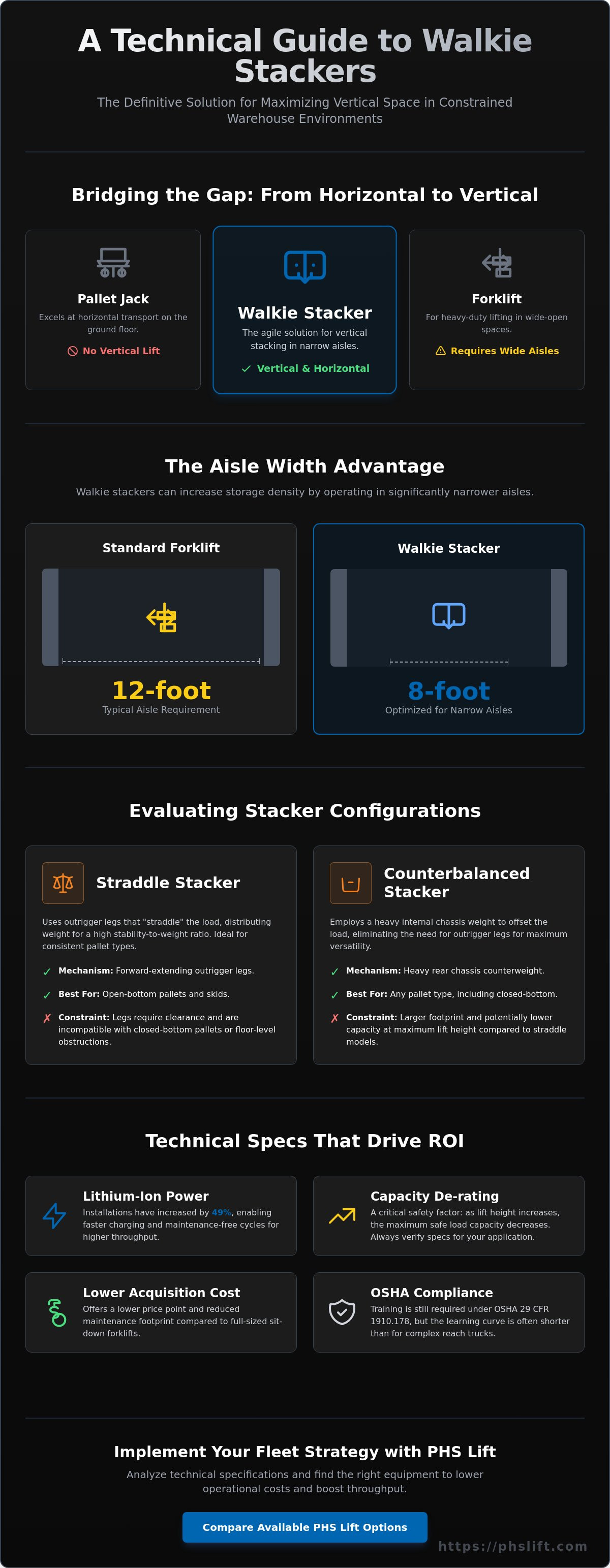
- Assess the technical "Aisle Width Gap" to determine if your floor layout supports narrow 8-foot or standard 12-foot turn radius requirements.
- Analyze capacity de-rating at maximum lift heights to maintain safety standards and justify long-term procurement ROI.
- Leverage lithium-ion power systems and NobleLift engineering to reduce maintenance intervals and optimize high-volume shift throughput.
Bridging the Gap: When to Deploy a Walkie Stacker vs. Traditional Equipment
A walkie stacker is a powered pallet lift designed with a mast for vertical positioning. It functions as the middle ground between a basic powered pallet jack and a full-sized forklift. While standard jacks excel at horizontal transport, they fail the moment a pallet needs to go up. In high-density environments, floor space is expensive. Verticality is the only way to scale without expanding your footprint. This equipment allows you to utilize the full cube of your warehouse effectively.
Operational triggers often dictate the transition to specialized lifting equipment. If your team relies on manual labor for vertical stacking or uses ladders to pick from height, you've reached a safety and throughput bottleneck. This is common in micro-fulfillment centers and retail backrooms where square footage is at a premium. The walkie stacker allows for dense racking in areas where a counterbalanced truck simply cannot turn. It transforms a congested floor into a high-capacity storage zone. It's about precision in tight quarters.
The Economic Case for Walk-Behind Lifts
Procurement teams favor these units for their lower acquisition costs. A sit-down electric forklift represents a massive capital expenditure. In contrast, walk-behind models offer a lower price point with high utility. Operator training is straightforward. While OSHA standard 29 CFR 1910.178 still requires formal instruction and evaluation every three years, the learning curve is shorter than that of a complex reach truck. Maintenance footprints are also smaller. With fewer hydraulic and electrical components than heavy machinery, operational uptime remains high. You can compare available PHS Lift options to see how these units fit into a lean budget model.
Comparing Vertical Reach and Floor Agility
Mast height directly impacts stability and facility overhead requirements. You must account for collapsed height to ensure the unit clears doorways and mezzanines during transit. Unlike large forklifts that often require 12-foot aisles, these compact units operate comfortably in 8-foot paths. They provide maneuverability in tight spaces where heavy counterweights are prohibited by floor load limits or structural constraints. The walkie stacker is a tactical tool for narrow-aisle optimization. It offers the vertical reach needed for modern racking without sacrificing the agility required for rapid floor movement. This balance is indispensable for facilities aiming for 2026 efficiency standards.
Evaluating Stacker Configurations: Straddle, Counterbalanced, and Reach Models
Configuration choice is a matter of physics and pallet geometry. Every walkie stacker relies on a specific method to maintain stability while lifting heavy loads to height. The most common design is the straddle stacker. It uses outriggers—legs that extend forward alongside the forks—to distribute weight across a wider base. This setup provides the highest stability-to-weight ratio. It's the industry standard for handling open-bottom pallets and skids where the legs can safely pass on either side of the load. Without these outriggers, the unit would tip forward as the mast extends.
Operations handling closed-bottom pallets require a different engineering approach. Since outriggers cannot pass through a pallet with bottom boards, a counterbalanced walkie stacker is necessary. These units use a heavy weight at the rear of the chassis to offset the load on the forks. This design allows the forks to approach any pallet type without floor-level interference. However, this safety comes with a trade-off in capacity and footprint. Adherence to OSHA standards for lift truck capacity is vital here. Because they lack outriggers, counterbalanced models often have a lower rated capacity at maximum lift heights compared to straddle units. You can compare available PHS Lift options to see which configuration matches your specific pallet inventory.
Straddle vs. Counterbalanced Engineering
Leg clearance is the primary constraint when choosing between these two. Straddle legs require clear floor space between the racking uprights and the pallet. If your racking is configured for tight tolerances, these legs might strike the rack beams or uprights. Turn radius is the second critical factor. Because counterbalanced models need a heavy rear chassis, they're physically longer. This increases the turning pocket, often requiring 10 to 12 feet of aisle space. In contrast, a straddle model is more compact. Choose straddle legs for standard GMA pallets to keep your aisles narrow and your storage density high.
The Versatility of the Walkie Reach Stacker
The walkie reach stacker combines a compact chassis with a pantograph, or scissor mechanism. This allows the forks to extend forward from the mast to pick or place loads. It's the ideal solution for double-deep stacking, where you store two pallets in a single rack opening. These units excel in aisles under 10 feet wide. They offer the functionality of a heavy reach truck without the massive footprint or high price tag. If your facility prioritizes high-density storage and rapid throughput, explore related PHS Lift equipment for specialized narrow aisle applications. The reach mechanism ensures you don't have to move the entire chassis to seat a load, which reduces wear on the drive tires and floor surface.
Walkie Stacker vs. Reach Truck: Selecting the Right Lift for Your Aisle Width
The decision between a high-performance walkie stacker and a reach truck often centers on the "Aisle Width Gap." While reach trucks are the standard for high-bay racking, they frequently require 10 to 12 feet of clearance to maneuver safely. A walkie stacker operates efficiently in aisles as narrow as 8 feet. This 4-foot difference isn't just a technical spec; it allows for an additional row of racking in many facility layouts. For a standard 20,000 square foot warehouse, that translates to a major increase in total pallet positions. You can find more details on this transition in our A Technical Buyer’s Guide to Fleet Selection.
Throughput is the second critical differentiator. Reach trucks provide superior travel speeds because they're designed as ride-on units. They excel in large distribution centers where travel distances between the loading dock and the rack exceed 100 feet. A walk-behind unit is limited by the operator's walking pace, typically 3 to 4 mph. If your facility processes more than 50 pallets per shift, the speed of a reach truck justifies the higher capital expenditure. For staging areas or retail backrooms with lower volume, the walkie stacker offers better ROI. It handles the verticality you need without the cost of a ride-on chassis.
Operator ergonomics must also influence your selection. Walk-behind configurations are ideal for short bursts of activity. They allow the operator to stay mobile and transition quickly to other floor tasks like inventory counting or labeling. Stand-on or sit-down reach trucks are better for full-shift operation to reduce operator fatigue. Choosing the wrong interface leads to unnecessary downtime and safety risks. It's about matching the tool to the duration of the task.
Space Optimization and Turning Radii
Calculating the right-angle stack width is essential for facility planning. This metric determines the minimum space the unit needs to turn 90 degrees and place a pallet in the rack. Chassis length is the primary driver of this requirement. A compact chassis allows for tighter rack spacing, which increases overall facility density. Before finalizing your floor plan or rack installation, consult the NobleLift Material Handling Equipment guide for precise chassis specs and turning data.
Duty Cycle and Shift Requirements
Extended travel distances make a standard walkie stacker inefficient over time. When your workflow involves moving pallets across a large footprint, transition to ride-on stackers or dedicated reach trucks. These units maintain high throughput during multi-shift operations. You should compare available PHS Lift options for high-capacity lifts if your duty cycle exceeds five hours of active runtime per day. Matching the equipment to the shift length ensures your batteries don't deplete before the work is finished.
Technical Specs That Drive ROI: Capacity, Lift Height, and Power Systems
Maximizing ROI requires a granular look at technical specifications beyond the sticker price. Nominal capacity is often misleading. A walkie stacker rated for 3,000 lbs at floor level will see its capacity de-rated as the mast extends. This reduction occurs because the center of gravity shifts forward and upward. You must verify the load chart for your specific racking height to avoid safety violations and equipment failure. Ignoring de-rating metrics is a primary cause of tip-over accidents in high-density storage environments.
Power systems represent the largest variable in Total Cost of Ownership (TCO). In 2026, the transition to Lithium-ion (Li-ion) is a strategic necessity. Research shows Li-ion installations have increased by 49 percent because they eliminate the labor-intensive "watering" required by lead-acid batteries. Over a five-year lifecycle, the savings in maintenance labor and energy efficiency often offset the initial premium. These sealed units also comply with the California Zero-Emission Forklift (ZEF) regulation that took effect January 1, 2026, for government fleets. The walkie stacker remains the most cost-effective way to meet these zero-emission standards in small-to-mid-sized operations. To determine the exact TCO for your facility, you can compare available PHS Lift options.
Battery Technology and Charging Infrastructure
2026 fleets prioritize integrated chargers that utilize standard 110V outlets. This eliminates the need for specialized electrical contractors and heavy-duty charging stations. Opportunity charging allows operators to plug in during 15-minute breaks, maintaining a consistent state of charge throughout multi-shift operations. You'll find a detailed breakdown of these efficiencies in the Transitioning to an Electric Forklift Fleet Case Study. This charging model effectively doubles the utility of a single unit compared to traditional lead-acid swap-out systems.
Mast Configurations and Collapsed Heights
Selecting between two-stage and three-stage masts depends on your facility's lowest overhead clearance. A three-stage mast provides high lift capabilities while maintaining a low collapsed height, which is essential for passing through standard doorways or under mezzanines. Free lift is another critical spec. It allows the forks to rise to a certain height without the mast itself extending. This is indispensable for stacking inside trailers or shipping containers where ceiling height is restricted. You can request a quote from PHS Lift for specific mast height configurations tailored to your warehouse dimensions.
Implementing Your Fleet Strategy with NobleLift Solutions
NobleLift engineering prioritizes mechanical accessibility to minimize mean time to repair (MTTR). Modern units, such as the 2026 PSE26N and PS30RM models, feature modular component layouts that allow technicians to access hydraulic and electrical systems without total chassis disassembly. Maximizing uptime is the primary driver of fleet ROI. You must also match your walkie stacker to the specific floor conditions of your facility. Polyurethane wheels are standard for smooth warehouse concrete, while specialized compounds are required for cold storage or mezzanine applications where floor load limits are restrictive. Choosing a unit with the correct tire compound ensures optimal traction and prevents premature wear on your industrial flooring.
Standardizing Your Material Handling Fleet
Standardizing on a single manufacturer simplifies your parts inventory and reduces maintenance complexity. When you utilize the same brand across your fleet, your maintenance team only needs to stock one set of common wear items like seals, sensors, and contactors. This consistency also improves safety. Operators who move between units benefit from a consistent tiller-arm interface and control layout. This reduces the risk of operational errors during high-stress shifts. To ensure your fleet receives consistent support across multiple locations, you should choose a forklift dealer that offers a spec-forward approach to national procurement and parts distribution.
Next Steps for Procurement
Successful implementation begins with a precise site survey. You must measure your narrowest aisle clearance, doorway heights, and floor load limits to ensure the equipment can navigate the entire facility safely. Don't guess these dimensions. Even a two-inch discrepancy can render a new unit unusable in a specific racking zone. Utilize PHS Lift tools for fleet calculation and sizing to verify that your chosen model meets your throughput requirements. These utilities help you account for pallet weights, lift heights, and duty cycles before you commit to a purchase. Once you've identified your technical requirements, schedule a consultation for high-density storage projects to finalize your configuration. You can review the full range of PHS Lift stackers to find the exact engineering solution for your facility's unique operational challenges.
Optimizing Your Material Handling Fleet for 2026
Configuring your facility for maximum vertical density requires more than just high-bay racking. It demands a strategic alignment of equipment specs and floor layout. Selecting the correct walkie stacker configuration ensures your team maintains high throughput while navigating narrow aisles as small as 8 feet. Prioritize Lithium-ion power systems to secure maintenance-free uptime and meet 2026 zero-emission regulatory standards. By focusing on capacity de-rating and mast heights, you protect both your operators and your inventory.
PHS Lift serves as your seasoned industry partner, offering Spec-Forward Technical Guidance and National Fleet Support. As an Official NobleLift Dealer, we prioritize operational accuracy because you can't afford unnecessary downtime. Our team understands the high-stakes nature of technical operations and the need for reliable equipment that performs under pressure. Take the next step in streamlining your warehouse workflows today. Compare professional-grade walkie stackers at PHS Lift and build a fleet designed for long-term industrial grit.
Frequently Asked Questions
What is the main difference between a walkie stacker and a forklift?
The primary difference is the operator position and the chassis footprint. A walkie stacker is a walk-behind or stand-on unit designed for narrow aisles, whereas a standard forklift is a larger, sit-down vehicle requiring wider turning paths. Stackers rely on outriggers or compact counterweights, making them more agile in tight quarters but limited in travel speed compared to heavy-duty trucks.
Can a walkie stacker be used on a mezzanine?
Yes, walkie stackers are often suitable for mezzanines due to their lower total weight compared to sit-down forklifts. You must verify the mezzanine's point-load capacity and the unit's service weight, including the battery and maximum load. Because these units lack the heavy counterweights found on larger trucks, they exert less pressure on structural flooring, making them a preferred choice for elevated storage areas.
How much aisle space does a walkie stacker require?
Most walkie stackers require between 8 and 9 feet of aisle width to operate efficiently. This is significantly less than the 12 feet typically required for a standard counterbalanced forklift. Exact requirements depend on your pallet dimensions and the unit's right-angle stack width. Consult your equipment specifications to ensure your rack spacing supports the specific turning radius of your chosen model.
What is the average lift capacity for an electric walkie stacker?
Average lift capacities typically range from 2,000 to 4,000 lbs. High-performance models can reach up to 5,000 lbs, though capacity often de-rates as the mast extends to maximum height. You must check the load center and de-rating chart to ensure the unit handles your heaviest pallets at the required rack level. Overloading a unit beyond its rated capacity at height poses a significant tip-over risk.
Do I need a forklift license to operate a walkie stacker?
Yes, OSHA standard 29 CFR 1910.178 requires operators to be trained and certified. This mandate includes formal instruction, practical training, and a performance evaluation conducted at the workplace. Certification must be renewed every three years. Employers are responsible for ensuring every operator is competent and authorized to handle the specific equipment type used in their facility.
Can walkie stackers handle both open and closed pallets?
Standard straddle stackers only handle open-bottom pallets and skids because the outriggers must pass on either side of the load. If you use closed-bottom pallets with bottom boards, you need a counterbalanced or reach-style unit. These configurations allow the forks to enter the pallet without floor-level legs interfering with the bottom boards. You can compare available PHS Lift options to find the right fit for your pallet inventory.
Are lithium-ion batteries worth the extra cost for a stacker?
Lithium-ion batteries provide superior ROI in multi-shift operations through opportunity charging and zero maintenance. Unlike lead-acid batteries, they don't require watering or dedicated ventilation rooms. With the 2026 California Zero-Emission Forklift regulation impacting government fleets, switching to Li-ion ensures compliance and lowers long-term operational costs. The 49 percent increase in Li-ion installations reflects the industry's shift toward this high-efficiency power source.
What is the maximum lift height for a standard walkie stacker?
Standard lift heights typically range from 60 to 180 inches. Specialized three-stage mast models can reach heights over 200 inches for high-density racking applications. Collapsed height is a critical factor; ensure the mast clears your lowest doorways and mezzanine supports when fully lowered. For high-bay requirements, a reach-style stacker often provides the best balance of height and stability.