What if the primary cause of your warehouse downtime isn't mechanical failure, but the outdated energy chemistry powering your fleet? Most operations managers agree that managing aging lead-acid batteries is a persistent logistical bottleneck, especially when inconsistent charging schedules disrupt multi-shift workflows. High capital expenditure for legacy brands often feels like a mandatory tax on reliability, but the 2026 market proves otherwise. By integrating NobleLift Material Handling Equipment into your facility, you can bypass the maintenance requirements of traditional power while slashing your total cost of ownership.
This guide provides the spec-forward intel you need to optimize your fleet using NobleLift’s latest engineering, including the NobleOne AI platform and the ALPHA series lithium-ion units. You'll learn how to transition to a maintenance-free power structure that complies with the OSHA 2025 Lithium-Ion Battery Safety Fact Sheet. We'll examine the ROI of the 6,500 lb. capacity Omega AI models and show you how to standardize operations across national locations. Before you commit to another high-priced lease, explore related PHS Lift equipment to see how lithium-first engineering scales your throughput.
Key Takeaways
- Analyze the 5-year operational cost of your fleet to move beyond initial purchase price and capture real labor savings from maintenance-free power.
- Eliminate dedicated battery rooms and mid-shift swaps by leveraging lithium-iron phosphate chemistry and high-efficiency opportunity charging.
- Use a technical selection framework to match NobleLift Material Handling Equipment to specific aisle widths and high-density storage requirements.
- Identify the performance metrics of Class I and II electric motor riders to optimize vertical space and load capacity in multi-shift environments.
- Streamline multi-location procurement and technical support through a national partner capable of providing spec-forward equipment selection and deployment.
What is NobleLift Material Handling Equipment?
NobleLift is a global manufacturer of Class I through Class V units. The brand's "spec-forward" philosophy prioritizes technical performance and data-driven results over traditional brand-name markups. This approach specifically targets 3PL providers, manufacturing plants, and high-density distribution centers where operational uptime is the primary metric for success. In 2026, NobleLift is the industry benchmark for lithium-ion integration. Engineering teams no longer just swap batteries; they design the entire chassis around lithium-iron phosphate (LiFePO4) power density. You can compare available PHS Lift options to see how these specialized specs translate to real-world floor performance.
The core market focus remains on high-volume environments that require 24/7 reliability. By removing the "brand tax" associated with legacy manufacturers, NobleLift provides procurement managers with a way to modernize their Material-handling equipment without exceeding capital expenditure limits. This pragmatic focus on performance metrics like lift speed, gradeability, and battery cycle life has made NobleLift Material Handling Equipment a staple in modern logistics hubs.
The Evolution of NobleLift in North America
NobleLift's trajectory in the North American market began as a dominant leader in manual pallet jacks. It has since matured into a full-spectrum electric fleet provider. The strategic shift toward LiFePO4 technology was finalized by late 2025 with the opening of the North American Tech Center in Milwaukee, WI. Every unit meets or exceeds ANSI safety standards and OSHA regulations. This includes the UL 2580 certification, which validates battery safety under extreme stress. This evolution ensures that even high-capacity units, like the 6,500 lb. Omega AI models, maintain the highest safety ratings in the industry.
Why Industrial Professionals are Switching
Procurement teams are increasingly choosing NobleLift Material Handling Equipment for its unique balance of factory pricing and Tier 1 performance specifications. Maintenance overhead is drastically lower than internal combustion alternatives. Electric units eliminate the mechanical complexity of engines and the rising costs of fuel. Parts standardization across the product line further simplifies fleet management. Technicians don't have to manage a fragmented inventory of unique SKUs for every model. This streamlined approach reduces the mean time to repair (MTTR) and keeps the fleet in motion. If you're ready to modernize your warehouse, you can request a quote from PHS Lift to explore specific model configurations.
The Lithium-Ion Advantage: Revolutionizing Fleet Uptime
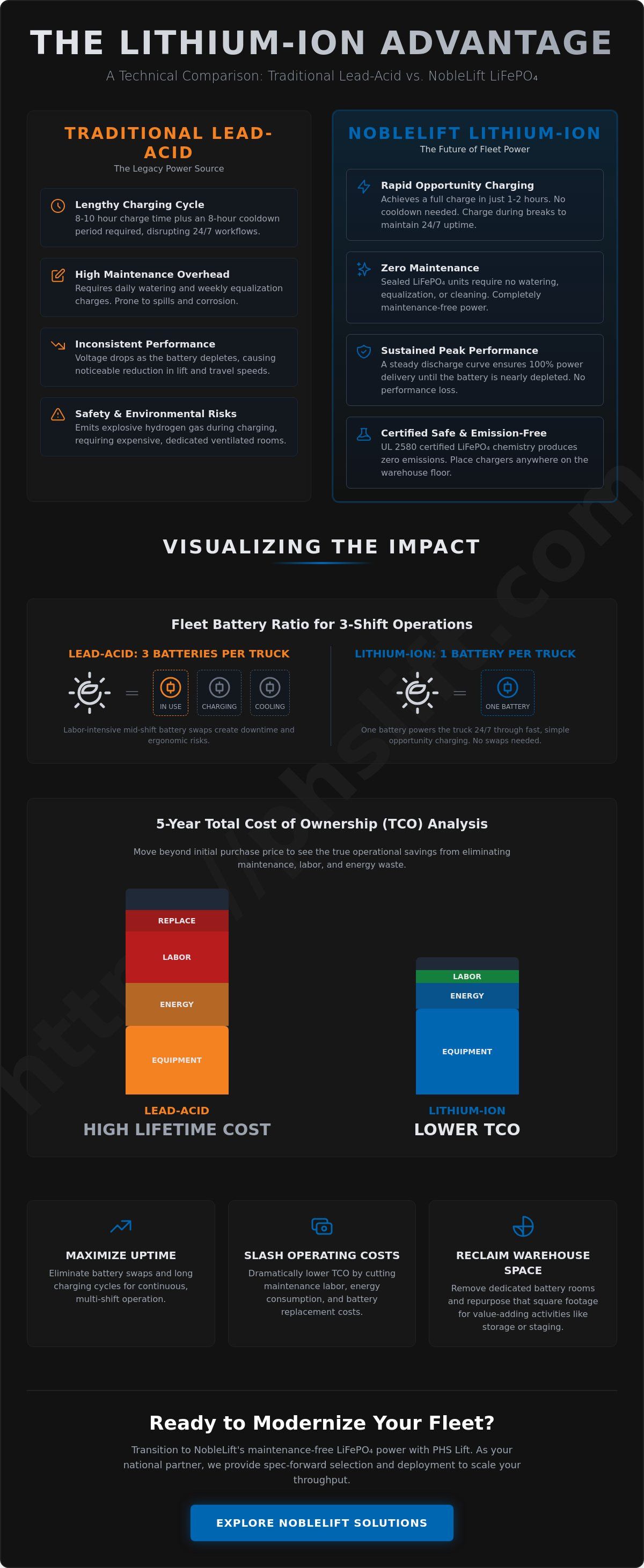
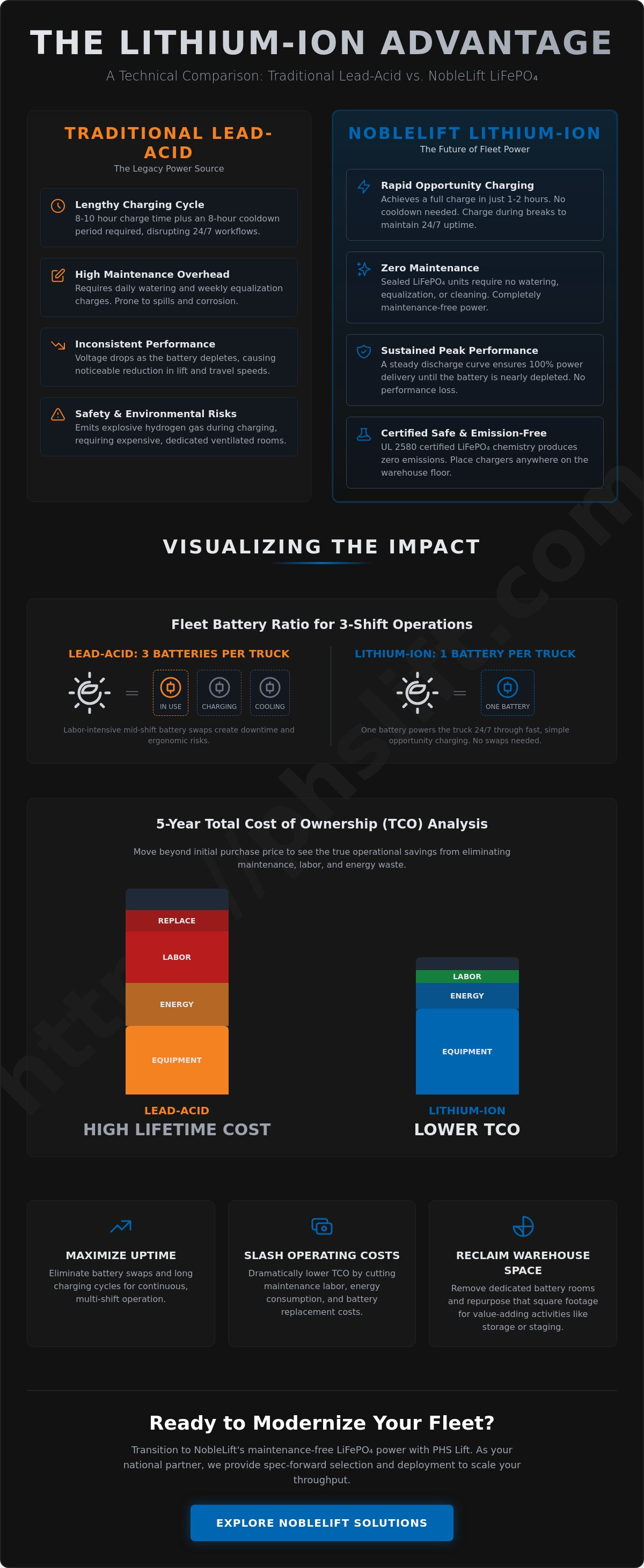
NobleLift Material Handling Equipment utilizes Lithium-Iron Phosphate (LiFePO4) chemistry, a critical distinction for 2026 warehouse operations. Unlike traditional lead-acid units, these batteries don't require "watering" or weekly equalization charges. Lead-acid fleets typically experience significant voltage drops as the battery depletes, reducing travel and lift speeds. Lithium-ion maintains a steady discharge curve, ensuring 100% power delivery until the battery is nearly empty. This chemistry is also inherently safer than cobalt-based alternatives. It complies with the OSHA 2025 Lithium-Ion Battery Safety Fact Sheet and carries UL 2580 certification, validating its stability under extreme industrial stress.
Environmental impact is another decisive factor. Lead-acid batteries emit hydrogen gas and acid mist during charging, requiring expensive ventilated rooms. NobleLift’s sealed LiFePO4 packs produce zero emissions. This allows you to place chargers directly on the warehouse floor in high-traffic zones. You can compare available PHS Lift options to see how this flexibility simplifies facility layouts and reduces the total footprint dedicated to non-productive charging tasks.
Fast Charging and Multi-Shift Logistics
Full charge times of 1 to 2 hours enable 24/7 operations without the need for spare batteries. In a three-shift environment, a lead-acid fleet requires three batteries per truck: one in use, one charging, and one cooling down. Standardizing on NobleLift Material Handling Equipment reduces this ratio to 1:1. By strategically placing chargers near breakrooms or shipping docks, operators can maximize "plug-in" time during short intervals. This approach eliminates the labor-intensive process of mid-shift battery swaps, which often take 15 to 20 minutes per truck and present significant ergonomic risks to technicians.
Long-Term Battery ROI Metrics
Lithium-ion batteries provide a 3x lifespan increase over conventional industrial batteries, often reaching 3,000 to 5,000 cycles before falling below 80% capacity. Opportunity charging is the practice of plugging in equipment during short breaks to maintain battery levels, which reduces fleet sizing by eliminating the need for standby units and spare batteries. This practice significantly lowers the total cost of ownership by extending the operational life of the asset. Energy efficiency is also improved; these systems consume approximately 30% less KWh per pallet moved compared to lead-acid counterparts. If you want to see how these metrics apply to your specific facility, you can explore related PHS Lift equipment and technical data sheets.
- Maintenance Savings: Zero watering, zero cleaning, and zero equalization.
- Operational Uptime: 100% power delivery throughout the entire discharge cycle.
- Safety Compliance: Sealed units that meet UL 2580 and OSHA 2025 standards.
NobleLift Equipment Categories & Selection Framework
Selecting the right NobleLift Material Handling Equipment requires a precise audit of your facility's physical constraints and throughput requirements. The selection framework begins with three primary metrics: aisle width, maximum lift height, and peak load capacity. For high-density storage environments, Class I and II units like electric motor riders and narrow aisle reach trucks are essential for maximizing vertical cube utilization. Class III units, including electric motor hand trucks, facilitate rapid floor-level throughput in shipping and receiving zones. You can compare available PHS Lift options to see how specific chassis dimensions impact your facility layout.
Specialty applications require equipment designed for non-standard loads or environmental challenges. Rough terrain forklifts provide the necessary gradeability and tire tracking for outdoor construction or lumber yards. For heavy-duty manufacturing where traditional towing is required, electric tuggers move modular carts and heavy machinery without the footprint of a full-sized forklift. This modular approach to fleet design ensures you aren't over-speccing equipment for simple tasks or under-powering your high-volume lanes.
Electric Pallet Jacks and Stackers
The Edge Series (PTE) represents the benchmark for ultra-compact lithium-ion power. These units are designed for LTL (Less-Than-Truckload) carriers and retail backrooms where space is at a premium. When selecting between straddle stackers and counterbalance stackers, the decision rests on your racking type. Straddle stackers use outriggers for stability, making them ideal for "open" pallets, while counterbalance stackers operate like traditional forklifts for "closed" pallets or bottom-board scenarios. Load capacities across this category range from 2,200 lbs to 8,000 lbs, allowing for precise matching of tool to task. To find the right fit for your dock, you can explore related PHS Lift equipment and technical specs.
High-Performance Forklifts and Reach Trucks
The N Series Lithium-Ion forklifts serve as the primary workhorse for indoor and outdoor manufacturing. These units offer the pneumatic tire performance of internal combustion engines with the efficiency of electric power. For facilities with Very Narrow Aisle (VNA) requirements, stand-up pantograph reach trucks provide the necessary reach-out capability to double-deep rack systems. Key performance metrics include mast visibility, which is optimized through wide-view mast designs, and a tight turn radius for 10-foot or 12-foot aisles. Standardizing on NobleLift Material Handling Equipment in these high-performance categories ensures parts commonality and simplified operator training. If you're sizing a new facility, request a quote from PHS Lift to get exact dimensions for your floor plan.
- Class I & II: High-density reach trucks and electric riders for vertical storage.
- Class III: High-speed pallet jacks and walkie stackers for dock operations.
- Specialty: Tuggers and rough terrain units for non-standard logistics.
Calculating Total Cost of Ownership (TCO) and ROI
Procurement teams often fixate on the initial purchase price. This is a narrow view that ignores the long-term financial reality of warehouse logistics. To understand the true value of NobleLift Material Handling Equipment, you must analyze the 5-year operational cost. This includes energy consumption, maintenance labor, and the cost of downtime. While the research brief shows a 2025 FE3D40N pneumatic tire model priced at approximately $34,715, the real savings accumulate through the elimination of fuel costs and the reduction of mechanical wearable parts. By 2026, the shift toward lithium-first fleets has fundamentally altered the ROI timeline for high-volume 3PL environments.
Labor savings represent a major pillar of TCO. Traditional lead-acid fleets require significant technician hours for watering, cleaning, and equalization. Lithium-ion units are maintenance-free. Even with mandatory inspections required by OSHA 29 CFR 1910.178(q)(7), the actual mechanical workload is approximately 40% lower. You don't have to manage battery rooms or hazardous acid disposal. These reclaimed labor hours allow your maintenance staff to focus on facility-wide uptime rather than battery chemistry management. To verify these savings for your specific application, you can explore related PHS Lift equipment and technical data sheets.
Residual value also plays a critical role in the secondary market. Legacy equipment with aging lead-acid batteries often sells for scrap value because the cost of battery replacement exceeds the unit's worth. NobleLift units with LiFePO4 packs retain higher value because the batteries are rated for 3,000 to 5,000 cycles. A 5-year-old unit still has significant operational life remaining. This keeps your asset's book value higher and provides a better exit strategy when it's time to refresh the fleet.
Maintenance and Serviceability
NobleLift utilizes simplified AC drive motors that lack the wearable brushes found in older DC or internal combustion systems. This reduces the number of components that can fail mid-shift. The NobleOne AI platform, unveiled at MODEX 2026, provides onboard diagnostics and total error code transparency. This allows your team to identify issues instantly without waiting for a specialized diagnostic tool. Standardized parts are readily available through national partners like PHS Lift, ensuring that mean time to repair (MTTR) remains low across all your locations.
Procurement and Financing Strategies
Preserving working capital is essential for scaling operations. Many commercial applicants utilize Net-30 terms or specialized industrial financing to manage cash flow. For example, qualified applicants can secure new equipment with payments as low as $699.03/month for a new forklift or $7.97/month for a manual pallet jack. Factory pricing models reduce the initial capital expenditure (CapEx) burden, enabling procurement teams to acquire a larger fleet of high-performance units for the same budget as a smaller legacy-brand order. Evaluating lease vs. buy options is critical for high-utilization fleets where tax advantages and refresh cycles are primary concerns.
Implementing NobleLift with PHS Lift: Your National Partner
PHS Lift acts as the primary strategic partner for deploying NobleLift Material Handling Equipment across North American operations. National coverage is essential for 3PLs and retailers managing multiple regional distribution centers. Centralizing procurement through a single authorized dealer ensures consistent equipment specs and standardized operator training. It also simplifies the logistical complexity of shipping. PHS Lift manages NMFC classes and LTL rates to provide transparent, factory-direct pricing to every site in your network. This direct-to-factory model eliminates the middleman markups common with legacy brands.
Post-sale support is the backbone of fleet optimization. PHS Lift provides a comprehensive parts inventory and technical assistance to maintain low MTTR (Mean Time to Repair). This ensures that the lithium-ion transition discussed in previous sections delivers on its promise of 24/7 uptime. You can request a quote from PHS Lift to begin a site-specific evaluation. Our technical team understands the high-stakes nature of warehouse operations and prioritizes operational uptime over sales hype.
Fleet Audits and Capacity Planning
Right-sizing is the first step in any lithium-ion conversion. A fleet audit identifies bottlenecks where aging lead-acid units slow down material movement. Using the PHS Lift Capacity Calculator allows operations managers to match equipment to specific pallet weights and racking heights. You can customize NobleLift specs to fit your facility's unique requirements. This includes selecting fork lengths for specialized pallets, mast types for low-clearance doorways, and non-marking tire compounds for cleanroom manufacturing. Data from these audits often reveals opportunities to reduce total fleet size by 15% to 20% through the use of high-efficiency lithium-ion power.
Next Steps for Warehouse Managers
The transition to a spec-forward fleet starts with data. Request a demo or a detailed spec-sheet comparison to see how NobleLift models perform against your current legacy trucks. Consult with PHS Lift experts on logistics and shipping timelines to ensure your peak season isn't interrupted by equipment shortages. Expert guidance helps you navigate the technical nuances of Class I through Class V requirements. To begin your modernization project, view the full NobleLift lineup at PHS Lift and compare performance metrics side-by-side.
Scale Your Throughput with Spec-Forward Engineering
Modernizing your warehouse requires moving beyond legacy power structures and brand-name premiums. By choosing NobleLift Material Handling Equipment, you secure a fleet designed for the high-density requirements of 2026. You've seen how lithium-iron phosphate chemistry eliminates battery rooms and how spec-forward engineering reduces the five-year total cost of ownership. These aren't just incremental improvements. They're fundamental shifts in operational efficiency that protect your bottom line. Standardizing your multi-location facility with a national partner ensures consistent parts availability and technical support across every dock.
PHS Lift provides the industrial expertise needed to navigate NMFC classes and LTL logistics for nationwide deployment. As an Authorized NobleLift Dealer and Lithium-Ion Fleet Specialist, we offer direct factory pricing and the technical tools to right-size your capacity. Don't let aging lead-acid technology or inconsistent charging schedules dictate your throughput limits. Take control of your logistics data and build a maintenance-free future that scales with your demand. Request a Spec-Forward Quote from PHS Lift to secure your 2026 fleet optimization plan. It's time to prioritize uptime and operational grit.
Frequently Asked Questions
Are NobleLift forklifts as durable as traditional premium legacy brands?
NobleLift units utilize Tier 1 components like Curtis controllers and Schabmüller motors, matching the mechanical reliability required for high-volume settings. The spec-forward approach focuses on performance density rather than brand markups. By using standardized parts, the equipment maintains high uptime in 24/7 industrial environments. This durability is supported by the Milwaukee Tech Center established in late 2025 to oversee North American engineering standards.
How long does a NobleLift lithium-ion battery actually last in a 3-shift operation?
A NobleLift lithium-ion battery typically lasts between 3,000 and 5,000 cycles before capacity drops below 80%. In a 3-shift operation, opportunity charging during 15-minute breaks allows a single unit to run around the clock without battery swaps. This technology eliminates the need for the three-battery-per-truck ratio required by lead-acid fleets. It follows the OSHA 2025 Lithium-Ion Battery Safety Fact Sheet for operational safety and longevity.
What is the difference between a walkie stacker and a reach truck for narrow aisles?
A walkie stacker is a pedestrian-operated unit for floor-level throughput and lower racking heights, while a reach truck features a pantograph mast for high-density vertical storage. Reach trucks are Class II vehicles designed for riders in very narrow aisles. Walkie stackers are Class III units that offer a smaller footprint but lower lift heights. Selecting the right NobleLift Material Handling Equipment depends on your specific rack height and aisle width constraints.
Can NobleLift electric pallet jacks be used in cold storage or freezer environments?
Yes, NobleLift offers specialized cold storage packages for electric pallet jacks that include heated components and low-viscosity hydraulic oil. These modifications prevent condensation buildup and ensure the lithium-ion batteries maintain optimal discharge rates in temperatures as low as -20°F. These units are frequently deployed in grocery distribution and frozen food manufacturing. You can compare available PHS Lift options for specific environmental ratings.
What kind of maintenance does a lithium-ion forklift require compared to lead-acid?
Lithium-ion units require zero battery maintenance, eliminating the watering and equalization cycles mandatory for lead-acid systems. Your maintenance schedule shifts entirely to mechanical preventative measures like tire inspections and mast lubrication. Since there's no acid evaporation, facility damage from corrosion is eliminated. This reduction in technician labor hours is a primary driver for the lower total cost of ownership found in NobleLift Material Handling Equipment.
Does PHS Lift provide national service and parts support for NobleLift equipment?
PHS Lift operates as a national partner providing comprehensive parts, service, and technical assistance across the US. Support is anchored by the 32,000-square-foot distribution center in Georgia, opened in July 2024, which maintains high stock levels of critical components. This infrastructure ensures that multi-location facilities receive consistent LTL shipping rates and standardized technical support. You can request a quote from PHS Lift for regional service contracts.
How do I determine which OSHA forklift class my facility needs?
OSHA classes are determined by the engine type and operational environment of the truck. Class I covers electric motor rider trucks, while Class II is dedicated to electric motor narrow aisle trucks like reach units. Class III includes electric motor hand trucks or pallet jacks. Identifying your class is the first step in compliance with OSHA 29 CFR 1910.178(q)(7) inspection protocols. Use a Class Finder tool to match equipment to your facility's safety requirements.
What is the typical lead time for new NobleLift material handling equipment?
Typical lead times for NobleLift units are often shorter than legacy competitors due to a streamlined direct-to-dealer supply chain. Stock units from the Georgia or Wisconsin distribution centers can often be shipped within 7 to 10 business days. Custom configurations or high-capacity Omega AI models may require longer timelines depending on production cycles. Contact PHS Lift to get real-time availability and NMFC class data for your specific order.