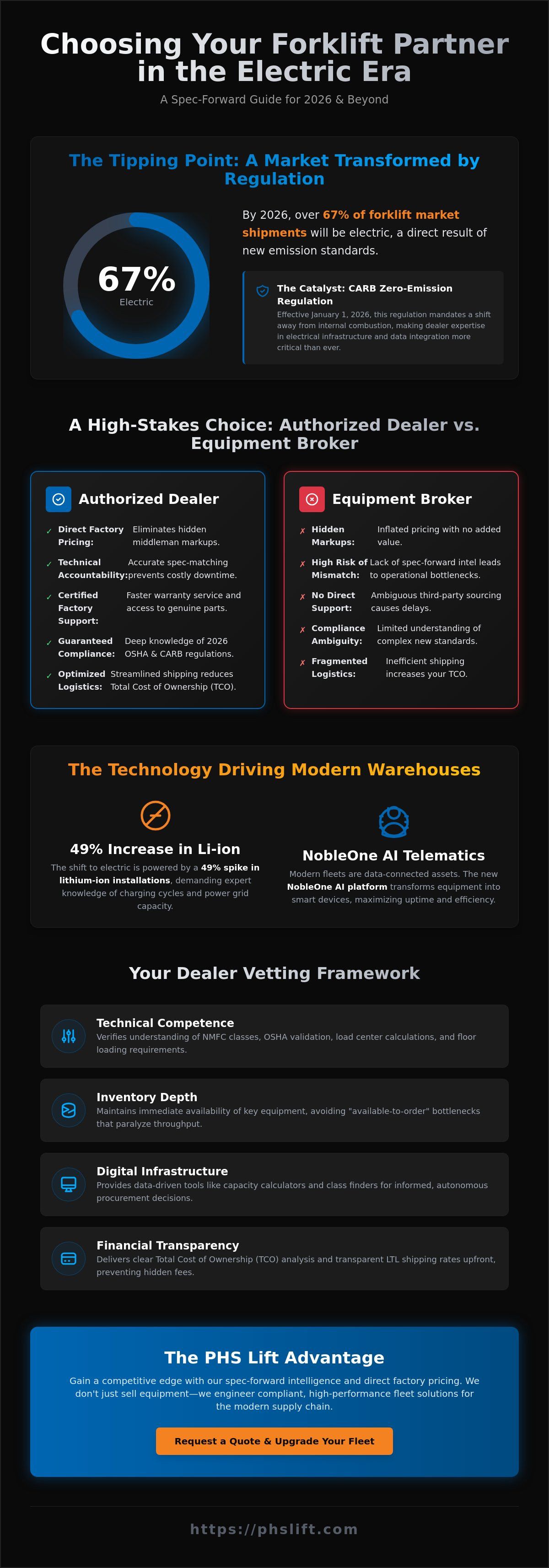
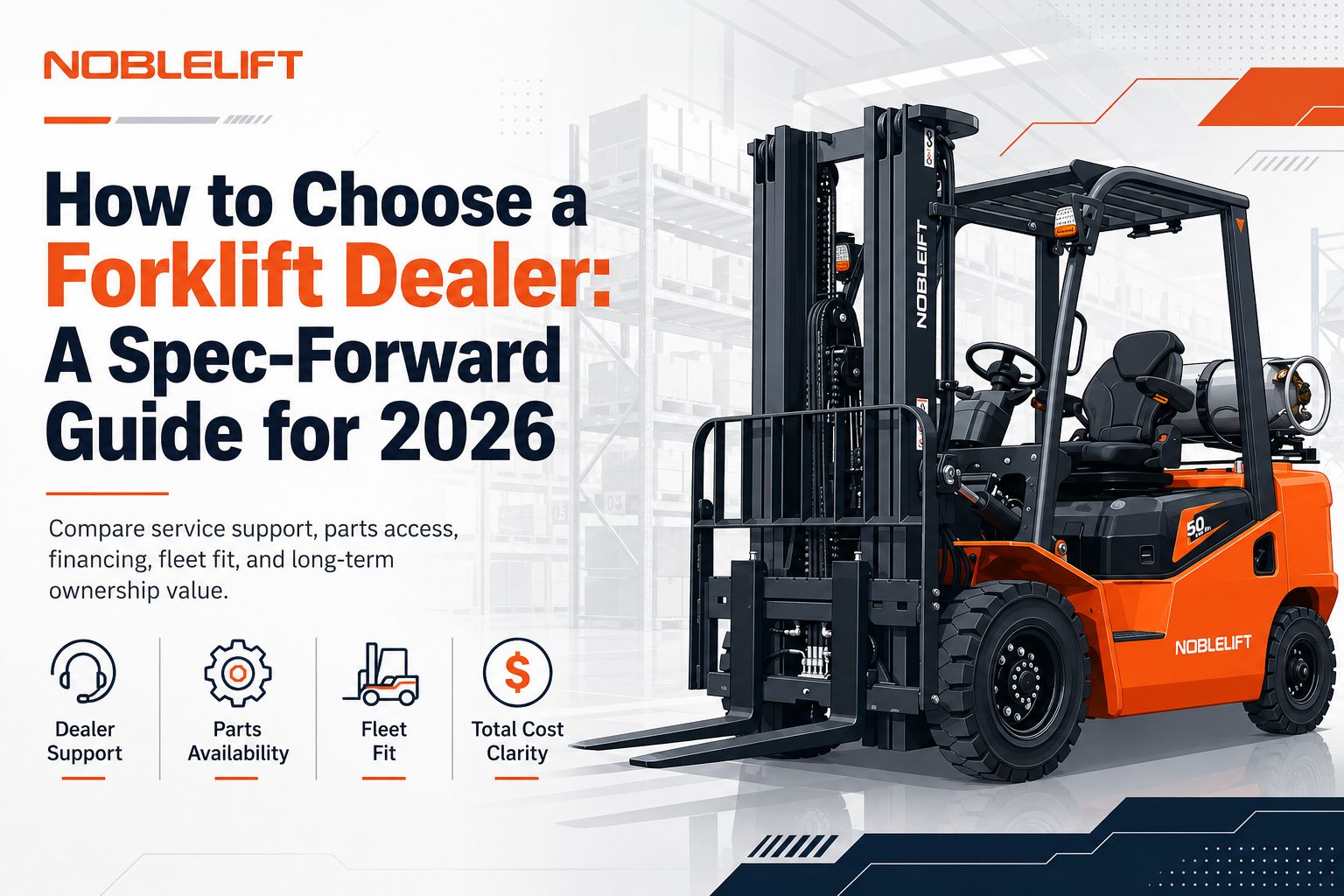
Over 67% of forklift market shipments in 2026 are now electric, a direct result of the January 1 CARB Zero-Emission Forklift regulation. Selecting a forklift dealer is no longer a simple procurement task; it's a high-stakes decision involving electrical infrastructure and data integration. You already understand that hidden middleman markups and inaccurate spec matching lead to costly downtime and operational bottlenecks.
This spec-forward guide identifies the critical criteria for choosing a national dealer that prioritizes technical accuracy and direct factory pricing. We examine how to vet partners based on their ability to handle the 49% increase in lithium-ion installations and the new NobleOne AI telematics platform. You'll learn how to secure streamlined logistics and equipment-specific OSHA validation to keep your warehouse compliant and efficient. Before making a capital investment, explore related PHS Lift equipment to compare specs against your facility requirements.
Key Takeaways
- Distinguish between an authorized forklift dealer and high-markup equipment brokers to secure direct factory pricing and technical accountability.
- Evaluate technical proficiency based on a dealer's understanding of NMFC classes and equipment-specific OSHA validation requirements for 2026.
- Assess the ROI shift toward lithium-ion and AI-integrated NobleLift systems to maximize operational uptime in high-demand environments.
- Identify how spec-forward partners optimize national logistics and LTL rates to reduce the total cost of ownership for heavy equipment.
- Utilize a data-driven framework to accurately match equipment specs to specific warehouse layouts and application-specific demands.
Beyond the Transaction: The Role of a Strategic Forklift Dealer
Procurement in 2026 isn't just about finding a machine. It's about securing a reliable link in your supply chain. A modern forklift dealer operates as a technical consultancy rather than a simple retail outlet. With the California Air Resources Board (CARB) Zero-Emission Forklift regulation taking effect on January 1, 2026, the margin for error has vanished. You need a partner who understands how these mandates impact your fleet lifecycle and total cost of ownership (TCO). For those new to the industry, a comprehensive overview of forklifts reveals how these machines have evolved from simple mechanical lifts into data-connected assets that require specialized support.
Transactional Vendors vs. Operational Partners
Buying from a vendor who only cares about the "box" creates long-term operational risk. These transactional sellers often lack the spec-forward intel required to prevent equipment mismatch. If your dealer doesn't ask about your aisle width, floor PSI, or existing charging infrastructure, your ROI will suffer. By 2026, electric models are projected to account for 67% of market shipments. This shift requires precise technical matching for lithium-ion charging cycles and power grid capacity. A strategic partner ensures your equipment fits your specific operational workflow and meets the strict 2026 OSHA standards for equipment-specific validation. You can explore related PHS Lift equipment to see how technical specs align with different warehouse applications.
The Authorized Dealer Advantage
The "broker" model often hides middleman markups and lacks direct factory support. In contrast, an Authorized Dealer provides a direct line to factory parts and certified technical data. This transparency is vital for maintaining operational uptime. You get direct factory pricing and faster access to warranty support. An Authorized Dealer for NobleLift must maintain rigorous standards for technical expertise, inventory depth, and post-sale support to ensure your fleet remains compliant with 2026 OSHA data-driven enforcement. This direct relationship eliminates the ambiguity of third-party sourcing. If you're ready to upgrade your fleet with reliable machinery, you can request a quote from PHS Lift to see the difference direct pricing and expert spec-matching makes for your bottom line.
Key Criteria for Evaluating a National Forklift Dealer
The selection process for a national forklift dealer requires a move away from legacy brand loyalty toward rigorous technical vetting. In 2026, a dealer's value is measured by their ability to navigate complex regulatory shifts and technical specifications. You must verify if a potential partner understands the nuances of OSHA forklift categories and NMFC classes. This knowledge directly impacts your compliance and shipping costs. Referencing standards from the Industrial Truck Association ensures the dealer adheres to recognized safety and manufacturing benchmarks. If they can't explain how Class II and Class III equipment differ in application, they aren't equipped to manage your fleet.
Inventory depth is a non-negotiable metric. A reliable dealer maintains immediate availability of NobleLift electric pallet jacks, stackers, and reach trucks. Relying on "available to order" status leads to lead-time bottlenecks that paralyze your throughput. Beyond hardware, evaluate the dealer's digital infrastructure. High-performing partners provide capacity calculators and class finders directly on their platforms. These tools allow your procurement team to make data-driven decisions without waiting for a sales representative to return a call. To simplify your research, you can find many of these free buying tools through PHS Lift.
Vetting Technical Competence
Test a dealer's expertise by asking for specific load center calculations at maximum lift heights. Inaccurate data here isn't just an inconvenience; it's a safety violation under the 2026 OSHA data-driven enforcement standards. Dealers must also understand floor loading requirements, especially for multi-level facilities where the combined weight of the machine and the battery matters. You can explore our technical forklift specs to see the level of granular data a professional partner should provide. This transparency prevents equipment mismatch before the unit arrives at your dock.
Financial and Procurement Transparency
Total cost of ownership (TCO) should be clear from the first interaction. Spec-forward dealers provide detailed spec sheets and transparent LTL shipping rates before you request a quote. This prevents hidden fees from inflating your capital expenditure. Look for partners offering Net-30 terms and direct factory pricing to maximize your budget. Avoiding the broker model means you aren't paying for a middleman's overhead. A strategic partner like PHS Lift prioritizes this level of financial clarity to help you maintain operational uptime without administrative friction.
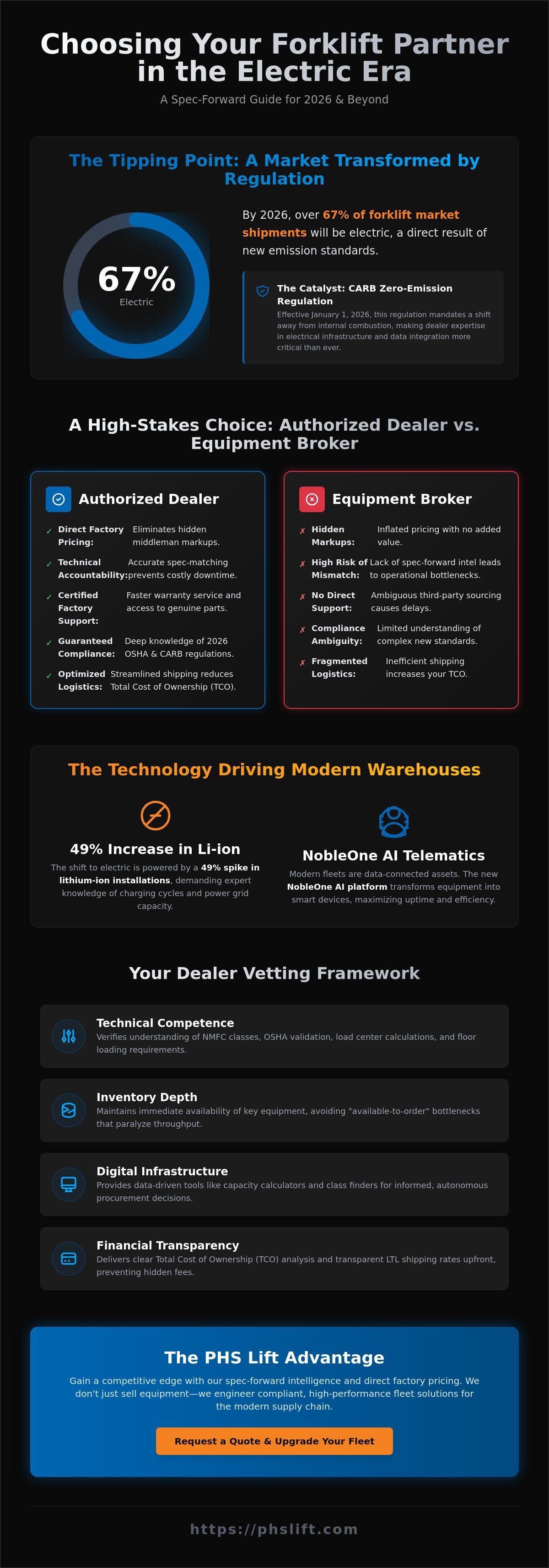
NobleLift Equipment: Why Your Dealer Choice Impacts TCO
NobleLift has emerged as the efficiency leader in electric material handling, specifically through its lithium-ion integration. By early 2026, lithium-ion installations in modern warehouses increased by 49%. This shift isn't just a trend; it's a financial strategy. Traditional lead-acid batteries require watering, equalization, and dedicated charging rooms. NobleLift lithium platforms eliminate these requirements. They offer opportunity charging and zero daily maintenance, which drastically lowers the total cost of ownership (TCO) over a standard five year lifecycle. Your choice of forklift dealer determines if you have the technical support to maximize these ROI advantages.
An authorized dealer ensures your equipment arrives with the latest 2026 hardware and firmware revisions. For example, the NobleOne AI Platform launched at MODEX 2026 requires specific dealer-side configuration to leverage its safety telematics and camera systems. A broker or unauthorized vendor cannot provide this level of technical calibration. This lack of support often leads to operational lag and missed performance benchmarks. A spec-forward dealer acts as a technical partner, ensuring your fleet is optimized for the data-driven requirements of modern logistics.
Skeptics often ask if NobleLift matches the durability of legacy brands. Industrial performance data from 2026 indicates that NobleLift's high-strength steel construction and simplified modular electronics result in lower mechanical failure rates compared to traditional internal combustion units. The durability is built into the specs. A professional partner provides the performance metrics and duty-cycle data to prove these claims before you commit your capital. This transparency is what separates a strategic partner from a simple equipment vendor.
Maximizing Warehouse Uptime
NobleLift electric pallet jacks and stackers are engineered for rapid serviceability. An authorized dealer provides the precise technical documentation and parts availability required for effective preventative maintenance. This keeps your Mean Time To Repair (MTTR) low and your throughput high. Access to genuine parts and certified technicians is essential for maintaining operational uptime in high-volume environments. You can view our NobleLift pallet jack inventory to find models optimized for these demanding logistics cycles.
Comparing Equipment Classes
Selecting the right machine class is vital for operational efficiency. While counterbalance units are versatile, reach trucks are necessary for warehouses utilizing high-density racking systems. Walkie stackers serve as the primary solution for retail backrooms and staging areas where space is at a premium. A knowledgeable dealer helps you navigate these choices based on your specific aisle widths and pallet weights. Explore our narrow aisle solutions to compare specific capacities and lift heights for your facility.
National Logistics and Shipping: What to Expect from Your Dealer
Procuring heavy industrial equipment on a national scale requires a forklift dealer with a sophisticated logistics engine. Shipping Class I or Class III machinery isn't as simple as standard palletized freight. It involves navigating complex NMFC (National Motor Freight Classification) variables that directly impact your landed cost. A spec-forward partner doesn't just "ship anywhere." They optimize LTL rates by ensuring accurate classifications and leveraging high-volume carrier contracts to prevent the re-weigh fees and re-class penalties that often surprise procurement managers. This level of logistical precision is what ensures your project stays within its capital expenditure budget.
Centralized national distribution models offer a distinct lead-time advantage over regional brokers. While a local vendor might wait for regional stock to replenish, a national dealer utilizes a centralized hub to move equipment across the United States with predictable transit times. This model ensures that when you order a NobleLift reach truck or stacker, it arrives in "Ready to Work" (RTW) condition. RTW status means the unit has undergone a final technical verification and battery charge before leaving the dock, allowing your facility to begin operations the moment the equipment is offloaded. If you're managing multiple sites, you can request a quote from PHS Lift to see how centralized logistics simplifies your multi-state procurement.
Streamlining the Delivery Process
- Step 1: Accurate Freight Quoting. Professional dealers provide firm freight quotes based on exact machine dimensions and weight, including the battery, to avoid billing discrepancies.
- Step 2: Carrier Coordination. Logistics teams coordinate with carrier networks to determine if your site requires a liftgate, a flatbed, or a specialized dock delivery based on your facility's infrastructure.
- Step 3: Technical Verification. Upon arrival, the equipment undergoes a post-delivery inspection to confirm that no shipping damage occurred and that all electronic systems are functioning to spec.
Handling National Service and Support
A national support model often outperforms local generalists by providing specialized technical depth. While local affiliates handle on-site physical repairs, a centralized technical support team manages warranty claims and firmware updates across all your regions. This ensures consistency in maintenance standards, regardless of where your facility is located. Centralized experts often resolve electronic or telematics issues faster because they possess specialized knowledge of the NobleOne AI platform and lithium-ion battery management systems. This tiered support structure minimizes downtime and keeps your fleet compliant with the 2026 OSHA data-driven enforcement standards mentioned earlier in this guide. To ensure your facility has the right tools for this process, explore the PHS Lift equipment catalog today.
The PHS Lift Advantage: Spec-Forward Intel and Factory Pricing
PHS Lift operates on a single manifesto: "Spec-forward intel, no fluff." In a 2026 market where electric models dominate 67% of shipments, vague sales pitches are an operational liability. Choosing a forklift dealer should feel like hiring a technical consultant who understands your specific facility constraints. We prioritize transparency by providing granular performance metrics and direct factory pricing on all NobleLift equipment. This approach removes the middleman markup and ensures your procurement team has the exact data needed for a successful fleet transition. Direct access to factory data means you receive equipment with the latest 2026 firmware and hardware revisions, securing your long-term ROI and operational uptime.
Interactive Procurement Tools
Technical errors in procurement often lead to costly equipment mismatch and safety violations. Our digital tools bridge this gap by putting engineering-grade data in your hands. The PHS Lift Capacity Calculator allows you to input specific load centers and lift heights to ensure your machine choice meets the data-driven OSHA safety standards of 2026. Simultaneously, our digital Class Finder simplifies the selection process by matching your warehouse layout and aisle widths to the correct OSHA equipment category. These resources prevent the common mistake of under-specifying equipment for high-intensity duty cycles. You can access our free material handling tools to begin your technical evaluation before requesting a quote.
Comprehensive Facility Solutions
Operational uptime extends beyond the racking and into the very foundation of your facility. Floor maintenance is a critical, yet often overlooked, component of warehouse safety and equipment longevity. Debris and uneven surfaces on warehouse floors increase tire wear and can interfere with the advanced AI sensors found on the NobleOne platform. Integrating NobleLift floor scrubbers into your facility maintenance plan protects your primary equipment investment and reduces the frequency of unplanned repairs. We provide a holistic approach to material handling that includes everything from reach trucks to sweepers. Explore our industrial floor cleaning equipment to see how we support total facility health and operational efficiency.
Trust in the material handling industry is built through data and reliability. PHS Lift provides the industrial grit and technical expertise required to navigate the complex 2026 regulatory environment and the CARB electrification mandates. We don't just sell machines; we provide the specs, tools, and direct pricing necessary for streamlined national logistics across all your locations. Partner with a forklift dealer that understands the high-stakes nature of your warehouse operations and prioritizes your uptime over traditional marketing hype. If you're ready to bypass the broker model and secure reliable equipment, get a direct factory quote today.
Optimizing Your Fleet for 2026 Standards
The transition to a 67% electric market by 2026 demands a shift in procurement strategy. You need a forklift dealer that operates as a technical consultancy rather than a simple hardware vendor. Vetting partners based on their understanding of NMFC classes and the January 1 CARB mandates ensures your fleet remains compliant and cost-effective. Prioritizing direct factory pricing and national LTL shipping expertise eliminates middleman markups and logistical bottlenecks. This data-driven approach protects your bottom line from the hidden costs of equipment mismatch.
As an Authorized NobleLift Dealer, PHS Lift provides the spec-forward technical support required to navigate these high-stakes operational changes. We provide the tools, such as our Capacity Calculator and Class Finder, to prevent under-specifying equipment and protect your operational uptime. Secure your facility's future with a partner that values technical accuracy over marketing hype. This ensures your warehouse stays ahead of the 49% increase in lithium-ion installations seen in modern facilities. Get spec-forward intel and direct factory pricing at PHS Lift today. Build a more efficient and resilient facility with equipment designed for the future of logistics.
Frequently Asked Questions
How do I verify if a forklift dealer is an authorized NobleLift partner?
Authorized status is verified through the manufacturer's dealer locator or by requesting an official authorization certificate. PHS Lift is an authorized dealer, providing direct factory warranty support and certified parts that unauthorized brokers cannot access. This status ensures your equipment receives official firmware updates and maintains its resale value through documented service history.
What are the typical lead times for national forklift shipping in 2026?
Lead times for in-stock units typically range from 5 to 10 business days for national LTL delivery. Custom configurations or out-of-stock specialized models may extend this to 12 or 16 weeks depending on factory production cycles. A spec-forward forklift dealer utilizes centralized distribution hubs to minimize transit time and provide real-time tracking through established industrial carrier networks.
Can I get financing and Net-30 terms through a national forklift dealer?
Established national dealers provide Net-30 terms for qualified corporate accounts and various industrial financing options. Procurement managers often utilize these terms to manage cash flow while upgrading to lithium-ion fleets. Applications typically require standard credit references and financial disclosures to establish a line of credit for multi-unit acquisitions or ongoing equipment needs.
What is the difference between a forklift dealer and a forklift broker?
A dealer maintains physical inventory and direct factory relationships, while a broker acts as a middleman without stocking equipment. Brokers often add markups without providing technical support or warranty fulfillment. Choosing an authorized forklift dealer ensures you receive direct factory pricing and technical accountability, which is essential for maintaining operational uptime in high-volume warehouse environments.
How does a national dealer handle forklift maintenance and repairs?
National dealers manage maintenance through a network of certified service affiliates and centralized technical support. While local technicians perform physical repairs, the national dealer oversees warranty claims and technical troubleshooting to ensure consistency across your entire fleet. This tiered model provides specialized expertise for complex electronic systems that local generalists may lack.
Are NobleLift forklifts compatible with standard US warehouse racking?
NobleLift equipment is engineered to exceed standard US racking requirements, featuring adjustable outriggers and industry-standard fork dimensions. Most Class II and Class III units are designed for narrow aisle compatibility, fitting 10 foot to 12 foot aisles with ease. You should verify your specific aisle widths and maximum lift heights against the equipment spec sheet to ensure a precise application match.
What information should I have ready before contacting a forklift dealer for a quote?
You should provide your maximum load weight, highest shelf height, aisle width, and floor surface type. Additionally, specify if your facility has a loading dock or requires a liftgate for delivery. Having these specs ready allows the dealer to provide an accurate quote and ensures the equipment is correctly rated for your facility's specific duty cycle and safety requirements.