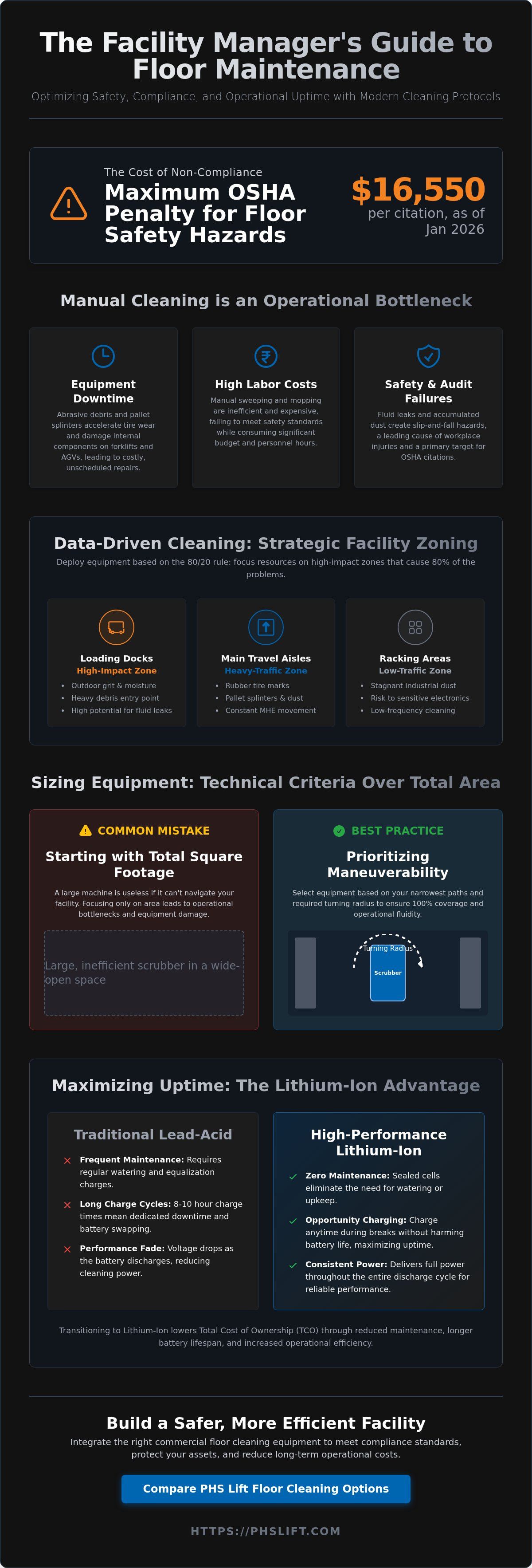
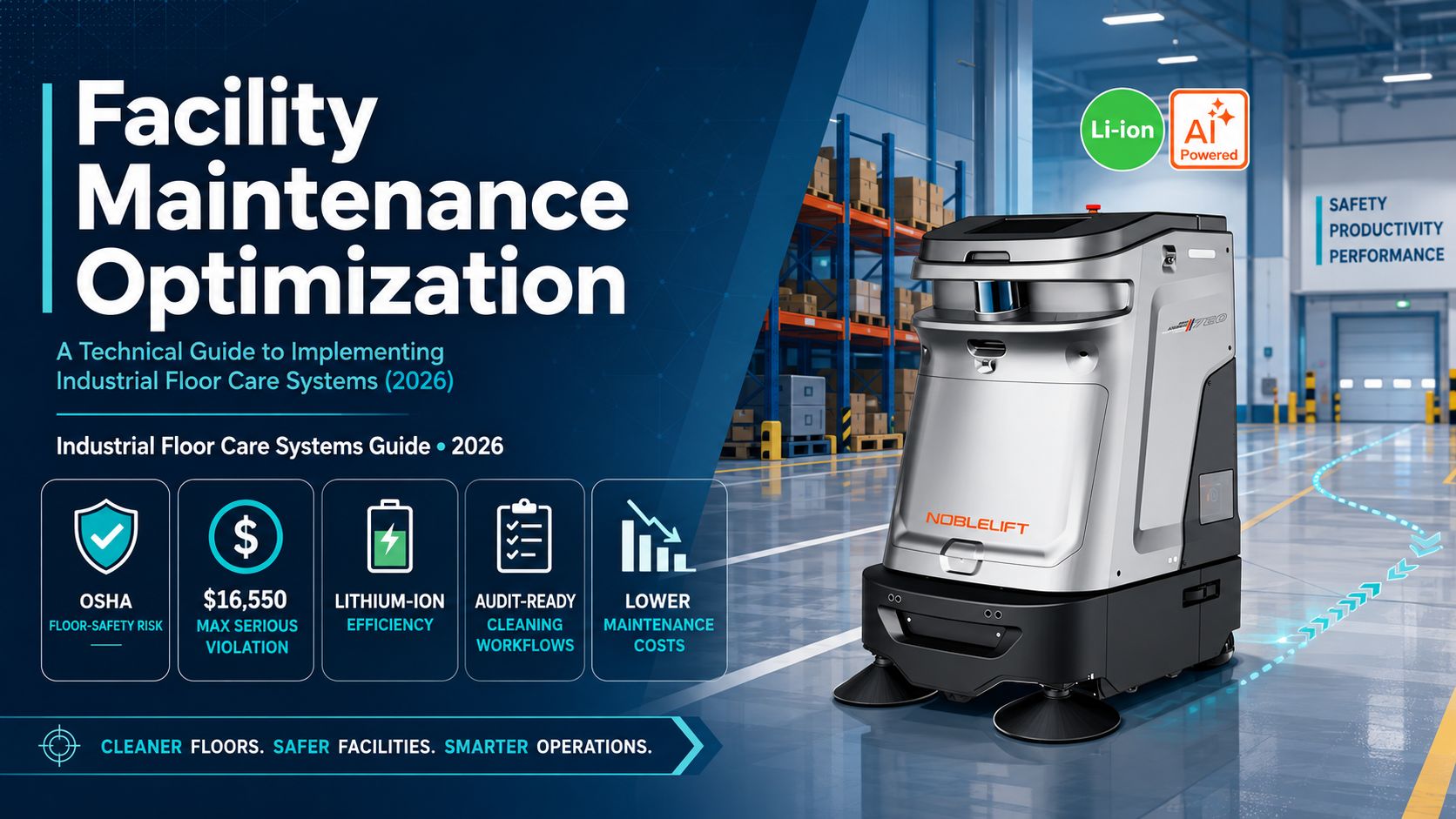
As of January 2026, a single serious OSHA violation for floor safety hazards carries a maximum penalty of $16,550 per citation. You already know that manual cleaning is an expensive bottleneck that often fails to meet rigorous safety standards. High labor costs and frequent equipment downtime are constant threats to your operational efficiency. Integrating the right commercial floor cleaning equipment is the only way to maintain a facility that passes audits without draining your maintenance budget.
This technical guide provides a roadmap for facility managers to optimize their floor maintenance protocols and reduce long term operational expenses. We will preview how to select equipment for specific aisle widths, the impact of the 2026 OSHA Hazard Communication Standard updates, and the transition to high performance lithium-ion technology. You'll learn to build a scalable strategy that ensures safety compliance while you compare available PHS Lift options for your specific industrial application. Our focus is on providing the data you need to maximize uptime and protect your facility from rising regulatory and labor costs.
Key Takeaways
- Develop data-driven cleaning schedules that extend the service life of forklift tires and reduce debris-related floor damage.
- Identify technical equipment selection criteria beyond square footage, focusing on turning radius and maneuverability in high-density storage environments.
- Execute a facility-wide floor audit to deploy the right commercial floor cleaning equipment based on the 80/20 rule of facility coverage.
- Analyze the total cost of ownership benefits of transitioning to lithium-ion power systems and the operational impact of opportunity charging.
- Mitigate slip and fall risks while ensuring compliance with the updated 2026 OSHA Hazard Communication Standards for workplace safety.
Establishing a High-Performance Facility Maintenance Protocol
Industrial facility maintenance is more than a janitorial task. It's a data-driven protocol designed to protect high-value material handling assets and ensure regulatory compliance. A professional protocol defines cleaning schedules based on facility throughput, soil load, and equipment runtimes. By treating floor care as a technical operation, managers can extend the lifespan of their fleet and maintain a safe, audit-ready environment. Modern commercial floor cleaning equipment serves as the primary tool in this strategy, moving beyond aesthetic results to deliver measurable operational uptime.
Failure to maintain floor hygiene has immediate financial consequences. As of January 2026, OSHA penalties for serious safety violations have reached $16,550 per citation. Slips and falls remain a leading cause of workplace injury, often stemming from fluid leaks or accumulated industrial dust. Beyond safety, floor condition directly correlates with the longevity of forklift tires. Abrasive debris and pallet splinters accelerate tire degradation, leading to premature replacement and increased vibration that can damage internal vehicle components. Implementing automatic floor scrubbers into daily workflows mitigates these risks by removing contaminants before they embed into the floor surface.
The Impact of Floor Condition on Material Handling Efficiency
Debris on the warehouse floor increases rolling resistance for every piece of equipment in your fleet. For electric pallet jacks, this translates to higher battery draw and increased strain on drive motors. When floors are neglected, automated guided vehicles (AGVs) often suffer from sensor interference. Industrial dust and fine particulates can coat optical sensors, triggering false obstacle detections and stopping production lines. Consistent sweeping and scrubbing reduce these interruptions, ensuring that your material movement remains fluid and predictable.
Identifying High-Traffic Zones and Soil Loads
Effective protocols require zoning. High-throughput facilities operating multiple shifts require a more aggressive schedule than low-volume warehouses. Categorize your facility into primary zones to optimize your resources:
- Loading Docks: High-impact areas where outdoor grit, moisture, and debris enter the facility.
- Main Travel Aisles: Zones prone to heavy rubber tire marks and pallet splinters from frequent traffic.
- Racking Areas: Low-traffic zones that collect stagnant industrial dust, which can migrate to sensitive electronics.
By categorizing these zones, you can deploy your commercial floor cleaning equipment where it generates the highest return on investment. This targeted approach focuses resources on the areas that impact safety and equipment health most significantly, rather than wasting labor on clean zones.
Sizing Your Equipment: Technical Criteria for Different Environments
Selecting the right commercial floor cleaning equipment requires a shift in perspective. Most procurement teams start with total square footage. This is a mistake. While total area dictates battery capacity and tank size, the physical layout of the facility dictates the machine's form factor. A machine with a 40-inch cleaning path is efficient in an open loading dock but becomes a liability in a high-density warehouse. You must prioritize the turning radius and the actual clearance of your narrowest paths to avoid equipment damage and operational bottlenecks.
Specialized environments demand even more granular criteria. Food-grade facilities require equipment that supports high-sanitation standards, often necessitating non-marking tires and easy-to-clean recovery tanks to prevent bacterial growth. Cold storage units require specialized lubricants and heated components to maintain mechanical integrity in sub-zero temperatures. Ignoring these technical requirements leads to rapid component failure and voided warranties. You can compare available PHS Lift options to find models specifically engineered for these challenging footprints.
Maneuverability in Narrow Aisle Environments
In narrow aisle configurations, every inch matters. Walk-behind scrubbers often outperform ride-on models in these environments due to their superior zero-turn capabilities. When evaluating a machine, check the squeegee width against your pallet rack spacing. If the squeegee is wider than the aisle, the operator will be forced to skip those sections. This leads to debris accumulation that compromises safety and increases tire wear on your material handling fleet. Small-footprint machines are essential for tight storerooms and mezzanines where larger units cannot navigate end-caps or tight corners.
Productivity Metrics: Cleaning Rates vs. Actual Uptime
Theoretical productivity rates provided by manufacturers rarely reflect floor-level reality. You must calculate practical square footage per hour. This metric accounts for overlapping passes, turns, and the time required for tank refills. In large-scale facilities, a machine with a smaller tank will require more frequent trips to the drainage station, slashing your actual cleaning time. This downtime is a critical component of a total cost of ownership model. High-capacity tanks and ergonomic controls reduce operator fatigue, which directly impacts how much ground is covered before a shift ends. Choosing commercial floor cleaning equipment based on these granular metrics ensures you aren't paying for theoretical performance that your facility layout won't allow.
Step-by-Step Implementation of a Commercial Floor Cleaning Strategy
Implementing a strategy for commercial floor cleaning equipment begins with a technical audit. You can't optimize what you haven't measured. Map your facility to identify high-risk zones where liquids or dust accumulate most rapidly. Apply the 80/20 rule: focus 80% of your mechanical resources on the 20% of floor space that sees the highest traffic. This typically includes loading docks and main transfer aisles. By prioritizing these areas, you satisfy OSHA requirements for floor safety while minimizing labor waste. It's a pragmatic approach that delivers the highest safety ROI for every hour of machine operation.
Standardization is the next step in the implementation process. Implement a centralized chemical dilution system to eliminate manual mixing, which often leads to chemical waste or slippery residue. Monitor your results monthly. If seasonal changes like winter salt or spring rain increase soil loads, adjust your cleaning frequency immediately. This data-driven approach prevents the "set it and forget it" mentality that leads to facility degradation and increased liability. Consistent monitoring ensures your maintenance protocol evolves with your operational demands.
Pre-Operation and Daily Maintenance Checklists
Daily readiness is non-negotiable. Operators must treat scrubbers with the same technical scrutiny as other lifting equipment. Inspect squeegee blades for nicks; a damaged blade leaves streaks that create immediate slip hazards. Check brush patterns for uneven wear, which indicates poor head pressure calibration. Verify battery electrolyte levels or lithium charge states before the shift starts. Documenting these checks creates a paper trail that protects your equipment warranty and ensures long-term reliability.
Optimizing Cleaning Paths for Maximum Coverage
Efficiency is won or lost in the pathing. Design "long-run" paths that minimize deadheading and unnecessary turns. Turns are the least efficient part of a cleaning cycle because they reduce speed and can leave water trails if the squeegee doesn't track perfectly. Focus on edge cleaning near racking where industrial dust settles. Coordinate these maintenance schedules to avoid peak forklift traffic hours. Cleaning during low-activity windows prevents bottlenecks and reduces the risk of collisions between maintenance and production teams. This logistical coordination ensures your commercial floor cleaning equipment operates at peak theoretical capacity.
Maximizing Equipment Uptime and Total Cost of Ownership (TCO)
Total cost of ownership (TCO) is the only metric that matters in high-volume industrial operations. While the initial purchase price of commercial floor cleaning equipment is a significant capital expenditure, operational costs often represent 80% of the total lifetime expense. Labor remains the largest variable. In facilities requiring daily cleaning, manual labor costs can exceed $30,000 to $40,000 per year. Transitioning to mechanical systems provides an immediate ROI by slashing man-hours and improving consistency. To maximize this return, managers must focus on energy efficiency and preventative maintenance protocols that prevent expensive mid-shift failures.
Equipment downtime is usually caused by three preventable factors: battery neglect, clogged vacuum systems, and worn consumables. When a machine sits idle, the facility's safety profile degrades and operational costs spike. Standardizing your fleet with high-performance systems ensures that maintenance teams can swap parts quickly and maintain a predictable service schedule. You can explore related PHS Lift equipment to find models engineered for maximum durability and simplified service access.
Battery Technology: Lithium vs. Lead-Acid Considerations
The shift from lead-acid to lithium-ion is the most significant technical advancement in modern floor care. Lead-acid batteries require dedicated charging rooms, specialized ventilation, and weekly water top-offs. Neglecting these tasks leads to sulfation and premature battery death. In contrast, maintenance-free lithium systems support "opportunity charging." This allows operators to plug in during lunch or shift changes without damaging the cells. For NobleLift Material Handling Equipment, lithium technology provides a longer cycle life and higher energy density. This reduces equipment depreciation and eliminates the need for spare battery packs in multi-shift environments.
Preventative Maintenance and Wear Parts Management
Proactive service is cheaper than reactive repair. You must standardize replacement intervals for high-wear components like squeegee blades, brushes, and vacuum filters. Keeping an "on-hand" inventory of these critical parts prevents minor wear from escalating into motor failure. Modern commercial floor cleaning equipment often incorporates telematics to track actual runtimes. Use this data to schedule proactive service before a component reaches its failure point. This data-driven approach ensures that your floor care strategy supports, rather than hinders, your facility's material movement goals.
Integrating PHS Lift Solutions into Your Facility Management Plan
Integrating floor care into your facility management plan requires an expert partner who understands the intersection of material handling and maintenance. PHS Lift provides the technical guidance needed to select commercial floor cleaning equipment that matches your specific operational footprint. By treating floor hygiene as a variable of fleet performance, you protect your investment in material handling assets from the abrasive effects of industrial debris. Our support model allows for fleet-wide standardization, ensuring every branch of your organization operates with the same level of efficiency and safety compliance. This approach moves beyond simple vendor transactions to create a reliable technical partnership.
Standardizing your commercial floor cleaning equipment through a single dealer simplifies procurement and streamlines parts management. This industrial pragmatism eliminates the need to manage multiple vendor relationships for different categories of machinery. It's a strategy designed to maximize uptime by providing a unified point of contact for technical support and maintenance schedules. Consistency in your fleet also reduces training complexity, as operators and maintenance technicians become experts on a standardized set of controls and mechanical components.
A Holistic Approach to Warehouse Equipment
Success in modern logistics depends on a unified equipment strategy. Sourcing warehouse material handling equipment alongside your cleaning fleet creates a cohesive operational environment. This holistic approach ensures that your floor scrubbers are technically compatible with your aisle widths and charging infrastructure. By consolidating your procurement through PHS Lift, you gain access to a deep knowledge base that spans from high-capacity lifting to precision floor care. This ensures every machine in your facility serves a specific, data-backed purpose in your maintenance protocol.
Next Steps: Fleet Evaluation and Procurement
The first step toward optimization is an objective evaluation of your current fleet performance. Utilize the PHS Lift tools and calculation utilities to determine the ideal machine size for your square footage and shift cycles. These resources help you compare manual versus powered options, ensuring you don't over-specify for retail backrooms or under-equip for heavy industrial docks. Once you've identified your requirements, you can request a quote from PHS Lift to initiate a formal facility audit. This partnership provides the technical grit and operational expertise required to maintain a clean, safe, and efficient facility through 2026 and beyond.
Future-Proofing Your Facility Maintenance Strategy
Optimizing your floor care protocol is a technical necessity for maintaining operational uptime and safety compliance. You've seen how the right commercial floor cleaning equipment reduces labor bottlenecks and protects high-value material handling assets from premature tire wear and sensor interference. Transitioning to lithium-ion power systems and implementing zoned cleaning schedules are the most effective ways to lower your total cost of ownership while meeting the 2026 OSHA standards. These strategic shifts ensure your facility stays productive without the hidden costs of equipment downtime.
PHS Lift provides the industrial expertise required to bridge the gap between material movement and facility hygiene. You gain direct access to NobleLift industrial solutions and expert technical guidance on fleet sizing to ensure every machine matches your specific aisle clearances and soil loads. Our national support and service network ensures your facility remains audit-ready and your equipment stays on the floor where it belongs. Explore related PHS Lift equipment for facility maintenance today to secure your operational readiness. Maintaining superior floor conditions is a strategic investment in your facility's long-term productivity.
Frequently Asked Questions
How often should a warehouse floor be cleaned with a commercial scrubber?
Cleaning frequency is dictated by facility throughput and soil load. High-traffic loading docks require daily mechanical scrubbing to prevent outdoor grit and moisture from migrating into the facility. Main travel aisles typically require service two to three times per week; while low-traffic racking areas can be maintained on a weekly schedule. Consistent schedules prevent the accumulation of industrial dust that can damage sensitive warehouse electronics and sensors.
Can industrial floor cleaning equipment handle wood pallet debris and splinters?
Standard scrubbers are designed for liquid removal and fine dust; they are not intended for large pallet splinters or wood chunks. Using a scrubber on large debris can tear squeegee blades and clog vacuum hoses. For facilities with heavy pallet debris, you must use a dedicated sweeper first or select a scrubber with a cylindrical brush head that can capture small solids in a debris tray before scrubbing.
What is the difference between a floor sweeper and a floor scrubber?
A floor sweeper uses dry rotating brushes to collect loose debris and dust into a hopper for disposal. A floor scrubber applies a water and chemical solution, agitates the floor with brushes or pads to lift stains, and vacuums the dirty liquid into a recovery tank. Most industrial facilities require both technologies to effectively manage solid waste and liquid contaminants while maintaining safety standards.
How do I choose between a walk-behind and a ride-on floor scrubber?
Selection depends on total square footage and your specific aisle widths. Walk-behind units are the preferred choice for facilities under 30,000 square feet or those with tight clearances and narrow aisles. Ride-on models are more efficient for large, open warehouses where operator fatigue and cleaning speed are the primary bottlenecks. You should explore related PHS Lift equipment to compare the turning radius and productivity metrics of each configuration.
Are lithium batteries better for commercial floor cleaning equipment?
Lithium batteries are superior for multi-shift operations because they support opportunity charging and require zero maintenance. They eliminate the need for battery watering and dedicated ventilation rooms required by lead-acid alternatives. While the initial cost is higher, the extended cycle life and increased machine uptime often result in a lower total cost of ownership for commercial floor cleaning equipment in high-volume environments.
What safety features are essential for floor cleaning machines in active warehouses?
Essential safety features include high-visibility strobe lights, audible backup alarms, and easily accessible emergency stop buttons. Machines must also utilize non-marking, high-traction tires to maintain stability on wet surfaces during the recovery process. These components ensure the machine is detectable by forklift operators and pedestrians; reducing the risk of collisions in high-traffic industrial zones where visibility may be limited.
How do I calculate the ROI of upgrading to a powered floor cleaning system?
ROI is calculated by comparing manual labor costs against the machine's purchase price and operational expenses. You must factor in the reduction in forklift tire wear and the mitigation of slip and fall liability. You can compare available PHS Lift options to determine which mechanical system provides the fastest payback period based on your facility's specific labor rates and square footage.
What maintenance is required for commercial floor cleaning machines?
Daily maintenance requires draining and rinsing the recovery tank, cleaning the vacuum filter, and wiping the squeegee blades to prevent streaking. Weekly tasks involve inspecting brushes for uneven wear and checking battery connections for corrosion. Consistent preventative maintenance is the only way to ensure long-term reliability and prevent your commercial floor cleaning equipment from suffering expensive mid-shift failures.