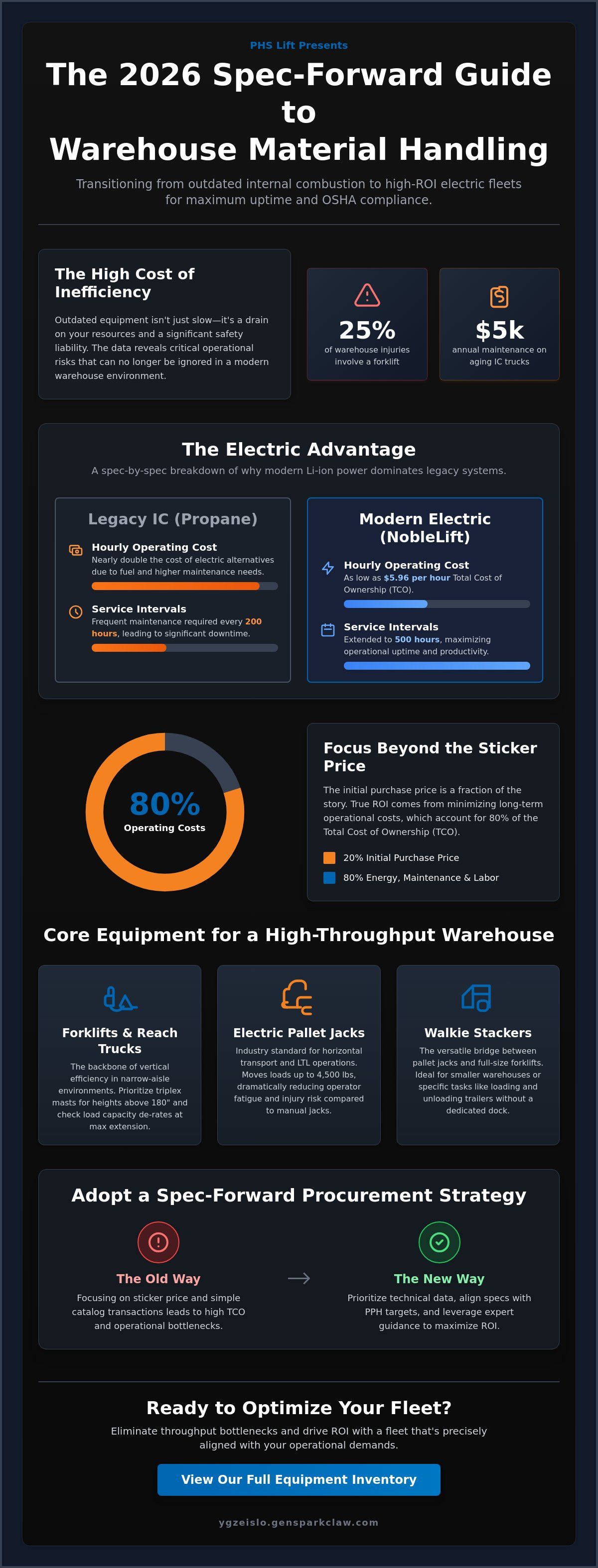
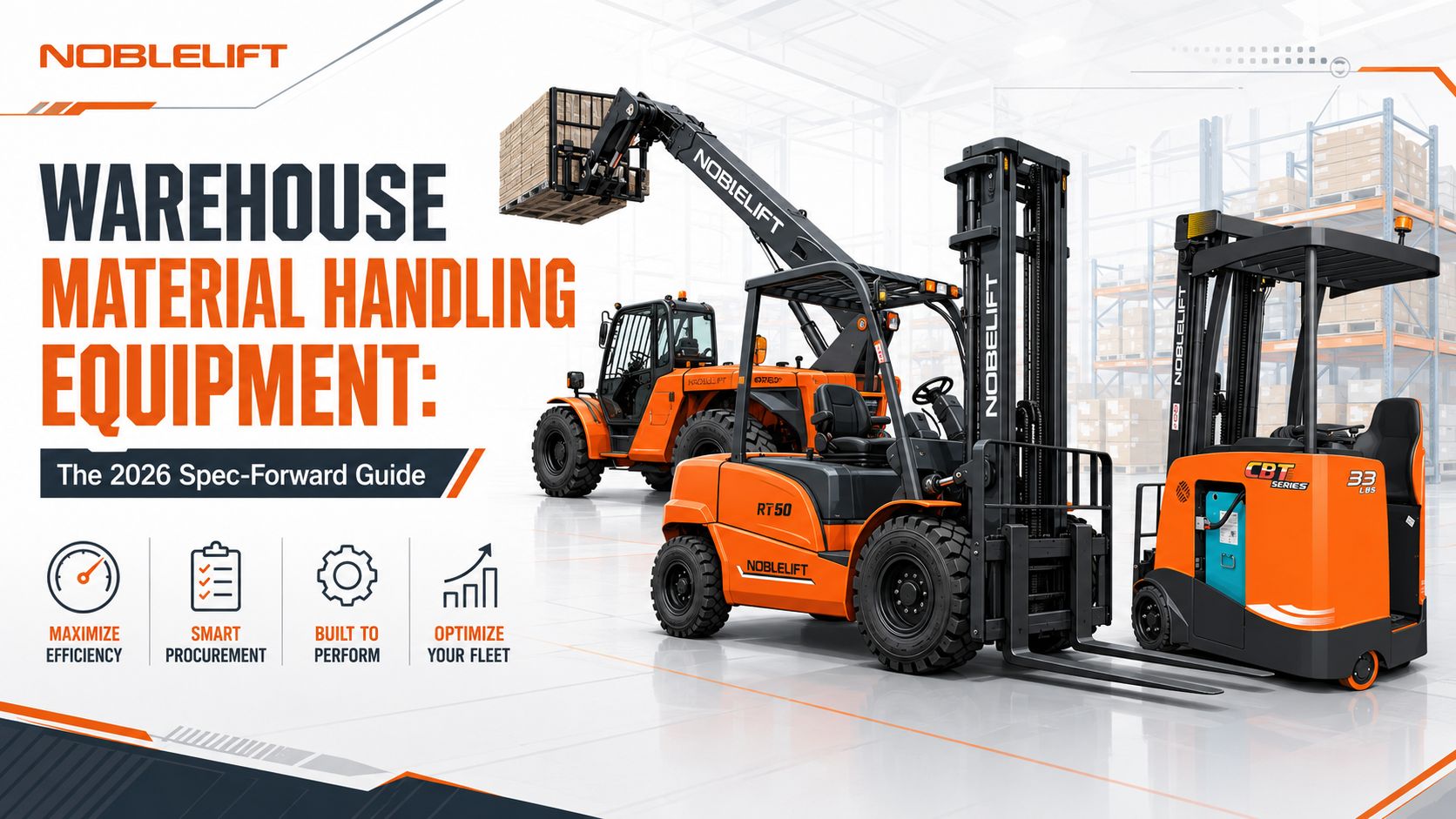
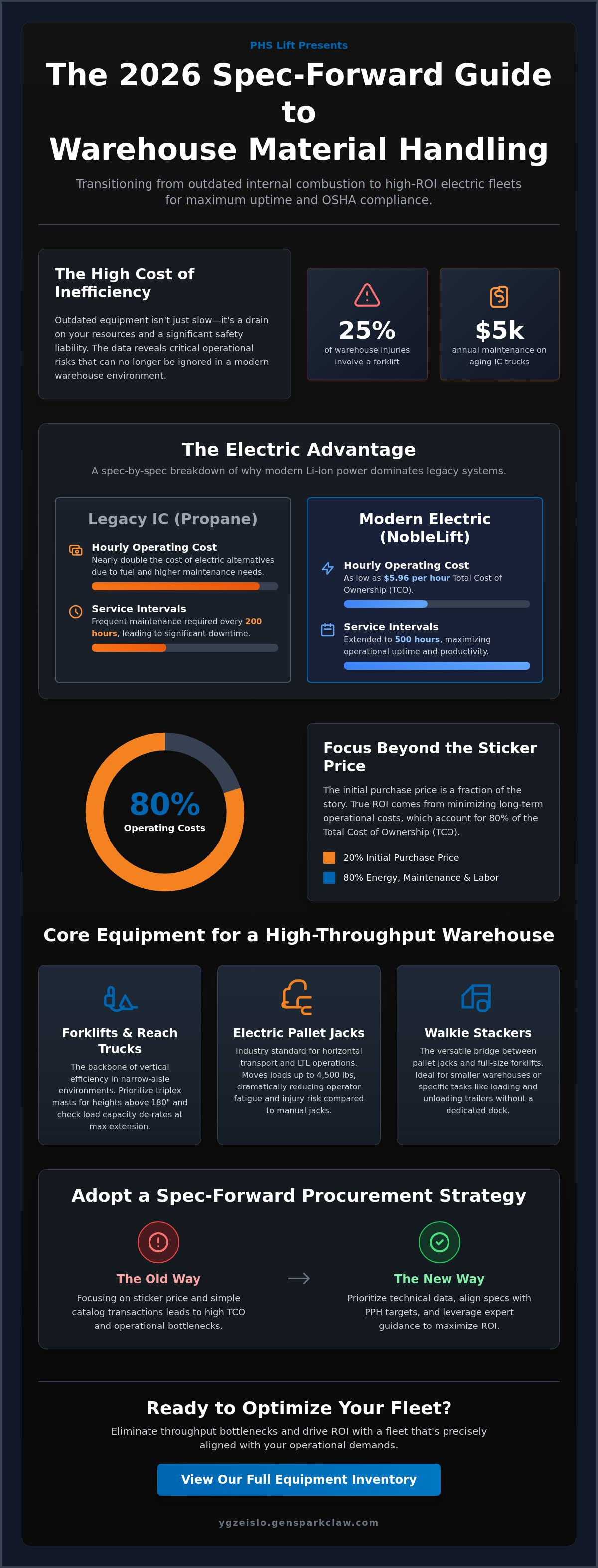
Did you know that 25% of all warehouse injuries involve a forklift, while operating a propane unit costs nearly double per hour compared to modern electric alternatives? Managing warehouse material handling equipment in 2026 requires more than just picking a brand. It demands a precise technical alignment with current OSHA National Emphasis Program standards and aggressive energy efficiency targets. You've likely felt the strain of $5,000 annual maintenance bills on aging internal combustion trucks and the pressure of expanded electronic recordkeeping requirements.
We understand that operational uptime is your primary metric. This guide delivers the spec-forward intel you need to master technical configurations and operational frameworks that drive ROI. We'll show you how transitioning to electric NobleLift units can extend your service intervals from 200 to 500 hours and drop your total cost of ownership to $5.96 per hour. You'll learn exactly how to select a reliable fleet that ensures full OSHA compliance while hitting maximum pallet-per-hour throughput targets.
Key Takeaways
- Align equipment specifications with pallets-per-hour (PPH) targets to eliminate throughput bottlenecks and maximize facility ROI.
- Identify the essential categories of warehouse material handling equipment, from NobleLift stackers to electric pallet jacks, required for your specific workflow.
- Analyze the ROI of switching to Lithium-ion (Li-ion) power sources to improve operational uptime and reduce long-term energy costs.
- Integrate industrial floor scrubbers into your maintenance schedule to mitigate the high cost of sensor failures and accelerated tire wear.
- Implement a spec-forward procurement strategy that prioritizes technical data and expert guidance over simple catalog transactions.
The Role of Material Handling Equipment in Warehouse Optimization
Warehouse material handling equipment acts as the mechanical heart of any industrial facility. It isn't just a collection of tools; it's the physical infrastructure that enables the movement, storage, and control of goods across the supply chain. Understanding the Core Categories of Material Handling Equipment is the first step toward building a high-performance operation. By 2026, the industry has moved past generic solutions. Success now depends on spec-alignment. If your equipment isn't dialed into your specific rack heights and aisle widths, your pallets-per-hour (PPH) metrics will crater.
Every time an operator touches a product, operational costs rise. Efficient MHE minimizes these manual interventions by streamlining the flow from receiving to shipping. High-performance NobleLift stackers and reach trucks allow for precision placement, reducing the risk of product damage and workplace injuries. The 2026 landscape is defined by an electric-first mentality. Internal combustion is fading as electric-powered fleets now offer the torque and runtime required for multi-shift operations without the emissions or noise of legacy systems.
The Economic Impact of Proper MHE Selection
Procurement managers often fail by focusing solely on the sticker price. The initial purchase price represents only about 20% of the total cost of ownership (TCO). The remaining 80% is tied to energy, maintenance, and operator labor. Selecting the right warehouse material handling equipment directly lowers these long-term overheads. In 2026, meeting throughput demands requires equipment that stays on the floor, not in the service bay. Choosing a unit with a 500-hour service interval over a 200-hour interval can save thousands in annual labor costs. Reliable MHE ensures that your warehouse isn't the bottleneck in your supply chain.
Safety and Compliance Frameworks
Safety isn't an afterthought; it's a productivity multiplier. Equipment must align with specific OSHA forklift categories, ranging from Class I electric motor riders to Class V internal combustion engine trucks with pneumatic tires. Using the wrong class for the application invites safety compliance risks and facility liability. Ergonomic designs in modern NobleLift units reduce operator fatigue, which accounts for a significant percentage of late-shift accidents. Material handling safety standards serve as a non-negotiable operational foundation for every modern distribution center.
Core Categories of Warehouse Material Handling Solutions
Selecting warehouse material handling equipment isn't about browsing a catalog. It's about matching mechanical capacity to your facility's spatial constraints. These solutions fall into four primary categories: lifting equipment, horizontal transport, positioning tools, and storage support. Each requires a specific technical evaluation to ensure your fleet doesn't become a bottleneck. Properly spec'd warehouse material handling equipment ensures that your horizontal transport isn't the weak link in your pallets-per-hour (PPH) chain.
The Material Handling Industry Association emphasizes that equipment selection must align with the physical layout of the warehouse to maximize efficiency. For instance, positioning equipment like lift tables reduces physical strain during sorting by keeping work at the "power zone" height between 30 and 40 inches. This ergonomic alignment prevents repetitive motion injuries and is a primary driver of long-term labor retention in 2026. For a detailed breakdown of specific model capacities, you can view our full equipment inventory.
Forklifts and Reach Trucks: Vertical Efficiency
NobleLift reach trucks excel in narrow-aisle environments. They allow for high-density storage in racking systems over five levels high. When evaluating vertical units, the mast configuration is critical. A two-stage mast is sufficient for low-profile docks. A three-stage (triplex) mast is mandatory for reaching heights above 180 inches while maintaining low collapsed heights for doorway clearance. Always check the load capacity at maximum lift height, as most units see a capacity de-rate as the mast extends.
Electric Pallet Jacks and Walkie Stackers
Electric pallet jacks are the industry standard for LTL (Less-Than-Truckload) operations. They move loads up to 4,500 lbs across the floor significantly faster than manual jacks. This reduces operator fatigue and injury risk. Walkie stackers serve as a bridge between manual jacks and full-sized forklifts, offering vertical lifting capabilities without the footprint of a sit-down truck. For high-volume facilities, calculating duty cycle requirements is essential. If a unit operates across three shifts, it needs a lithium-ion battery system capable of opportunity charging during 15-minute breaks to maintain 100% uptime.
Technical Evaluation: Electric vs. Manual and Power Source ROI
Choosing the power source for your warehouse material handling equipment determines your facility's long-term operational rhythm. While manual pallet trucks offer a low entry cost, they create throughput bottlenecks in high-volume environments where speed is the primary KPI. Electric units increase pallets-per-hour (PPH) by removing the physical limitations of human exertion. By 2026, the technical debate has shifted from "electric vs. manual" to "Lithium-ion vs. Lead-acid." This choice impacts everything from your charging infrastructure to your daily maintenance schedule.
Traditional lead-acid batteries require dedicated charging rooms with specialized ventilation and eyewash stations to manage acid outgassing. This consumes valuable square footage that could otherwise be used for high-density racking. Lithium-ion (Li-ion) technology eliminates this requirement through opportunity charging. Operators simply plug in during 15-minute breaks or lunch intervals. This decentralized approach keeps the fleet on the floor and removes the need for battery swapping, a high-risk task that often leads to workplace injuries.
Lithium-ion vs. Lead Acid: The Spec-Forward Breakdown
Modern NobleLift units utilizing Li-ion technology offer a distinct advantage in multi-shift distribution centers. The technical gap is significant when looking at uptime data and lifecycle costs. Consider these spec-forward comparisons:
- Charging efficiency: Li-ion reaches full charge in 1-2 hours. Lead-acid requires 8 hours to charge and another 8 hours to cool down.
- Maintenance requirements: Li-ion is a zero-maintenance solution. Lead-acid demands weekly watering, cleaning, and equalizing charges to prevent sulfation.
- Life cycle: NobleLift Li-ion batteries are rated for 3,000+ cycles at 80% depth of discharge. Traditional batteries often fail after 1,000 to 1,500 cycles.
The total cost of ownership for Lithium-ion powered equipment typically yields a full return on investment within 24 months due to eliminated maintenance labor and reduced energy consumption over a 5-year operational window.
Manual Equipment: When Simplicity Wins
Manual warehouse material handling equipment still holds a place in 2026, specifically in low-volume zones or as backup units. Premium manual pallet jacks are built for durability with reinforced frames and high-quality hydraulic pumps. They remain the most cost-effective solution for staging areas where equipment usage is intermittent. However, ergonomics must remain a priority. Even in manual applications, selecting units with low-rolling resistance wheels and ergonomic handles is essential to prevent operator fatigue and repetitive strain injuries during short-distance transport tasks.
Operational Uptime: Maintenance and Facility Cleaning Strategies
Operational uptime depends on more than just the battery technology discussed earlier. It requires a facility-wide maintenance strategy that includes the floor itself. Debris, dust, and metal shavings are the primary enemies of warehouse material handling equipment. These contaminants embed in polyurethane tires, causing flat spotting and excessive vibration that damages internal electrical components. In modern electric units, fine dust infiltration leads to premature sensor failure and motor controller overheating. Integrating industrial floor scrubbers into your daily MHE schedule isn't a luxury; it's a tactical cost-avoidance measure.
Maintaining your warehouse material handling equipment requires a holistic view of the operational environment. When floors are neglected, the total cost of ownership (TCO) spikes due to avoidable mechanical wear. By treating facility cleanliness as a component of fleet management, you protect sensitive electronic steering and lift components from environmental degradation.
Industrial Floor Scrubbers and Sweepers
Cleaning equipment choice depends strictly on your facility square footage and aisle configuration. Walk-behind scrubbers are the industry standard for tight aisles and staging areas under 50,000 square feet. For larger distribution centers, ride-on units offer productivity rates exceeding 30,000 square feet per hour. These machines utilize automatic scrubbing technology to remove grease and moisture, significantly reducing slip-and-fall risks at high-traffic docks. Maintaining the scrubber itself is equally vital. Daily rinsing of recovery tanks and inspecting squeegee blades ensures consistent performance and prevents streaks that can confuse MHE navigation sensors.
Fleet Longevity and Service Support
A NobleLift-heavy fleet requires standardized preventative maintenance protocols. This starts with a daily pre-shift inspection checklist that operators must complete before the first pallet moves. Key checkpoints include hydraulic fluid levels, tire integrity, and chain tension. Leveraging telemetry and hour-meter data allows for predictive maintenance, shifting from reactive repairs to scheduled service intervals based on actual usage rather than calendar dates. This data-driven approach prevents the $2.00 per hour maintenance cost spike often seen in neglected fleets. It ensures that service occurs during planned downtime, not during peak shipping windows.
Working with an Authorized Dealer ensures access to factory-spec parts and certified technicians who understand the specific load-sensing valves and motor controllers of your equipment. This partnership is the difference between a 48-hour repair window and weeks of costly downtime. To protect your investment and maintain peak throughput, browse our warehouse cleaning solutions to find the right match for your facility.
Procurement Strategy: Selecting Your Material Handling Partner
Procuring warehouse material handling equipment requires a shift from transactional purchasing to strategic partnership. A simple "checkout button" approach ignores the granular technical requirements of high-density facilities. You need a partner that provides spec-forward intel, not just a SKU number. Evaluating a dealer starts with their technical transparency. They should provide clear data on lift height de-rates and explain the NMFC classes of the equipment they ship. These details prevent the wrong equipment from landing on your dock and stalling your operation.
Reliable dealers offer more than a catalog. They provide functional extensions of your procurement team through free buying tools. Utilizing a Class Finder or a Capacity Calculator ensures your fleet meets OSHA forklift categories without guesswork. Financing also plays a critical role in 2026. Aligning equipment acquisition with your cash flow through Net-30 terms or structured leasing ensures your new fleet generates ROI before the final invoice is due. This pragmatic approach to warehouse material handling equipment separates high-growth operations from those struggling with capital bottlenecks.
The PHS Lift Advantage: Authorized NobleLift Expertise
Authorized Dealer status is a non-negotiable trust signal. It guarantees direct factory pricing by eliminating middleman markups. This ensures your procurement budget goes further. PHS Lift provides access to spec-forward intel for custom warehouse configurations, ensuring every NobleLift unit fits your specific aisle widths and rack heights. For multi-location distribution networks, national support capabilities are essential. You need a partner capable of providing consistent service and parts across different regions to maintain fleet uniformity and uptime.
Implementation and Next Steps
The path to a streamlined fleet starts with data. Initiate a facility equipment audit to analyze your current throughput bottlenecks and aging fleet maintenance costs. This audit should evaluate aisle dimensions, average load weights, and shift durations. Once you have these metrics, requesting a quote for NobleLift electric pallet jacks or forklifts becomes a data-driven decision. Don't settle for generic equipment. Optimize your fleet with PHS Lift’s spec-forward equipment lineup to ensure your 2026 operations are built on a foundation of technical accuracy and industrial reliability.
Future-Proof Your Facility Through Spec-Alignment
Optimizing your fleet for 2026 demands a departure from legacy procurement habits. Success lies in the technical details. You've seen how precise spec-alignment drives pallets-per-hour metrics and slashes the total cost of ownership. By prioritizing zero-maintenance Lithium-ion battery technology and factory-spec parts, you eliminate the high-stakes risks of equipment downtime and safety non-compliance. Integrating industrial cleaning protocols further protects your sensitive sensors and extends tire life by preventing debris infiltration.
The right warehouse material handling equipment isn't just about moving pallets; it's about building a reliable, data-driven operational framework. As an Authorized NobleLift Dealer, we provide the technical accuracy and direct factory pricing required to hit your ROI targets. We deliver spec-forward intel with no fluff, ensuring your procurement team has the tools to make high-performance decisions. Your facility's maximum throughput is within reach.
Browse Spec-Forward NobleLift Equipment at PHS Lift
Frequently Asked Questions
What are the main types of material handling equipment used in a warehouse?
The primary categories include lifting equipment like forklifts and stackers, horizontal transport such as pallet jacks and tuggers, and positioning equipment like lift tables. Each serves a specific role in moving goods from receiving docks to high-density racking. In 2026, these categories are increasingly defined by their power source and automation compatibility to meet aggressive throughput targets.
How do I choose between a manual and an electric pallet jack?
Base your decision on travel distance and load frequency. Manual jacks are cost-effective for staging areas and low-frequency tasks under 50 feet. Electric pallet jacks are mandatory for high-throughput LTL operations where operators move 4,500 lb loads across large facilities. This shift reduces operator fatigue and prevents the high percentage of warehouse injuries caused by manual overexertion.
What is the difference between a reach truck and a standard forklift?
Reach trucks are engineered for narrow-aisle storage, while standard forklifts are general-purpose units for wide aisles and loading docks. A NobleLift reach truck uses a pantograph to extend forks into racking, allowing aisles to be as narrow as 8 feet. Standard counterbalance forklifts require 12 feet or more of clearance for safe maneuvering and turning during pallet placement.
Why is Lithium-ion better than Lead-acid for warehouse forklifts in 2026?
Lithium-ion offers 3,000+ cycles and zero maintenance compared to the 1,500 cycles and weekly watering required for lead-acid batteries. Li-ion enables opportunity charging during 15-minute breaks, which eliminates the need for dedicated battery rooms. This technology reduces energy costs by 30% and keeps your warehouse material handling equipment fleet on the floor for multi-shift operations without battery swapping.
How often should warehouse floor scrubbers be used to maintain MHE safety?
Run industrial floor scrubbers daily to prevent debris from damaging polyurethane tires and sensitive MHE sensors. High-traffic dock areas often require twice-daily cleaning to mitigate slip-and-fall risks and maintain current OSHA safety standards. Clean floors reduce vibration; this prevents the premature failure of electronic motor controllers and load-sensing valves in modern electric units.
What are the OSHA requirements for operating electric pallet jacks?
Operators must be trained and certified under OSHA 1910.178 standards for Powered Industrial Trucks before use. This process includes formal instruction, practical training, and a performance evaluation. Refresher training is mandatory every three years or after a workplace accident to ensure continued safety compliance and reduce facility liability during surprise inspections.
Can NobleLift equipment be used in narrow-aisle warehouse layouts?
Yes, NobleLift specializes in compact designs like the RT series reach trucks and walkie stackers specifically for narrow-aisle layouts. These units feature tight turning radii and slim chassis profiles that maximize storage density. They allow warehouses to increase pallet positions by 20% compared to using standard counterbalance equipment in wide-aisle configurations.
How does material handling equipment impact warehouse safety audits?
Equipment condition dictates the outcome of OSHA National Emphasis Program audits, which focus heavily on powered industrial vehicle hazards through 2026. Auditors inspect maintenance logs, operator certifications, and safety features like proximity sensors. Utilizing modern, well-maintained warehouse material handling equipment demonstrates proactive compliance and significantly reduces the risk of expensive facility citations and recordkeeping penalties.