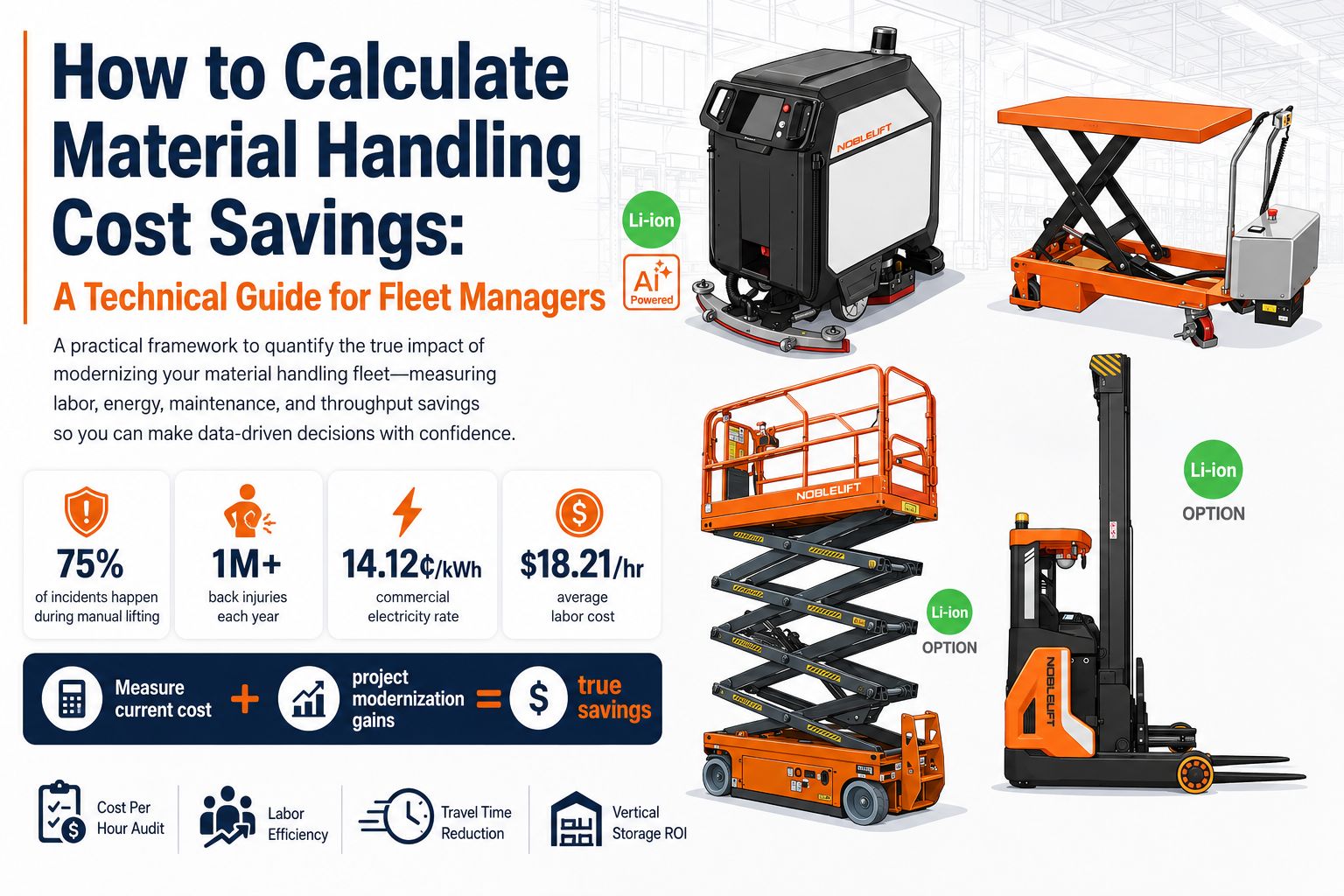
More than one million workers experience back injuries every year, and 75% of those incidents happen during manual lifting tasks. For fleet managers, these aren't just safety metrics; they're direct hits to the bottom line through workers' comp and lost productivity. Understanding how to calculate material handling cost savings is no longer a luxury for the back office. It's a technical necessity. With commercial electricity rates climbing to 14.12 cents per kilowatt-hour as of January 2026, the delta between operational friction and modernized throughput determines your fleet's survival.
You likely feel the pressure from the CFO to justify every equipment upgrade with hard ROI data rather than intuition. We understand that aging fleets and rising labor costs, currently averaging $18.21 per hour, make "business as usual" unsustainable. This guide provides the precise formulas and operational metrics you need to quantify efficiency gains and secure investment approval. You'll master a repeatable formula for cost savings, explore industry standard ROI benchmarks, and identify a clear path to fleet optimization. Before finalizing your procurement strategy, compare available PHS Lift options to see how modern engineering impacts your total cost of ownership.
Key Takeaways
- Identify the maintenance inflection point where repair costs exceed equipment value to prevent aging fleets from draining your operational budget.
- Master the technical steps on how to calculate material handling cost savings by auditing current Cost Per Hour (CPH) and projecting modernization throughput gains.
- Quantify labor efficiency by measuring travel time reductions and the impact of the fatigue factor on productivity across an eight-hour shift.
- Benchmark potential savings by calculating the real estate value of narrow aisle configurations and vertical storage density improvements.
- Protect your projected ROI by utilizing technical calculation utilities to ensure precise fleet sizing and selecting equipment with high serviceability ratings.
Establishing the Baseline: Understanding Total Cost of Ownership (TCO)
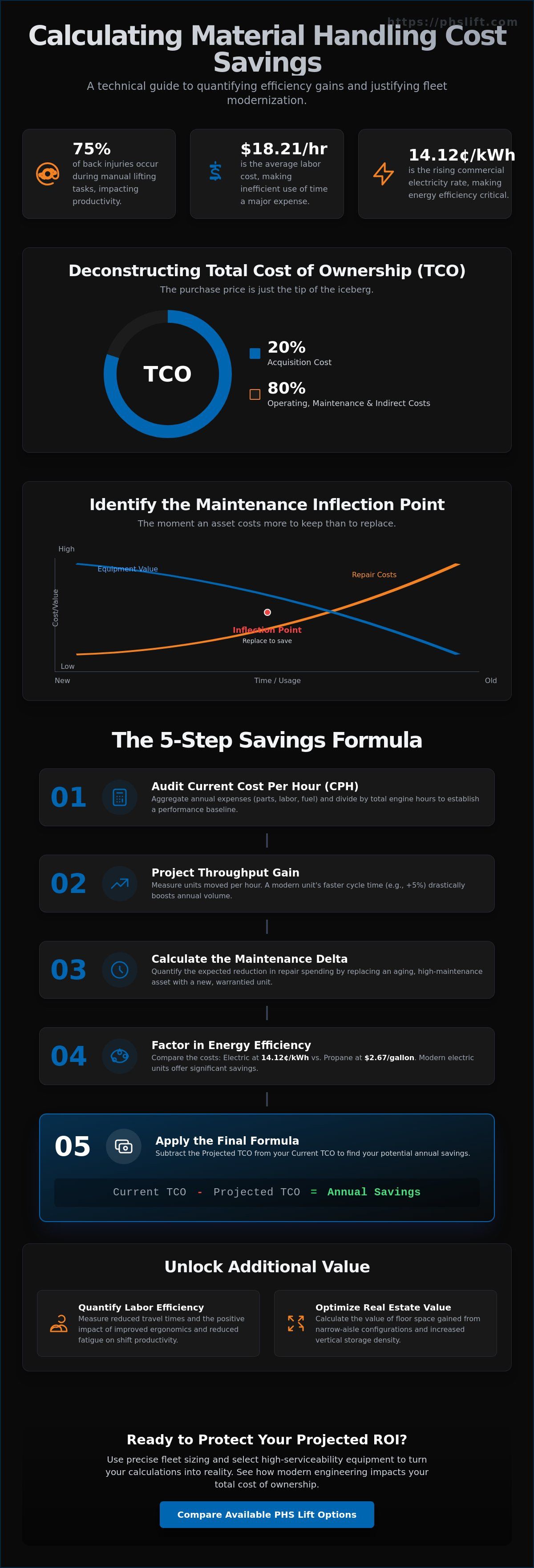
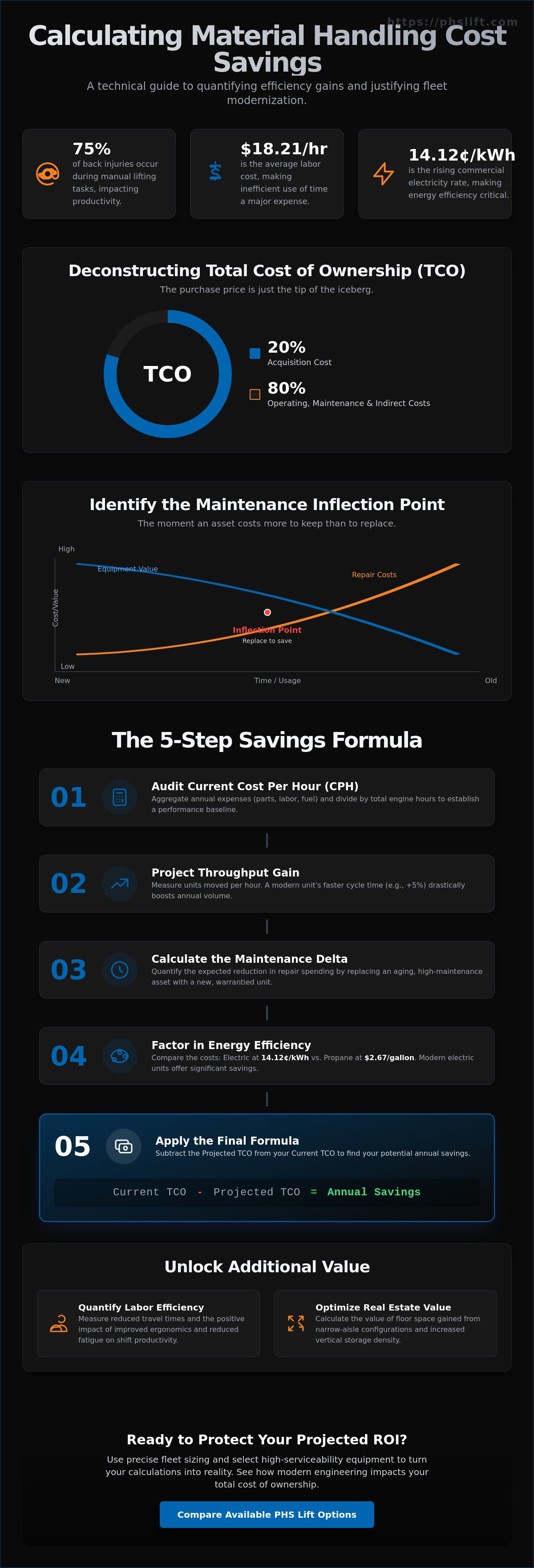
Successful fleet management begins with a shift in perspective. The purchase price of a unit is a poor indicator of its long-term financial impact. In reality, the acquisition cost typically represents only 20% of the total lifecycle expense. To understand how to calculate material handling cost savings, you must first establish a comprehensive baseline using the Total Cost of Ownership (TCO) model. This framework aggregates acquisition, operating, and maintenance costs into a single, actionable metric.
Every asset has a Maintenance Inflection Point. This is the specific moment when the cumulative cost of repairs and the value of lost uptime exceed the fair market value of the equipment. Operating beyond this point isn't just inefficient; it's a drain on capital. Fleet managers often ignore this threshold, resulting in a "zombie fleet" that looks operational on paper but costs more to sustain than to replace. Identifying these units is the first step in quantifying potential efficiency gains.
Direct costs are easily tracked. They include operator labor, which averages $18.21 per hour nationally, and energy consumption. For electric units, this involves the national average commercial electricity rate of 14.12 cents per kilowatt-hour. Indirect costs are more insidious. These include downtime, safety incidents, and the administrative burden of managing aging assets. Over 80% of manual handling injuries affect the lower back. The indirect costs of these incidents, including workers' comp and lost shifts, can dwarf the price of a new powered unit.
Fixed vs. Variable Costs in Warehouse Operations
Fixed costs remain constant regardless of usage. Depreciation and insurance are your baseline variables. Variable costs fluctuate based on duty cycle. Energy consumption and routine parts replacement are the primary drivers here. As equipment ages, the frequency of parts replacement accelerates. This creates an exponential increase in variable costs that eventually compromises the entire facility's budget. Tracking these variables allows you to see exactly where your capital is leaking.
The Cost of Operational Friction
Unplanned downtime is the enemy of throughput. In a high-volume facility, one hour of a stalled unit can cost thousands in missed shipments and idle labor. You must quantify this loss per hour to accurately determine how to calculate material handling cost savings for a potential upgrade. Operational friction is the measurable loss in productivity due to mechanical or ergonomic inefficiency. Eliminating this friction requires moving from reactive maintenance to strategic fleet modernization. Utilize PHS Lift calculation tools to verify your current fleet sizing and identify where friction is eroding your margins.
The Step-by-Step Material Handling Savings Formula
Moving from general theory to concrete numbers requires a structured approach. To determine how to calculate material handling cost savings, you must isolate the performance metrics of individual units. This process reveals which assets are contributing to throughput and which are merely occupying floor space. Follow this five-step sequence to build your financial case.
- Step 1: Audit current fleet Cost Per Hour (CPH). Aggregate all annual expenses for a specific unit, including parts, labor, and fuel. Divide this by the total engine hours logged. This provides a baseline of what that unit costs to operate every hour it's in service.
- Step 2: Project the Throughput Gain. Measure how many pallets or units the current equipment moves per hour. Modernized equipment often features faster lift speeds and better maneuverability. Even a 5% increase in cycle time significantly impacts annual volume.
- Step 3: Calculate the Maintenance Delta. This is the expected reduction in repair spend when replacing an aging asset with a warranty-backed unit.
- Step 4: Factor in energy efficiency gains. With commercial electricity rates at 14.12 cents per kilowatt-hour, a 6.4% increase over last year, the energy profile of your fleet is critical. Compare this against propane prices, which averaged $2.67 per gallon in April 2026.
- Step 5: Apply the final formula. Subtract your Projected TCO from your Current TCO. The resulting figure is your potential annual savings.
Calculating the Maintenance Delta
Compare your year-over-year repair invoices for legacy units against the projected costs of new equipment. Don't forget the internal labor cost. If your technicians spend 15 hours a month on a single unit, that's over $270 in direct labor alone based on national averages. Researching Analyzing warehouse cost structures shows that maintenance often becomes the largest variable expense in aging facilities. For specific performance data, consult the NobleLift Fleet Optimization Guide to see how modern engineering minimizes these spikes.
Determining Simple Payback Period
Procurement teams need a clear break-even point. Divide your total investment cost by the projected annual savings. While some industries tolerate a 36-month window, a 24-month payback is the gold standard for industrial upgrades. This timeline demonstrates how to calculate material handling cost savings in a way that satisfies strict procurement requirements. It shows that the equipment pays for itself through efficiency alone. To verify your specific requirements and ensure your math aligns with current market data, you can request a quote from PHS Lift for a detailed equipment breakdown.
Quantifying Labor Efficiency and Ergonomic Gains
Labor is the most significant variable expense in any warehouse operation. With the average hourly wage for material handling jobs currently at $18.21, every minute of inefficiency carries a specific dollar value. When determining how to calculate material handling cost savings, you must move beyond equipment maintenance and map labor hours against actual throughput. Travel time is the primary driver of labor waste. A worker using manual equipment is limited by physical endurance and a slower walking pace, whereas powered units provide consistent speed regardless of the shift hour.
The 'Fatigue Factor' is a technical reality that erodes margins. In a standard 8-hour shift, manual labor productivity typically drops by 15% to 20% during the final three hours due to physical exhaustion. Powered equipment eliminates this performance curve, maintaining a steady cycle time from start to finish. Ergonomics also plays a critical role in financial stability. More than one million workers experience back injuries each year, and 80% of these injuries affect the lower back. By reducing manual strain, you mitigate the risk of workers' compensation claims that can easily exceed the cost of a fleet upgrade.
Manual vs. Powered Equipment ROI
The transition from manual to electric operation offers the most immediate impact on ROI. Manual operators are restricted by load weight and floor conditions, often resulting in inconsistent movement patterns. Transitioning to electric pallet jacks typically yields a 30% to 50% increase in speed for both travel and placement. If your facility moves 100 pallets per shift, this speed increase recovers several hours of labor that can be reallocated to higher-value tasks. To see how modern engineering impacts these cycle times, explore related PHS Lift equipment and compare the specific acceleration and travel specs for your application.
Reducing 'Double Handling' Costs
Double handling is a symptom of equipment mismatch. It occurs when materials must be moved twice because the initial equipment cannot reach the required lift height or handle the total weight capacity. This redundancy effectively doubles the labor cost of a single task. To find the true cost, multiply the hourly labor rate by the time spent on these unnecessary movements. Every touch of a product adds cost without adding value. Eliminating these redundant touches is a fundamental step in understanding how to calculate material handling cost savings. By selecting equipment that matches your specific workflow requirements, you ensure that every movement contributes directly to throughput.
Benchmarking Savings Across Equipment Categories
General formulas provide a foundation, but true precision requires category-specific benchmarks. Savings profiles shift dramatically depending on whether you're optimizing vertical density or horizontal transport. When determining how to calculate material handling cost savings for your specific facility, you must analyze how different equipment classes address unique operational bottlenecks. High-capacity lifts, for instance, drive ROI through vertical space optimization. By utilizing the upper reaches of your facility, you maximize the value of your existing roofline and defer the massive capital expenditure of warehouse expansion.
Horizontal transport presents a different set of variables. In "milk run" applications where materials move long distances, electric tuggers replace the inefficiency of multiple operators moving individual loads. One tugger operator can transport a train of carts, effectively tripling or quadrupling the throughput of a single labor hour. Even maintenance equipment like floor scrubbers contribute to the savings formula. Clean floors reduce the abrasive wear on the poly tires of your entire fleet and mitigate slip-and-fall liability, which is critical given that manual handling injuries already account for a significant portion of workplace claims.
Space Optimization Savings
Real estate is a silent margin killer. To find your space-based savings, start by calculating the annual cost per square foot of your facility, including lease, utilities, and taxes. Standard aisles often waste 40% of available floor space. By transitioning to narrow aisle equipment, you can reduce aisle widths from 12 feet to as little as 6 feet. This change increases your pallet position count without adding a single square foot to your building footprint. These gains allow you to store more inventory in the same space, directly reducing the "real estate tax" on every pallet moved.
The Energy Efficiency Variable
The energy profile of your fleet is no longer a minor detail. Commercial electricity rates reached 14.12 cents per kilowatt-hour in January 2026, marking a 6.4% year-over-year increase. Despite this, electric units remain significantly more cost-effective than internal combustion alternatives. Propane prices averaged $2.67 per gallon in April 2026, making the cost-per-hour of fuel far higher than the cost-per-charge. Modern lithium-ion technology further tips the scales by eliminating the need for battery rooms and specialized maintenance. For a detailed comparison of energy specifications and battery longevity, consult the Technical Buyer's Guide. To ensure your fleet is sized correctly for these efficiency gains, compare available PHS Lift options today.
Strategic Procurement: Protecting Your Calculated Savings
The final phase of any technical guide on how to calculate material handling cost savings is protecting the projected ROI through strategic procurement. Calculations on paper only manifest as actual savings if the equipment is supported by a rigorous operational framework. This requires a shift from reactive purchasing to proactive fleet management. Selecting equipment with high serviceability ratings is the most direct way to control maintenance labor costs, which currently average $18.21 per hour. When a unit is designed for rapid component access, your internal technicians spend less time on routine tasks, effectively lowering your cost per hour (CPH).
Avoid the "Emergency Repair" premium. Reactive maintenance for aging or mismatched units often carries a 20% to 30% surcharge in the form of expedited shipping for parts and lost throughput. You must implement a preventative maintenance schedule that aligns with your duty cycle. To ensure your fleet is right-sized for your specific throughput requirements, utilize PHS Lift calculation tools. These utilities verify that you aren't over-investing in capacity you don't need or under-investing in units that will fail under heavy use. Proper sizing is the foundation of a sustainable cost-reduction strategy.
Standardization as a Savings Multiplier
Operating a fragmented fleet is a logistical drain. When your warehouse utilizes multiple brands and models, operator error increases and training time doubles. Standardization creates a uniform operational environment that reduces the learning curve for new hires. It also simplifies your parts inventory. Instead of stocking unique components for five different brands, you can maintain a lean inventory of common wear items. NobleLift material handling equipment often features modular designs, allowing for interchangeable parts across different models. This modularity reduces your total capital tied up in spare parts and streamlines the repair process.
Requesting Data-Driven Quotes
Move away from "price shopping" during the RFP process. A low initial purchase price often hides high energy consumption or frequent service intervals. Demand that vendors provide detailed energy and maintenance projections based on your specific shift patterns. With commercial electricity rates climbing 6.4% year-over-year to 14.12 cents per kilowatt-hour, energy efficiency is a primary driver of long-term savings. Compare these projections against the cost of propane, which averaged $2.67 per gallon in early 2026. If you're ready to run the numbers for your facility, request a quote from PHS Lift to start a detailed ROI analysis. Transitioning to a solution-sourcing model ensures that your equipment choice supports the technical efficiency goals established in your initial audit.
Optimizing Your Fleet for Long-Term ROI
Mastering how to calculate material handling cost savings requires moving beyond the sticker price to analyze the full lifecycle of your assets. By establishing a TCO baseline and quantifying the maintenance delta, you shift from guessing to data-driven decision making. This technical approach identifies the exact moment an aging unit becomes a liability rather than an asset. You've seen how labor efficiency, ergonomic safety, and space optimization combine to create a measurable impact on your bottom line; it's the difference between operational friction and streamlined throughput.
Securing these gains requires a partner that prioritizes technical accuracy over marketing hype. PHS Lift provides expert NobleLift product guidance and national service-focused assistance to ensure your fleet remains operational and efficient. Our technical spec-forward procurement model is designed to find the right solution for your specific application. Request a customized ROI analysis and quote from PHS Lift to start transforming your operational metrics into realized savings. Your path to a leaner, more profitable facility is ready for implementation.
Frequently Asked Questions
What is a good ROI percentage for material handling equipment?
A good annual ROI for material handling equipment typically ranges between 15% and 25%. This target ensures that the asset pays for itself within a three to four year payback period. Achieving this percentage requires a combination of direct labor savings, improved throughput, and a significant reduction in year-over-year maintenance expenses.
How do I calculate the cost of forklift downtime?
Calculate downtime by multiplying the lost throughput units per hour by their specific profit margin and adding the idle operator labor rate. If an operator earning $18.21 per hour is idle while a unit is repaired, that's a direct loss. You must also factor in the emergency repair premium and potential late-shipment penalties from customers.
Can I include tax incentives like Section 179 in my savings calculation?
Yes, Section 179 allows businesses to deduct the full purchase price of qualifying equipment during the tax year it's placed in service. This deduction lowers the net acquisition cost, which immediately improves the initial ROI calculation. Consult with a tax professional to verify current limits and eligibility for specific models before finalizing your procurement budget.
How does lithium-ion battery tech change the ROI formula?
Lithium-ion technology shifts the ROI formula by eliminating the infrastructure costs of battery rooms and the labor required for lead-acid maintenance. While the initial investment is higher, the total cost of ownership is lower due to opportunity charging and a longer lifecycle. It's a key factor when learning how to calculate material handling cost savings for multi-shift operations.
What is the most overlooked cost in material handling?
Administrative and management time spent on aging fleets is the most frequently overlooked cost. This includes the hours spent by procurement and facility managers coordinating repairs, sourcing parts, and managing temporary rentals. These soft costs erode operational margins but rarely appear as line items on a standard maintenance invoice, making them difficult to track without a dedicated audit.
Should I calculate savings based on a 3-year or 5-year outlook?
Use a five-year outlook to capture the full impact of the maintenance inflection point and equipment depreciation. While a three-year window is useful for short-term payback analysis, it often misses the exponential rise in repair costs that occurs as units reach their secondary lifecycle. A longer horizon provides a more accurate technical projection of total savings.
How do I quantify 'safety' as a cost saving?
Quantify safety by tracking the reduction in workers' compensation premiums and the direct costs of lost workdays. Since 80% of manual handling injuries affect the lower back, moving to powered equipment significantly reduces these liabilities. You can also factor in the cost of OSHA compliance training and the avoidance of potential hazard citations under updated 2026 standards.
Is it better to lease or buy to maximize material handling ROI?
Leasing often maximizes ROI for facilities that require high uptime by keeping the fleet within the warranty period and allowing for frequent technology refreshes. Buying is more cost-effective for low-hour applications where the asset's long-term residual value outweighs the maintenance risks. Both methods require a detailed analysis of how to calculate material handling cost savings based on your specific duty cycle.