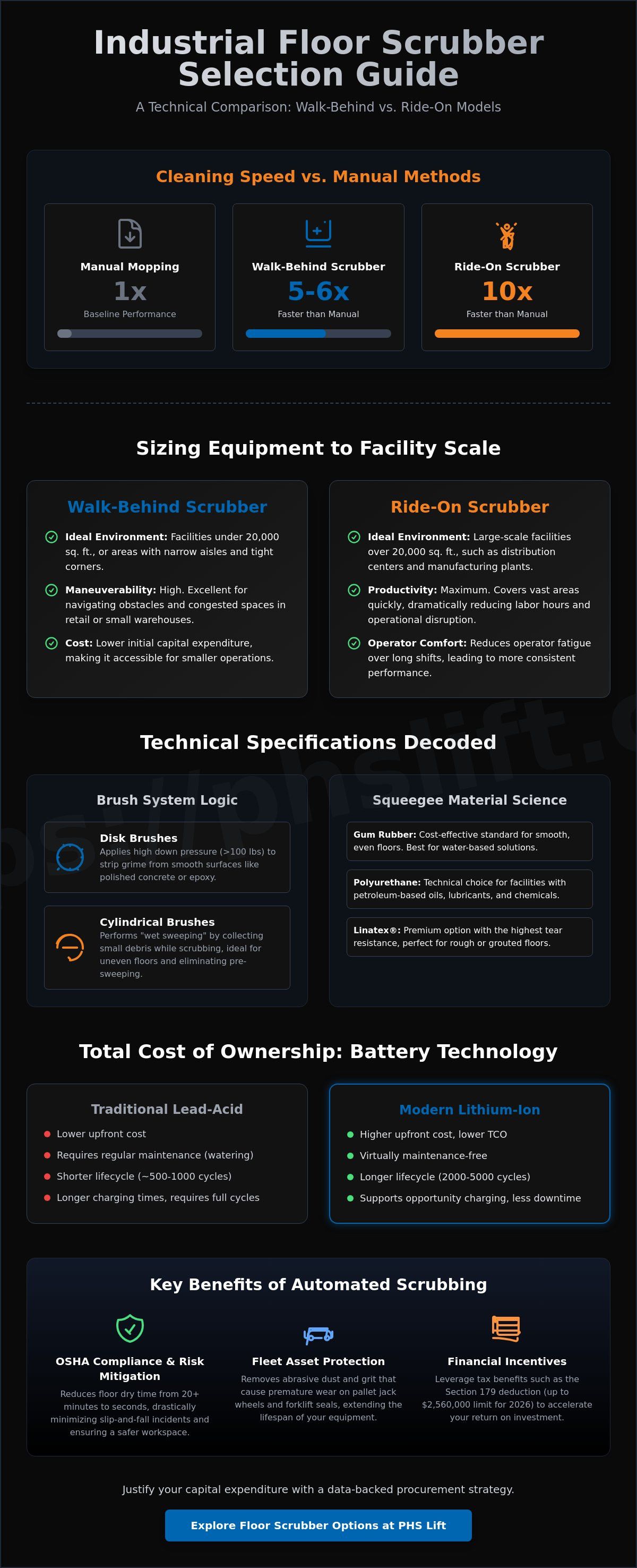
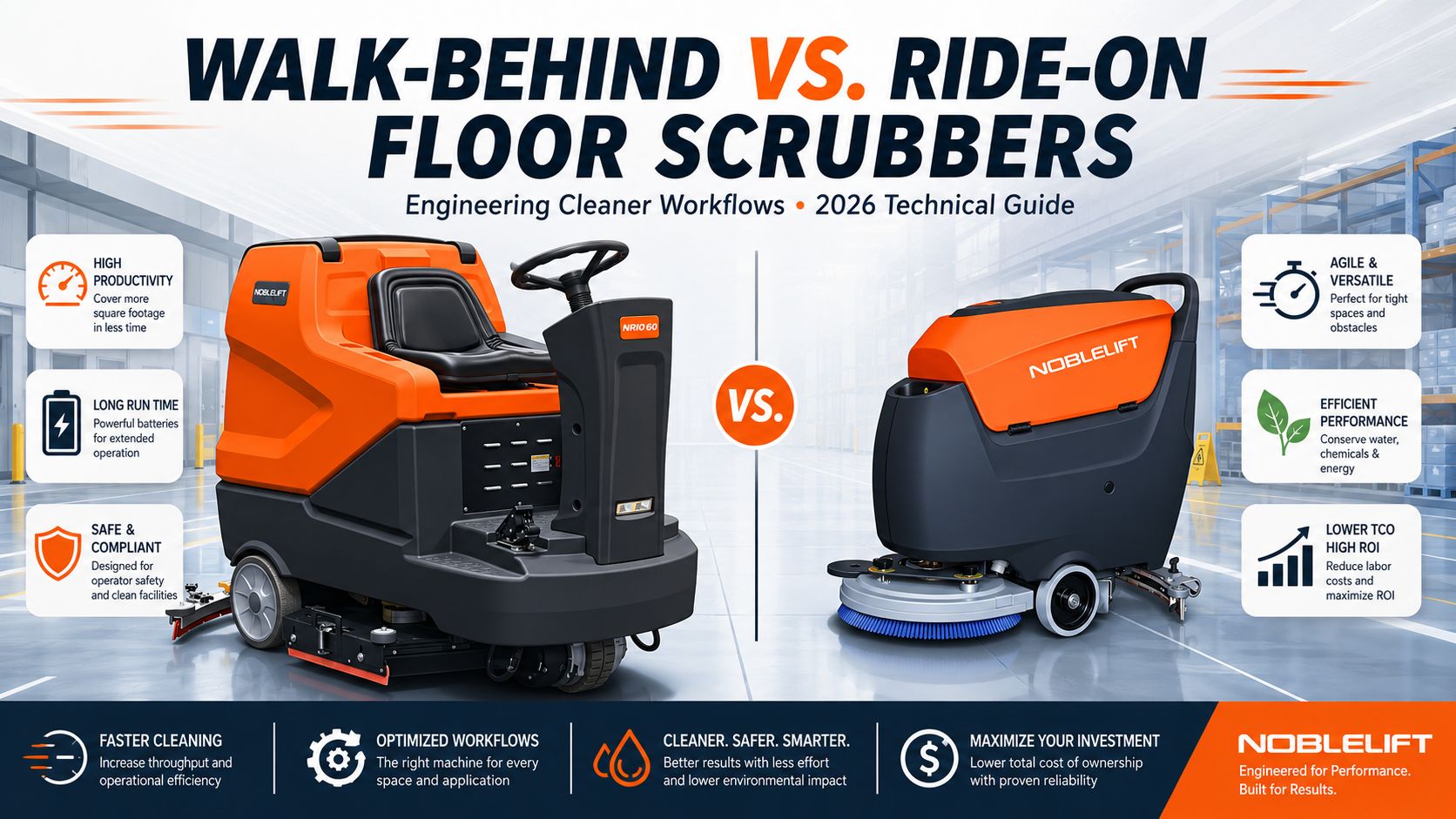
A ride-on floor scrubber can be up to 10 times faster than manual mopping, while a walk-behind model is 5-6 times faster. For industrial facility managers, these aren't just speed metrics. They represent the difference between a streamlined workflow and ballooning labor costs. You already understand that floor hygiene is a critical throughput variable, not a secondary janitorial task. Selecting the optimal walk-behind vs ride-on floor scrubber is essential to mitigate slip-and-fall risks and avoid equipment downtime in high-traffic zones.
This technical guide delivers the operational logic and performance data required to select the most efficient floor maintenance system for your facility. You'll master the specifications that drive a sub-six-month ROI and maintain OSHA-compliant safety standards. We'll analyze square footage thresholds, battery management, and 2026 tax incentives like the $2,560,000 Section 179 deduction limit. Before you compare available PHS Lift options, use this data to bridge the gap between janitorial needs and industrial engineering.
Key Takeaways
- Understand the mechanical systems behind automated scrubbing to maximize soil removal and minimize floor drying times for safer high-traffic zones.
- Evaluate the performance impact of disk versus cylindrical brush systems and the critical role of adjustable down pressure in removing industrial grime.
- Identify the specific square footage transition point in the walk-behind vs ride-on floor scrubber debate to ensure your equipment choice matches facility scale and aisle width.
- Analyze the total cost of ownership by comparing Lithium-Ion battery lifecycles against traditional Lead-Acid maintenance requirements and consumable expenses.
- Develop a data-backed procurement strategy that justifies capital expenditure through labor hour reductions and the extended lifespan of related fleet assets.
Beyond the Mop: The Role of Automated Scrubbing in Industrial Safety
Industrial floor maintenance has evolved beyond the bucket and mop. A modern commercial floor scrubber is a precision mechanical system designed to apply cleaning solution, agitate surfaces with high-torque brushes, and recover wastewater in a single pass. Unlike manual mopping, which often redistributes suspended solids and leaves a biofilm behind, automatic floor scrubbers ensure the total removal of industrial oils and particulates. This transition is vital for high-volume distribution centers where floor traction directly impacts the safe operation of forklifts. When evaluating a walk-behind vs ride-on floor scrubber, the decision hinges on how effectively the system maintains a consistent coefficient of friction across thousands of square feet to prevent equipment skidding and operator injury.
Automated systems also solve the problem of cross-contamination. In large facilities, manual cleaning often drags industrial lubricants, metal shavings, or chemical residues from production zones into clean storage areas. Scrubbers isolate these contaminants within a recovery tank, ensuring that soil removed from one zone isn't deposited in another. This level of control is essential for maintaining facility-wide hygiene and protecting sensitive inventory from airborne dust or floor-borne grease.
The Mechanics of One-Pass Cleaning
Efficiency in industrial cleaning relies on a synchronized three-step process: solution dispensing, mechanical agitation, and vacuum recovery. The primary technical goal is a "bone dry" surface. Wet floors are liability zones. High-speed vacuum motors and parabolic squeegees ensure that nearly 100% of moisture is recovered immediately. This technical rigor aligns with modern industrial floor cleaning equipment standards, prioritizing operational uptime. It's a mechanical solution to a logistical bottleneck. By scrubbing and drying in one motion, facilities eliminate the need for "Wet Floor" cordons that disrupt traffic flow.
Risk Mitigation and OSHA Compliance
Manual cleaning leaves floors wet for up to 20 minutes, creating a massive window for slip-and-fall incidents. Automated systems reduce this recovery window to mere seconds. This is a primary driver for facilities considering a walk-behind vs ride-on floor scrubber; the faster the machine covers the area, the lower the overall risk profile. Beyond human safety, clean floors protect your mechanical assets. Dust and grit are abrasive. They cause premature seal failure and wheel wear on manual and electric pallet jacks. Maintaining a debris-free environment through automated scrubbing reduces equipment depreciation and supports a safer, OSHA-compliant facility. It's an investment in the longevity of your entire fleet.
Technical Specifications: Decoding Brush Types and Squeegee Systems
The effectiveness of a walk-behind vs ride-on floor scrubber depends largely on the brush head configuration and its interaction with the floor substrate. Brush selection is the primary technical variable in industrial maintenance. Disk systems utilize a flat pad or brush rotating on a vertical axis. They are the industry standard for smooth, flat surfaces like polished concrete or epoxy. These systems excel at applying high down pressure, often measured in increments exceeding 100 lbs, to strip stubborn industrial grime. In contrast, cylindrical systems use horizontal rollers designed for "wet sweeping." This allows the machine to capture small debris like wood chips or metal shavings while simultaneously scrubbing, eliminating the need for a separate pre-sweep pass.
Squeegee assemblies represent the final stage of the one-pass cleaning process. Material choice is critical for maintaining operational uptime and safety. Gum rubber is the cost-effective standard for smooth floors but degrades quickly in oily environments. Polyurethane is the technical choice for facilities handling petroleum-based lubricants or chemicals. Linatex offers the highest tear resistance for uneven or grouted floors. Maintaining these components ensures compliance with OSHA safety standards by guaranteeing a dry, slip-free surface immediately following the machine's path.
Disk vs. Cylindrical Scrubbing: Application Logic
Choose your brush system based on floor texture and debris levels. Disk brushes offer more surface contact on flat floors, providing a deeper scrub for heavy-duty soilage. Cylindrical brushes are superior for grouted tile or textured slip-resistant surfaces because they reach into crevices that disk pads might skip. Whether you're deploying a walk-behind vs ride-on floor scrubber, ensure the brush type matches your facility profile. Using the wrong brush head increases pad wear and reduces cleaning efficiency.
Water Management and Solution Control
Tank capacity directly impacts labor efficiency. Solution tank volume must be balanced against recovery tank capacity; typically, recovery tanks are 10-20% larger to account for foam and air recovered during the vacuum cycle. Undersized tanks increase operator downtime through frequent "dump and fill" cycles. Modern systems utilize variable flow rates to meter chemical and water usage precisely. High-efficiency models can reduce chemical consumption by up to 70%. You can use specialized technical tools to calculate the necessary scrub path width for your facility. To optimize your maintenance fleet, you may compare available PHS Lift options to find the right technical fit.
Walk-Behind vs. Ride-On: Sizing Equipment to Facility Scale
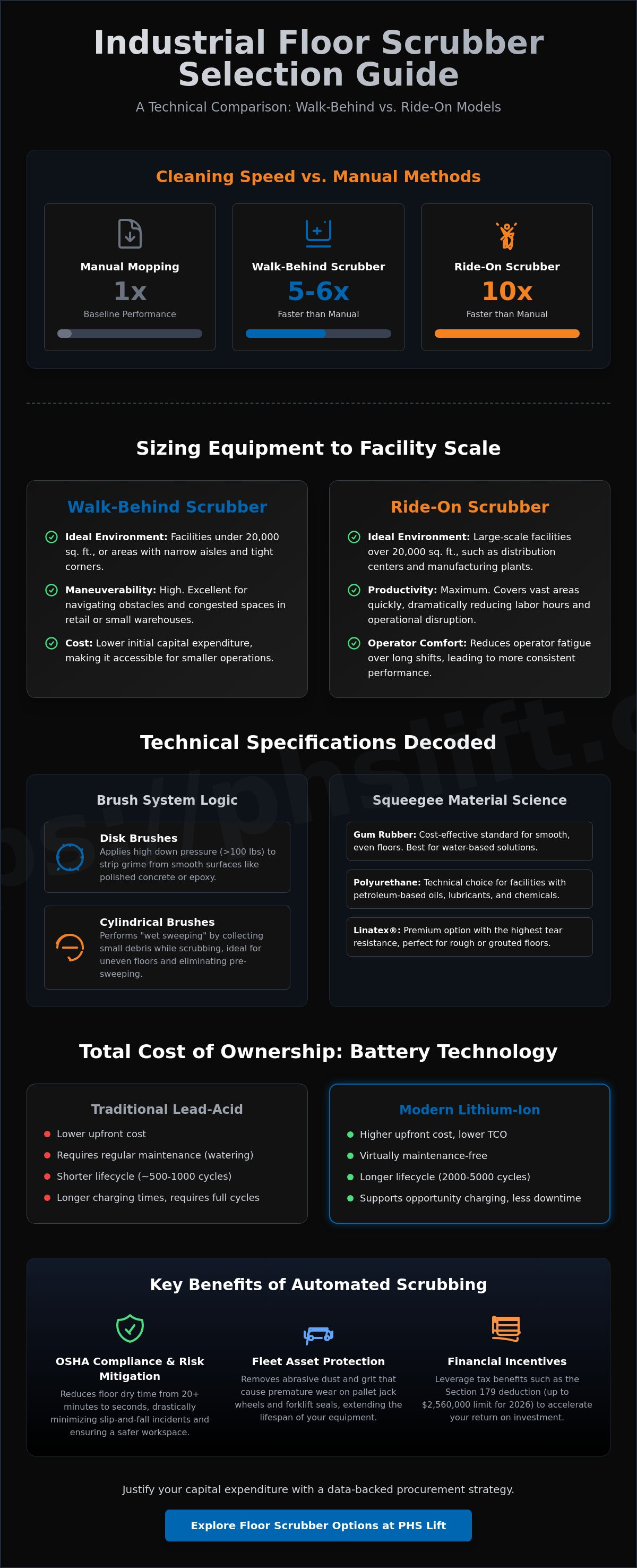
The transition point from a walk-behind to a ride-on unit is primarily dictated by total cleanable square footage and labor cost thresholds. While a walk-behind model is 5-6 times faster than manual mopping, a ride-on scrubber can be up to 10 times faster. For facilities exceeding 15,000 square feet, the ride-on format typically cuts cleaning time in half. This efficiency gain is the foundation of a data-backed ROI. In most high-volume environments, a ride-on scrubber pays for itself in under six months due to reduced labor hours. When evaluating a walk-behind vs ride-on floor scrubber, procurement teams must balance this speed against the physical constraints of the floor plan.
Maneuverability is the secondary technical variable. Open loading docks and expansive warehouse aisles favor the high cleaning rates of ride-on systems. However, narrow aisles and congested manufacturing cells require the tighter turning radii of walk-behind units. Integrating these machines into sustainable floor care practices involves right-sizing the equipment to minimize energy consumption and chemical waste. Over-sizing a machine leads to underutilized capacity; under-sizing leads to operator fatigue and inconsistent results. Fatigue is a hidden throughput killer. As an operator tires, their pass overlap increases and speed decreases, directly impacting the total square footage cleaned per shift.
The Case for Walk-Behind Units in Tight Spaces
Walk-behind models are the technical choice for facilities between 10,000 and 50,000 square feet with complex layouts. They excel in retail backrooms and narrow-aisle storage where a ride-on unit cannot navigate. These systems offer a lower entry cost and simplified maintenance cycles, making them ideal for decentralized cleaning tasks. For a deeper dive into these compact systems, see our guide on selecting the optimal walk-behind floor scrubber. They provide the agility needed for precision cleaning without the footprint of a larger vehicle.
Scaling Up: When Ride-On Systems Are Essential
Ride-on systems become essential when cleaning throughput must exceed 30,000 square feet per hour. Beyond the 50,000-square-foot mark, the ergonomic benefits of a seated operator translate directly into consistent cleaning quality. These units maintain a steady pace throughout an entire shift, unlike walk-behind operators whose productivity often drops by 20% in the final hours of a shift. You can explore available PHS Lift floor scrubber options to compare the technical dimensions and cleaning paths of these high-capacity machines. Selecting a ride-on unit is a commitment to industrial-scale efficiency and long-term labor stability.
Total Cost of Ownership: Battery Tech and Maintenance Cycles
The total cost of ownership (TCO) for a walk-behind vs ride-on floor scrubber extends far beyond the initial procurement price. Battery technology and consumable management represent the largest variables in long-term operational expense. While lead-acid batteries have been the historical standard, the industrial sector is rapidly pivoting toward Lithium-Ion (LiFePO4) power. This shift is driven by the need for maximum equipment uptime. Beyond power, hidden costs like squeegee blades, brushes, and chemical solutions account for a significant portion of the annual budget. Identifying "yellow touch points" is the most effective way to prevent catastrophic pump or motor failure. These are components designed for daily operator inspection and cleaning without specialized tools.
Opportunity charging is a technical game-changer for high-volume facilities. Unlike lead-acid units that require a full discharge and eight-hour recharge cycle, lithium batteries can be plugged in during 15-minute breaks. This keeps the machine in service across multiple shifts. It eliminates the need for expensive, ventilated battery rooms and the safety risks associated with battery watering. When calculating the ROI of a walk-behind vs ride-on floor scrubber, the ability to run 24/7 without battery swaps often justifies the higher upfront cost of lithium-equipped models.
Lithium vs. Lead-Acid: The ROI Calculation
Lithium-ion batteries typically offer 3,500 to 5,000 charging cycles. Traditional deep-cycle lead-acid units often fail after 500 to 1,000 cycles. This means a lithium battery can outlast five lead-acid sets, significantly reducing the long-term cost of replacement and disposal. For a deeper analysis of industrial power logic, refer to the 2026 spec-forward guide. Eliminating the maintenance labor associated with battery watering further accelerates the return on investment.
Preventative Maintenance for Maximum Longevity
Daily maintenance is the only way to prevent major repairs. Operators must rinse recovery tanks, clean squeegee blades, and inspect brushes after every shift. The most critical component is the vacuum motor protection system. If the float shut-off is clogged or damaged, moisture enters the motor, causing immediate failure. Consistent floor maintenance also protects the rest of your fleet. A clean floor reduces abrasive wear on the wheels and drive systems of your tuggers and other transport equipment. To ensure your facility stays operational, you should compare available PHS Lift options that feature simplified maintenance access.
Procurement Strategy: Integrating Scrubbers into Facility Workflows
The final decision in the walk-behind vs ride-on floor scrubber debate often stalls at the capital expenditure phase. To secure approval from a CFO or Operations Director, you must frame the machine as an asset protection tool rather than a janitorial expense. Industrial dust is an abrasive. It infiltrates the precision components of your forklifts, accelerating wear on drive tires and compromising hydraulic seals. By maintaining a debris-free floor, you're directly extending the service life of your primary material handling fleet. Sourcing these units from a comprehensive partner like PHS Lift allows you to synchronize maintenance schedules and parts procurement across your entire equipment roster, creating a unified operational workflow.
Service availability is the ultimate trust signal for large-scale operations. For national fleets, the initial purchase price is secondary to the reliability of the parts network. Equipment downtime in a high-volume facility costs thousands in lost productivity and safety risks. Ensure your dealer stocks critical components like vacuum motors and squeegee blades locally. A specialized material handling partner understands that a floor scrubber is a vital link in the logistics chain. They prioritize operational uptime and technical accuracy, ensuring your cleaning equipment is as reliable as your pallet jacks and reach trucks.
The Labor-to-Machine ROI Formula
A manual cleaning task requiring four labor hours can be reduced to 30 minutes with an automated system. At standard industrial labor rates, this efficiency gain typically pays for the equipment in approximately 18 months. Beyond the balance sheet, clean floors elevate warehouse morale and reinforce a professional image for 3PL providers during client audits. For more transition strategies, consult our buyer’s guide to automated floor maintenance. It's a mechanical solution to a labor bottleneck.
Finalizing the Spec Sheet
Before signing a procurement contract, ask these five questions: What is the guaranteed service response time? Are replacement consumables stocked locally? Does the warranty cover the full lifecycle of the lithium battery? Is operator training included? What is the projected trade-in value? After-sales support determines your long-term uptime. To begin a tailored facility assessment, you can request a quote from PHS Lift. Whether you deploy a walk-behind vs ride-on floor scrubber, ensure the machine is backed by a partner that understands industrial-scale grit and performance.
Optimizing Industrial Floor Maintenance for 2026 and Beyond
Industrial hygiene is a mechanical variable that dictates the safety and efficiency of your entire facility. Selecting the optimal walk-behind vs ride-on floor scrubber involves more than comparing square footage. You must account for battery cycle life, brush down pressure, and the specific maneuverability constraints of your loading docks or narrow aisles. Transitioning to automated scrubbing reduces labor hours while protecting your primary fleet assets from abrasive dust and debris. It's a strategic move that pays for itself through increased uptime and lower maintenance costs.
PHS Lift provides the technical depth required to bridge the gap between procurement costs and long-term ROI. Our national service and support network ensures your equipment maintains maximum performance across multi-shift operations. We offer expert guidance to help you select the most efficient system for your unique floor plan and throughput requirements. Invest in precision engineering to drive your operational excellence today.
Explore the full PHS Lift line of floor scrubbers and sweepers
Technical FAQs for Industrial Floor Maintenance
How long do commercial floor scrubber batteries typically last in a warehouse environment?
Lithium-ion batteries in a warehouse environment typically last between 3,500 and 5,000 charging cycles. In contrast, traditional lead-acid units often provide 500 to 1,000 cycles. Daily runtime for most industrial models ranges from 3 to 5 hours of continuous operation. Your choice between a walk-behind vs ride-on floor scrubber will dictate the total amp-hour capacity required. Proper opportunity charging with lithium systems can extend this runtime across multiple shifts without battery swaps.
What is the difference between an auto-scrubber and a floor buffer for industrial use?
An auto-scrubber is a comprehensive system that applies solution, agitates the surface, and recovers water in a single pass. A floor buffer is a single-action machine designed for polishing or stripping. Buffers don't have recovery tanks or vacuum systems. They require a separate process to remove the slurry or dust they generate. Industrial facilities prioritize auto-scrubbers because they leave floors dry and safe for immediate traffic.
Can I use a commercial floor scrubber on unsealed or rough concrete floors?
You can use these machines on rough or unsealed concrete, but it requires specific hardware. Cylindrical brush heads are superior for rough surfaces because they reach into pits and crevices. Unsealed concrete is porous and absorbs cleaning solution quickly, so you'll need higher flow rates. Using heavy-duty Linatex squeegee blades is essential to prevent tearing on abrasive surfaces. This ensures consistent water recovery even on non-uniform industrial floors.
How much water and chemical solution does a standard walk-behind scrubber use per hour?
Solution consumption varies based on the machine's flow rate settings and the level of soilage. High-efficiency systems can reduce chemical usage by up to 70% compared to legacy models. Most industrial units allow operators to meter the solution precisely to match the floor conditions. Managing this consumption is critical for controlling your total cost of ownership. Precise metering prevents waste and ensures that no chemical residue is left behind to create slip hazards.
What are the daily maintenance requirements to prevent squeegee streaks and vacuum clogs?
Preventing streaks and clogs requires daily attention to "yellow touch points" after every shift. Operators must rinse the recovery tank to prevent sediment buildup and wipe the squeegee blades to remove trapped debris. Inspect the vacuum intake for clogs and ensure the float shut-off is clear. Streaking is usually caused by worn squeegee edges or debris caught in the blade. Flipping or replacing blades regularly maintains the "bone dry" finish required for safety.
Is a ride-on scrubber worth the investment for a facility under 30,000 square feet?
A ride-on unit is often worth the investment for facilities as small as 15,000 square feet if labor costs are high. While walk-behind models are efficient, ride-on scrubbers can be up to 10 times faster than manual mopping. This speed allows one operator to cover more ground in less time, often resulting in a sub-six-month ROI. For facilities under 30,000 square feet with narrow aisles, a compact ride-on provides the best balance of speed and maneuverability.
How does floor scrubbing impact the maintenance costs of my forklift fleet?
Consistent floor scrubbing reduces abrasive wear on forklift tires and prevents dust from infiltrating sensitive hydraulic seals. Grit on a warehouse floor acts like sandpaper, grinding down drive wheels and increasing the frequency of tire replacements. By removing metal shavings and industrial oils, you protect the mechanical integrity of your entire material handling fleet. This preventative measure directly lowers the long-term depreciation and repair costs of your more expensive lift assets.
What is the difference between disk and cylindrical scrubbing heads?
Disk heads use flat, rotating pads and excel on smooth surfaces where high down pressure is needed to remove stubborn grime. Cylindrical heads use horizontal rollers that rotate at high speeds. These rollers provide a "wet sweep" function, capturing small debris while they scrub. This eliminates the need for pre-sweeping in most applications. When choosing a walk-behind vs ride-on floor scrubber, select the head type based on whether your facility has polished concrete or textured, debris-heavy floors.