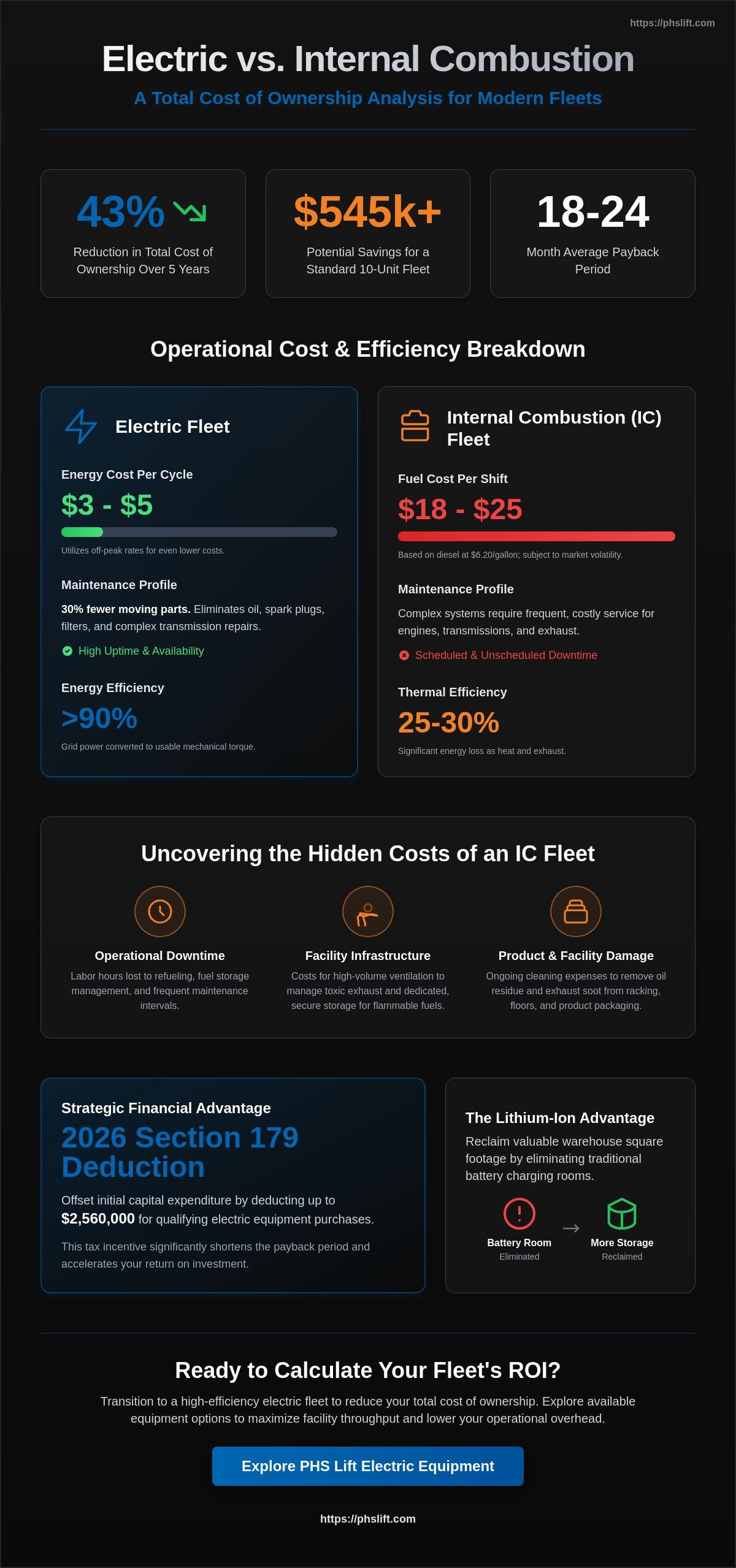
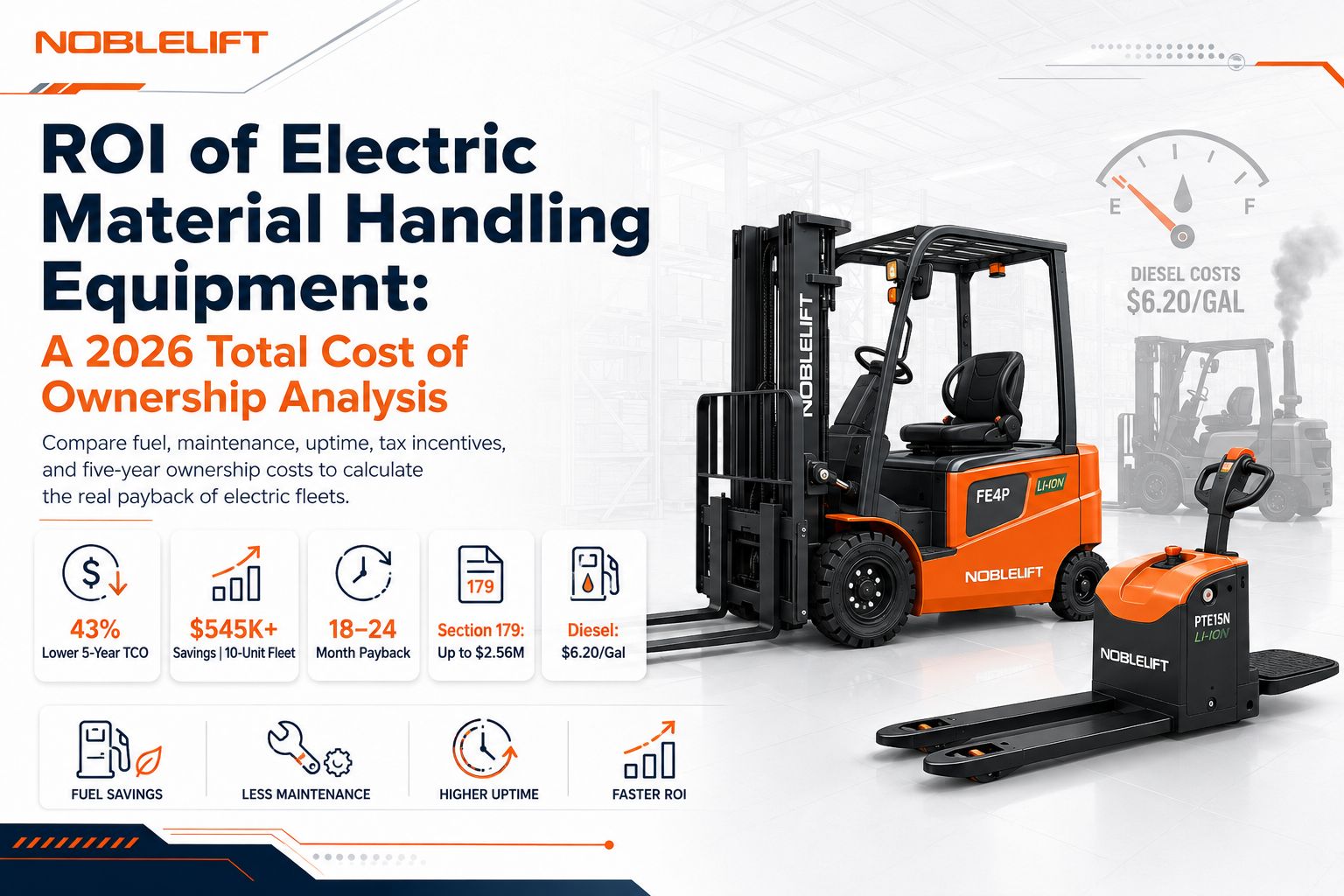
With diesel prices averaging $6.20 per gallon as of May 2026, internal combustion fleets have transitioned from a standard expense to a significant financial liability. You're likely managing the dual pressure of volatile fuel costs and the relentless maintenance downtime required by aging engines. Evaluating the ROI of electric material handling equipment is no longer a theoretical exercise; it's a requirement for maintaining a competitive bottom line. Current data confirms that electric fleets can reduce the total cost of ownership by 43% over five years. This shift represents a potential savings of over $545,000 for a standard 10-unit fleet.
This technical breakdown examines how electric equipment outperforms internal combustion in both long-term profitability and operational uptime. We'll provide a framework to calculate your specific payback period, which currently averages between 18 and 24 months. You'll also learn how to leverage the 2026 Section 179 deduction, which allows for a $2.56 million write-off on qualifying equipment. We'll explore the transition from high-maintenance engines to high-efficiency systems, helping you compare available PHS Lift options to maximize facility throughput and reduce overhead.
Key Takeaways
- Learn how the simplified mechanical design of electric units, featuring 30% fewer moving parts, directly translates to lower maintenance labor and higher equipment availability.
- Understand the strategic advantage of lithium-ion batteries in reclaiming warehouse square footage by eliminating traditional battery charging rooms.
- Utilize our 4-step framework to calculate the definitive ROI of electric material handling equipment by aggregating energy savings, tax incentives, and operational uptime.
- Explore how standardizing your fleet with NobleLift solutions provides high-performance specifications while minimizing the total investment required for procurement.
Defining TCO: The Foundation of Electric Equipment ROI
Procurement managers often focus on the invoice price. This is a strategic error. To find the true Total Cost of Ownership (TCO), you must calculate every dollar spent from the moment of acquisition until the unit is decommissioned. TCO is the only reliable metric for determining the ROI of electric material handling equipment. It captures the delta between high initial capital expenditure and low recurring operational costs.
Industry data for 2026 indicates that electric fleets deliver a 43% reduction in TCO over a five-year lifecycle compared to internal combustion (IC) models. This calculation includes both direct and indirect variables:
- Direct Costs: Acquisition price, energy consumption (electricity versus diesel/propane), and scheduled maintenance intervals.
- Indirect Costs: Operator downtime during fuel swaps, battery watering labor, and the energy required for facility ventilation.
By 2026, the benchmark for efficiency has shifted. The gap between IC and electric costs is widening as fuel prices remain volatile and emission regulations tighten. Understanding these variables allows you to build a business case based on data rather than estimates.
Acquisition Cost vs. Lifecycle Value
Sticker shock often prevents companies from transitioning to cleaner fleets. It's a misleading metric. While electric units command a higher initial price, the 2026 Section 179 tax deduction allows businesses to deduct up to $2,560,000 for qualifying equipment. This immediately offsets the initial CapEx. Modern electric powertrains now offer a reliable five to seven year lifespan with minimal performance degradation. When you spread the acquisition cost over these thousands of operational hours, the per-hour cost is significantly lower than IC alternatives. You can compare available PHS Lift options to see how specific models fit your budget and tax strategy.
Identifying Invisible Operational Costs
IC engines carry "invisible" costs that rarely appear on a single line item. Propane management requires dedicated storage space, safety training, and labor for tank swaps. These units also demand high-volume ventilation systems to manage exhaust emissions. This is especially critical under strict 2026 mandates like California’s Zero Emission Forklift rule, which prohibits new IC purchases in many categories.
Electric units eliminate these requirements entirely. They also reduce facility maintenance. You won't deal with oil leaks or exhaust soot that accumulates on racking and product packaging. These savings in cleaning labor and secondary infrastructure are critical components of a comprehensive ROI analysis. Transitioning to electric models isn't just about the machine; it's about optimizing the entire facility environment.
Operational Efficiency: Quantifying Energy and Maintenance Savings
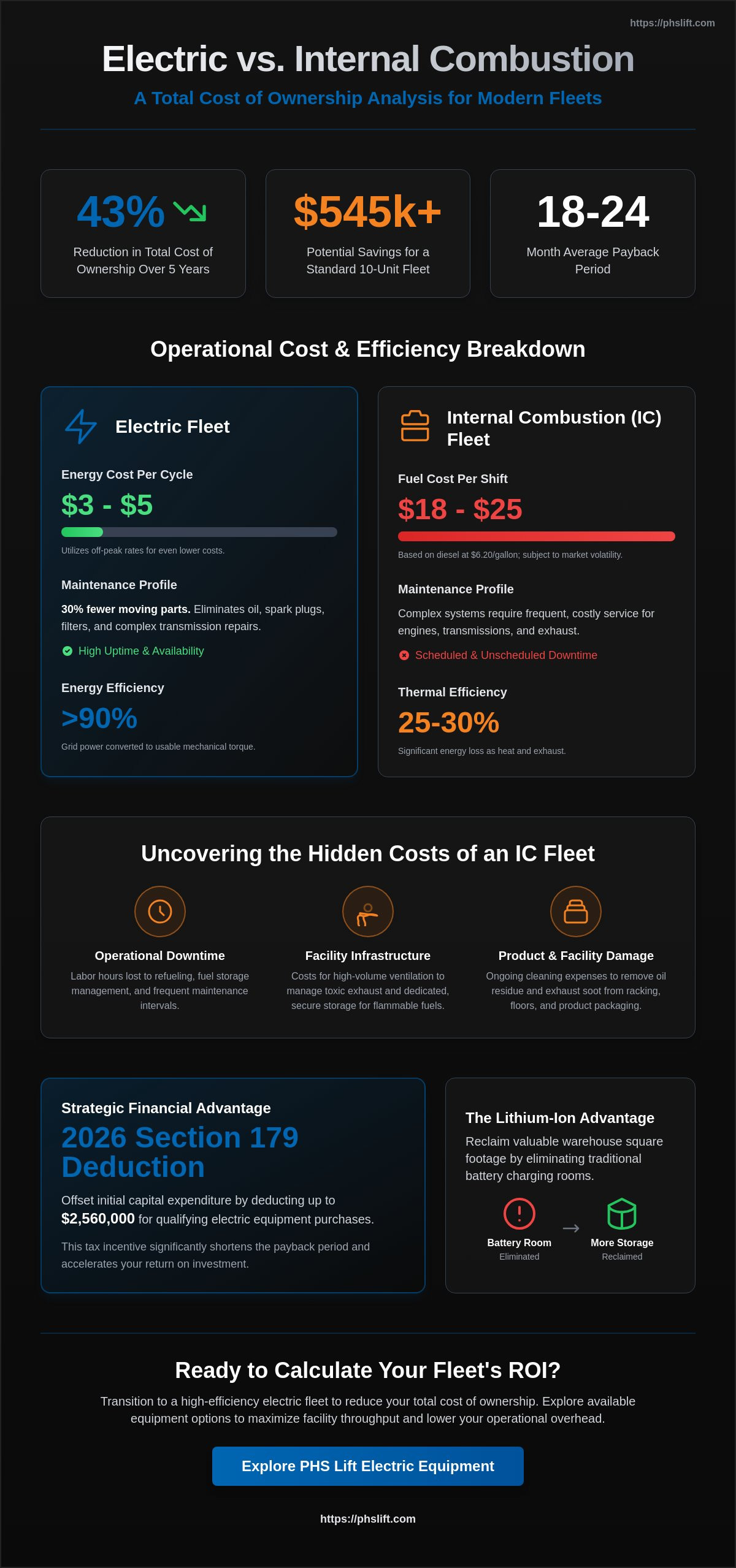
The core of the ROI of electric material handling equipment lies in the massive disparity between kilowatt-hour costs and fossil fuel prices. By mid-2026, diesel prices have reached $6.20 per gallon. In contrast, recharging a lithium-ion battery costs between $3 and $5 per cycle. For a standard eight-hour shift, an internal combustion (IC) unit consumes $18 to $25 in fuel. This daily cost delta creates an immediate operational advantage that compounds over the life of the fleet.
Beyond fuel, the mechanical simplicity of electric drivetrains drives long-term profitability. Electric units contain roughly 30% fewer moving parts than their IC counterparts. You eliminate the need for oil changes, spark plugs, air filters, and complex transmission repairs. Systems like regenerative braking further extend the lifecycle of wear items. By reversing the motor to slow the vehicle, these units recapture energy for the battery while significantly reducing the heat and friction on brake pads and tires.
Energy Consumption Benchmarks for 2026
Operational managers must look beyond simple fuel swaps. Transitioning from manual equipment to powered pallet equipment increases throughput, but the energy source determines the margin. Smart chargers now allow facilities to capitalize on off-peak utility rates, further lowering the cost per shift. Energy efficiency for material handling equipment in 2026 is defined by the ability to convert over 90% of grid power into usable mechanical torque, drastically outperforming the 25-30% thermal efficiency of internal combustion engines. This efficiency is bolstered by advances in battery technology that ensure consistent power delivery throughout the entire discharge cycle.
Reduced Maintenance and Increased Uptime
Maintenance schedules dictate your operational ceiling. Standard IC units require major service intervals every 250 hours. Electric models often extend these intervals to 1,000 hours or more. This 4x increase in uptime directly impacts the bottom line by reducing labor overhead and keeping equipment in service. This logic applies across the entire facility. For instance, the ROI of electric floor scrubbers is realized through reduced downtime and the elimination of hazardous fluid leaks that can damage warehouse flooring.
Simplified drivetrains also reduce the Mean Time to Repair (MTTR). When components do fail, modular electric systems allow for faster diagnostics and part replacement compared to the invasive teardowns required for engines. To maximize these gains, you should explore related PHS Lift equipment to identify high-uptime solutions tailored for your specific application.
The Lithium-Ion Factor: How Battery Technology Accelerates ROI
While the shift to electric power is driven by rising fuel costs, the specific battery chemistry determines the velocity of your payback period. The ROI of electric material handling equipment is significantly accelerated when moving from traditional lead-acid to lithium-ion (Li-ion) technology. This transition isn't merely a change in power source; it's a fundamental shift in how facility managers utilize labor and warehouse square footage. Li-ion batteries operate at roughly 95% efficiency, whereas lead-acid units lose significant energy to heat and internal resistance during charging and discharge cycles.
One of the most immediate financial gains comes from reclaiming the "battery room." Lead-acid batteries require dedicated, ventilated charging areas to manage hazardous outgassing. They also necessitate heavy-duty gantry cranes for battery swaps between shifts. Li-ion technology eliminates these infrastructure requirements. By removing the need for a dedicated charging zone, operations can reclaim hundreds of square feet for high-density racking or additional staging areas. This conversion of dead space into revenue-generating pallet positions provides a direct boost to facility-wide profitability.
Labor Savings through Opportunity Charging
Traditional battery management is a hidden drain on productivity. Lead-acid units require weekly "watering" to maintain electrolyte levels and equalizing charges to prevent sulfation. Industry data suggests these tasks consume approximately 15 minutes of labor per shift. Li-ion removes this maintenance entirely. These units support "opportunity charging," allowing operators to plug in during 15-minute breaks or lunch periods without damaging the cells. This eliminates the need for spare battery inventory and the high-risk labor of swapping 2,000-pound batteries. This high-uptime model allows for optimized forklift fleet sizing, as fewer units are needed to cover the same multi-shift demand.
Lifecycle and Degradation Metrics
The technical delta between chemistries is stark when viewed over a five-year horizon. Lead-acid batteries typically provide 1,500 cycles before significant capacity loss occurs. In contrast, industrial Li-ion units deliver between 3,000 and 5,000 cycles while maintaining stable voltage throughout the entire discharge. Integrated Battery Management Systems (BMS) protect the investment by preventing over-discharge and thermal abuse, ensuring the battery reaches its full rated lifespan. For lighter applications, you can review technical specs for electric pallet jacks with integrated Li-ion tech to see how these degradation metrics impact smaller fleet assets. This longevity ensures that the initial capital investment is amortized over a much longer period, driving down the cost per hour of operation.
Payback Period: A 4-Step Framework for ROI Calculation
Calculating the ROI of electric material handling equipment requires a shift from simple price comparisons to a multi-variable financial model. You can't just look at the invoice. You must analyze the intersection of capital expenditure, tax incentives, and recurring operational costs. Use this four-step framework to determine the exact month your investment pays for itself and starts generating profit.
- Step 1: Aggregate Total Initial Investment. Total your acquisition costs. This includes the unit price, charging stations, and any necessary electrical infrastructure upgrades. Immediately subtract the 2026 Section 179 tax deduction, which allows for a full write-off of up to $2,560,000 for qualifying equipment.
- Step 2: Calculate Annual Operational Savings. Compare your current fuel costs against projected electricity use. With diesel at $6.20 per gallon and lithium-ion charging at roughly $5 per cycle, the energy delta is massive. Include the 40-60% reduction in maintenance costs documented for electric drivetrains.
- Step 3: Factor in Productivity Gains. Quantify the value of increased uptime. Account for the elimination of battery watering labor and the speed of opportunity charging. These factors increase the number of pallets moved per labor hour.
- Step 4: Determine the Payback Month. Divide your net initial investment by your total annual savings. This provides a clear timeline for when the unit becomes cash-flow positive.
Adjusting for Application Intensity
Your duty cycle is the primary driver of the ROI of electric material handling equipment. In single-shift operations, the payback period typically lands between 18 and 24 months. However, three-shift environments see this timeline accelerate significantly. Multi-shift facilities benefit most from lithium-ion technology because it eliminates the need for spare battery inventories and the labor-intensive swapping process. High-capacity lifting and narrow aisle configurations also impact the math by increasing throughput density, which maximizes the value of every operational hour.
Real-World ROI Scenarios
Consider a facility transitioning a fleet of 10 internal combustion units to electric. Based on 2026 utility rates and maintenance benchmarks, this move yields approximately $545,000 in savings over five years. Application-specific duty cycles dictate ROI by determining how quickly operational savings offset initial capital expenditure. For example, deploying NobleLift stackers in retail backrooms often results in a faster payback due to the elimination of engine idling and reduced mechanical wear in stop-and-go applications. To run these numbers for your specific facility, you should request a quote from PHS Lift to get precise technical specifications and pricing data.
Strategic Fleet Procurement: Maximizing ROI with NobleLift Solutions
Achieving a sustainable ROI of electric material handling equipment requires more than just picking a battery type. It demands a procurement strategy that balances technical specifications with industrial pragmatism. PHS Lift provides a unique ROI proposition by delivering high-performance specifications without the "premium" brand markup often found in legacy equipment manufacturers. This direct approach to value ensures that your initial capital expenditure is lower, which immediately shortens the payback period calculated in previous sections.
Standardization is a force multiplier for fleet managers. By deploying PHS Lift equipment across your facility, you reduce the complexity of your spare parts inventory and simplify technician training cycles. Many PHS Lift models utilize standardized components, meaning your maintenance team spends less time diagnosing unique failures and more time ensuring operational uptime. National support and rapid parts availability act as a critical ROI protector. Every hour a machine sits idle waiting for a proprietary sensor is an hour of lost productivity that erodes your total cost of ownership gains.
Rightsizing Your Fleet for Maximum Efficiency
Over-speccing is a common pitfall that kills ROI. Purchasing a high-capacity forklift for tasks that tuggers can handle leads to unnecessary energy consumption and higher maintenance overhead. It's essential to match the machine to the specific application. For example, using specialized equipment for horizontal transport allows you to reserve your high-reach assets for vertical stacking. You should explore related PHS Lift equipment to identify the exact tools needed to optimize your specific workflow. Application-specific duty cycles dictate ROI by ensuring the machine's capacity aligns with the actual workload without excessive overhead.
Securing the Best ROI Path
The final step in maximizing your investment is a technical fleet audit. PHS Lift acts as a seasoned industry partner, helping facility managers identify where internal combustion units are underperforming and where electric alternatives provide the fastest payback. Beyond the machine itself, managers should evaluate how different acquisition models impact cash flow and long-term TCO. With electric units now accounting for 64% of the North American industrial vehicle market, the data supporting this transition is definitive. To move from analysis to implementation, you can request a quote from PHS Lift for an ROI-focused fleet analysis that targets your specific operational challenges.
Transitioning to a Data-Driven Fleet Strategy
The transition toward electrification is a financial imperative driven by rising fuel costs and stricter emissions mandates. By focusing on the ROI of electric material handling equipment, facility managers can capture significant savings through reduced maintenance labor and optimized energy consumption. Transitioning to lithium-ion technology eliminates the infrastructure costs of traditional battery rooms and provides the uptime necessary for multi-shift operations. You've seen how the 2026 Section 179 deduction and 43% TCO reduction create a clear path to long-term profitability.
As a NobleLift Direct Dealer with specialized lithium-ion fleet experts, PHS Lift provides the technical depth required to rightsize your equipment assets. Our nationwide service and support ensure that your transition is backed by industrial reliability and rapid parts availability. You don't have to navigate these complex technical specifications alone. Request a technical ROI analysis for your fleet from PHS Lift to identify the exact payback period for your specific application. Start building a more profitable, high-efficiency operation today.
Frequently Asked Questions
What is the average payback period for electric material handling equipment?
The average payback period for the ROI of electric material handling equipment typically falls between 18 and 24 months. In high-intensity, multi-shift operations, this timeline often accelerates as fuel and maintenance savings compound more rapidly. This calculation assumes a shift from internal combustion to high-efficiency lithium-ion platforms that eliminate the need for spare battery inventories and the labor associated with battery swaps.
How do electricity costs compare to propane for industrial forklifts in 2026?
Recharging a lithium-ion battery costs approximately $3 to $5 per cycle while propane and diesel costs are significantly higher per shift. With 2026 diesel prices averaging over $6.00 per gallon, the energy cost per hour for electric units remains a fraction of internal combustion alternatives. Smart chargers further optimize this delta by utilizing off-peak utility rates during non-operational hours, ensuring the lowest possible cost per pallet moved.
Does cold storage affect the ROI of electric equipment?
Cold storage applications significantly improve the ROI of electric material handling equipment when utilizing lithium-ion technology. Unlike lead-acid batteries that lose capacity in sub-zero temperatures, modern lithium-ion units often feature integrated heaters. This maintains consistent voltage and prevents the performance degradation that typically forces internal combustion engines to run continuously to prevent freezing, which saves both fuel and engine wear.
What are the maintenance requirements for lithium-ion batteries?
Lithium-ion batteries require virtually zero daily maintenance compared to lead-acid counterparts. You don't need to perform weekly watering, equalizing charges, or acid cleaning. The integrated Battery Management System automatically monitors cell health and prevents over-discharge, which protects the long-term value of the asset without requiring dedicated technician labor. This shift allows your maintenance team to focus on mechanical inspections rather than battery chemistry.
Can electric material handling equipment handle outdoor applications?
Modern electric units can handle outdoor applications provided they are equipped with appropriate IP ratings and pneumatic tires. While internal combustion was once the standard for yard work, high-voltage electric systems now provide the torque and weatherproofing necessary for loading docks and paved outdoor storage areas. It's essential to verify the specific environmental protection rating for your application to ensure long-term durability in rain or dusty environments.
How does operator ergonomics impact the overall ROI of a fleet?
Operator ergonomics impact ROI by reducing worker fatigue and the risk of musculoskeletal injuries. Electric units operate with significantly lower noise levels and zero tailpipe emissions, creating a healthier work environment. This leads to higher labor retention and lower insurance premiums, which are critical indirect factors in a comprehensive total cost of ownership analysis. Happy operators are more productive, which increases the number of cycles per shift.
Is it worth upgrading from lead-acid to lithium-ion for existing equipment?
Upgrading existing equipment from lead-acid to lithium-ion is often a viable strategy for preserving capital. Many manufacturers offer drop-in lithium-ion replacements that utilize the same battery compartment. This allows you to capture the benefits of opportunity charging and reduced maintenance without the full cost of a new vehicle acquisition. It's a strategic way to extend the life of your current fleet while modernizing your charging infrastructure.
What is the typical lifespan of a modern electric motor in MHE?
A modern AC electric motor in material handling equipment typically lasts 10,000 to 20,000 operational hours. Because these motors have no brushes or internal combustion components, they experience minimal wear compared to engines. This longevity ensures that the powertrain often outlasts the chassis, providing a reliable foundation for long-term fleet operations. When compared to the frequent rebuilds required for internal combustion engines, the motor's durability is a primary ROI driver.