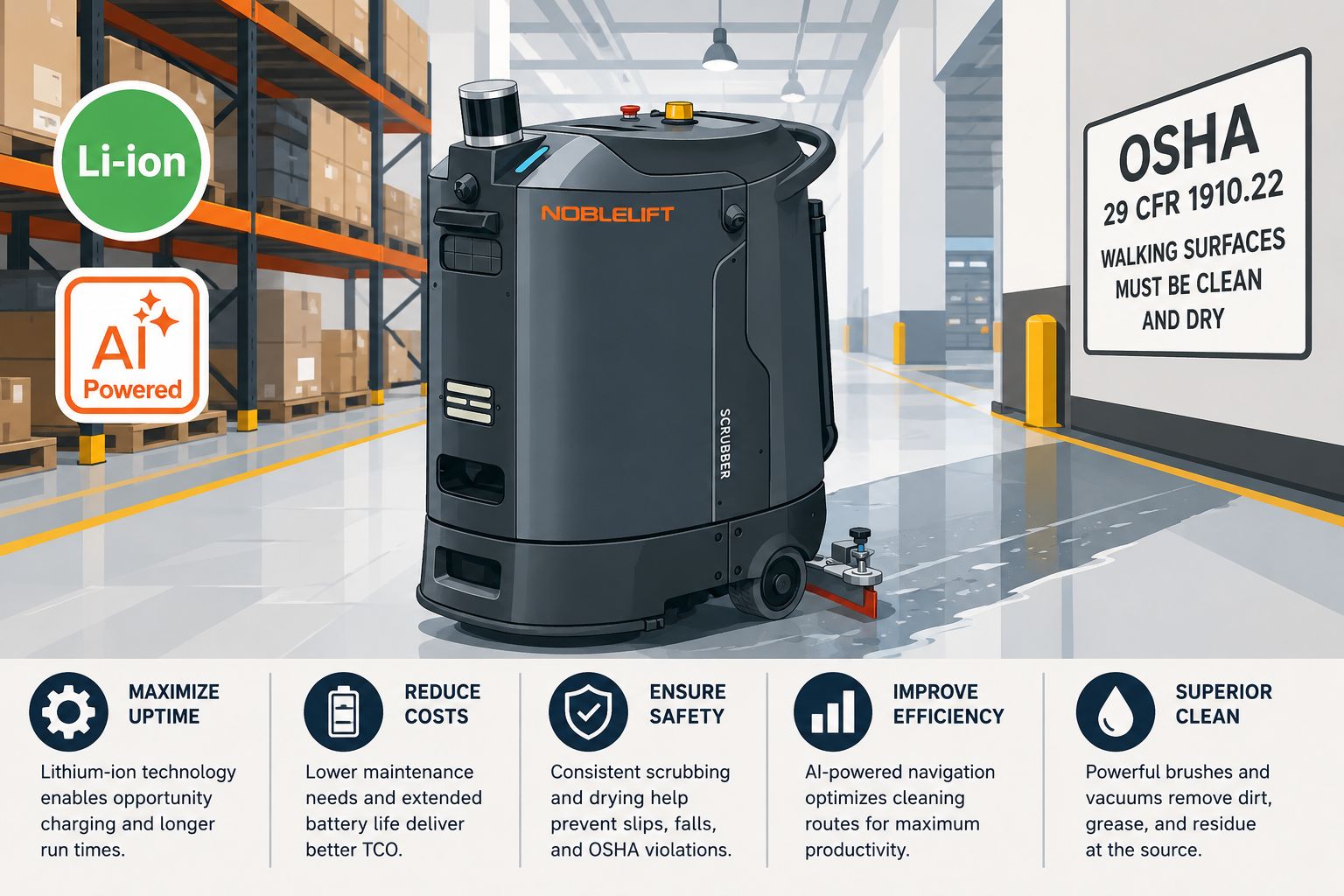
What if the most significant bottleneck in your facility isn't the shipping dock, but the thin layer of residue on your concrete floor? Industrial hygiene isn't a secondary concern; it's a core operational requirement. OSHA standard 29 CFR 1910.22 mandates that walking surfaces remain clean and dry to prevent hazards. Managing this through manual labor is often a losing battle against high costs and inconsistent results. Selecting the right warehouse floor scrubber is the only way to maintain safety standards while protecting your bottom line.
You likely recognize that clean floors are essential for safety audits and equipment longevity, but poor battery management and improper machine sizing often lead to unexpected downtime. This guide provides a technical roadmap to align your equipment specs with your facility's duty cycle. You'll learn how to choose the correct deck size for your square footage, maximize battery life, and implement a maintenance schedule that ensures predictable TCO. We will examine specific sizing metrics and technical considerations to help you compare available PHS Lift options for your operational needs.
Key Takeaways
- Quantify the labor-hour delta between manual mopping and automated systems to justify equipment ROI and reduce operational overhead.
- Determine whether cylindrical or disc brushes are appropriate for your specific floor texture and the removal of industrial tire marks.
- Use a two-step selection framework to size your warehouse floor scrubber based on net cleaning productivity and minimum aisle widths.
- Establish daily and weekly preventative maintenance protocols to extend equipment life and maintain a predictable total cost of ownership.
- Synchronize cleaning schedules with material handling workflows to improve the precision and safety of equipment like NobleLift stackers.
Beyond the Mop: Evaluating Industrial Cleaning Efficiency
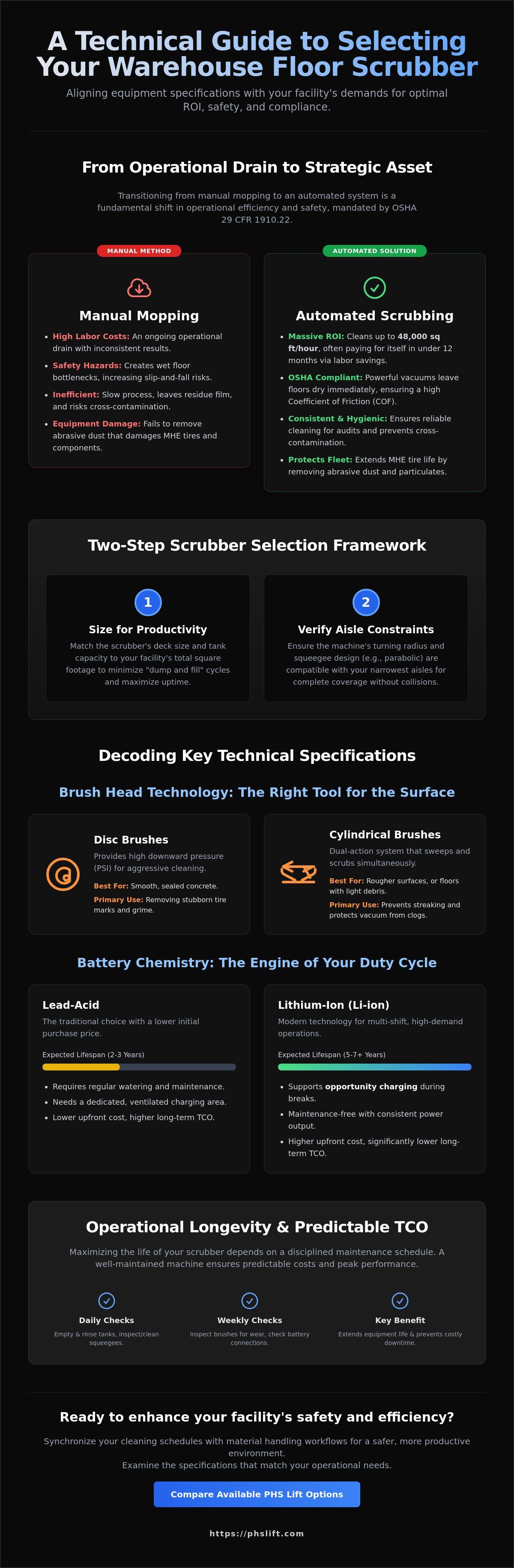
Manual floor maintenance in a high-volume facility is an operational drain. Traditional mopping doesn't scale. It's slow and often leaves a film that compromises traction. Transitioning to automatic floor scrubbers shifts hygiene from a labor-intensive chore to a technical process. A ride-on warehouse floor scrubber can clean up to 48,000 square feet per hour. This speed creates a massive labor-hour delta compared to manual methods. Beyond labor, floor hygiene affects your fleet's bottom line. Abrasive dust acts like sandpaper on the polyurethane tires of pallet jacks and forklifts. Regularly removing these particulates extends tire life and prevents debris from fouling the precision sensors in modern MHE. Clean floors also reduce the grit that can lodge in steering components, preventing premature mechanical failure.
The ROI of Automated Floor Maintenance
Calculating the break-even point for a warehouse floor scrubber requires looking beyond the sticker price. Analyze the total cost of ownership (TCO). Labor is typically the highest expense in manual cleaning. Automating this task allows you to reallocate staff to high-value logistics roles. A mid-sized scrubber often pays for itself within 12 months through labor savings alone. When you compare available PHS Lift options, consider the chemistry used. Some systems use chemical-free tech to lower recurring costs. You're buying back hundreds of man-hours every year. This reallocation improves overall facility uptime and operational flow.
Safety Standards and OSHA Compliance
OSHA standard 29 CFR 1910.22 requires all walking-working surfaces to be kept clean and dry. Manual mopping creates a wet floor bottleneck where aisles must be closed. Automated systems use high-powered vacuums and precision squeegees to leave the floor dry immediately. This maintains a high Coefficient of Friction (COF) on concrete, which is vital for preventing slip-and-fall accidents. For food-grade or pharmaceutical storage, mechanical scrubbing is the only reliable way to pass hygiene audits. It ensures moisture doesn't pool in low spots, especially in high-humidity zones. Consistent mechanical cleaning also eliminates the risk of cross-contamination that occurs with reused mop heads.
Technical Specifications: Decoding Brush Pressure and Battery Chemistry
Selecting a warehouse floor scrubber requires a granular look at the mechanical specs that drive performance. The choice between disc and cylindrical brush heads depends entirely on your floor's texture and debris profile. Disc brushes provide high downward pressure (PSI), making them the industry standard for removing stubborn tire marks on smooth, sealed concrete. Cylindrical brushes are the technical choice for rougher surfaces or facilities with light debris. They sweep small particulates into a removable tray while they scrub, which prevents the squeegee from streaking and protects the vacuum system from clogs. Squeegee geometry also matters; parabolic designs offer superior water recovery during tight turns compared to straight blades, ensuring aisles are immediately safe for foot traffic.
Battery Systems: Lithium-Ion vs. Lead-Acid
Battery chemistry is the most critical factor in determining your machine's duty cycle. Lead-acid batteries have a lower entry price but require significant maintenance, including regular watering and dedicated ventilation during charging. They typically last 2 to 3 years. Lithium-ion technology has revolutionized multi-shift operations. These batteries support opportunity charging, allowing operators to plug in during 15-minute breaks without degrading the cells. This eliminates the need for battery swapping and maximizes the daily uptime of your warehouse floor scrubber. Lithium-ion batteries also provide a consistent power curve and last 5 to 7 years, significantly lowering the long-term total cost of ownership.
Solution and Recovery Tank Engineering
Tank capacity is a direct lever for operational efficiency. Small tanks force frequent "dump and fill" cycles, which creates unnecessary downtime. Look for tank-in-tank designs that simplify the rinsing process and prevent sludge buildup. Precision filtration is non-negotiable; it shields the internal vacuum motor from foam and aerosolized particulates. To ensure your cleaning hardware matches your facility's throughput, you can compare available PHS Lift options that prioritize high-capacity recovery and advanced battery management. Optimizing the water-to-detergent ratio through automated dispensing systems also prevents chemical waste and ensures the floor's Coefficient of Friction remains within safe parameters.
Sizing Your Equipment: A Selection Framework for Facility Managers
Sizing a warehouse floor scrubber is a technical calculation, not a guess. Many managers make the mistake of looking only at gross square footage. You must calculate Net Cleaning Productivity instead. This figure accounts for real-world overlaps, turns, and tank refill times. Typically, net productivity is 20% to 30% lower than the theoretical maximum speed listed on a spec sheet. If your facility has narrow aisles, a machine that's too large will actually decrease efficiency due to constant maneuvering. You can compare available PHS Lift options to see how different deck widths impact these productivity rates.
Physical constraints dictate the chassis size. Measure your narrowest aisle and the tightest turnaround point before selecting a model. Ride-on units offer high speed but require wider turning radii. Walk-behind units excel in high-density rack environments where maneuverability is the priority. Also, identify any floor gradients or ramps. Not all ride-on scrubbers can maintain traction or suction on inclines. Finally, assess your debris. If your floor has wood chips or metal shavings, a pre-sweep function or a cylindrical brush system is mandatory to prevent squeegee damage and vacuum clogs.
Walk-Behind vs. Ride-On Scrubber Logic
The 30,000 square foot mark is the industry tipping point. Facilities under this threshold usually find a walk-behind unit more cost-effective. These machines are easier to store and offer better visibility in tight spaces. Once you cross 30,000 square feet, operator fatigue becomes a significant productivity drain. A ride-on warehouse floor scrubber keeps the operator alert and maintains a consistent pace throughout the shift. In high-traffic zones, ride-on models also provide a higher seating position, which improves the operator's line of sight around blind corners.
Navigating Narrow Aisles and Tight Corners
Modern industrial scrubbers often feature zero-turn radius capabilities. This allows the machine to pivot on its own center, which is essential for dead-end aisles. Offset brush decks are another critical technical feature. These decks extend slightly beyond the machine's frame. They allow the operator to clean flush against rack uprights and walls without risking chassis damage. For facilities with extremely tight footprints, you should explore related PHS Lift narrow-aisle solutions to ensure your cleaning equipment and material handling fleet are perfectly synchronized. This integrated approach prevents operational bottlenecks and maximizes facility uptime.
Operational Longevity: Preventative Maintenance and TCO
Industrial cleaning assets are high-stakes investments. Longevity isn't a guarantee from the manufacturer; it's a result of operational discipline. A warehouse floor scrubber that's neglected will see its performance degrade within months. Most mechanical failures aren't due to manufacturing defects. They're caused by the accumulation of sludge and debris in critical systems. Post-shift protocols are non-negotiable. Draining and rinsing the recovery tank prevents bacterial growth and foul odors. If you leave gray water in the tank, it creates a thick sediment that stresses the drain valves and adds unnecessary weight to the chassis. You must also clear the debris tray daily. If particulates bypass the filtration system, they can enter the vacuum motor, leading to catastrophic failure and expensive repairs.
Weekly inspections should focus on wear items. Squeegee blades must be checked for nicks or rounding. A worn blade leaves water behind, which creates slip hazards and forces operators to make redundant passes. This redundancy wastes labor and energy. You should also maintain a local inventory of wear parts, including blades, filters, and brushes. Having these on hand prevents minor wear from turning into extended equipment downtime. Neglect has hidden costs. For lead-acid systems, failing to water the cells leads to desulfation and permanent capacity loss. This turns a five-year asset into a two-year liability. To protect your investment, you can compare available PHS Lift options that feature tool-free maintenance access for easier daily servicing.
The Daily Maintenance Checklist
Consistency is the primary driver of equipment life. Operators must rinse the recovery tank after every shift to prevent sludge buildup. This is especially critical in food-grade environments where hygiene audits are strict. Check the vacuum intake screen for clogs to ensure consistent suction power. If you're using lead-acid batteries, inspect the water levels and cable integrity daily. For lithium-ion models, simply ensure the charging port is clear of debris before connecting the power source.
Total Cost of Ownership (TCO) Calculation
Calculating TCO requires looking past the initial procurement price. You must factor in annual wear parts, energy consumption, and the labor required for both operation and maintenance. Lead-acid batteries typically require replacement every 2 to 3 years, while lithium-ion cells can last 5 to 7 years. This lifespan difference significantly impacts your long-term budget. For a deeper dive into these metrics, consult the Industrial Floor Cleaning Equipment Technical Guide. Proper depreciation schedules should reflect the machine's duty cycle and the harshness of the environment it services.
Integrating Cleaning Systems into Modern Material Handling Fleets
Operational efficiency is a holistic metric. Industrial hygiene shouldn't be treated as a siloed janitorial task. It's a technical prerequisite for high-performance material handling. Precision equipment, such as NobleLift stackers and reach trucks, relies on consistent floor conditions to maintain traction and load stability. A warehouse floor scrubber ensures that the polyurethane wheels on these machines don't pick up abrasive particulates. When debris is allowed to accumulate, it embeds into wheels, causing flat spots and vibration. These vibrations can eventually compromise sensitive electronic sensors and hydraulic seals. Integrating your cleaning schedule with your pallet movement peak times prevents bottlenecks. Schedule heavy scrubbing during shift changes or low-activity windows to ensure aisles are dry before high-speed traffic resumes.
Infrastructure standardization is another area for optimization. By selecting a warehouse floor scrubber that utilizes the same battery chemistry as your electric MHE, you can simplify your charging station requirements. Standardizing on lithium-ion across your fleet allows for shared opportunity charging zones. This reduces the footprint of your battery room and streamlines maintenance training for your technical staff. PHS Lift supports this integrated approach by acting as a single-source partner for both material handling and floor maintenance equipment. Sourcing from one dealer ensures that your service intervals are aligned and your technical support is centralized.
The Synergy of Clean Floors and MHE Performance
Clean floors directly impact the longevity of smaller assets like electric pallet jacks. These units often have smaller load wheels that are highly susceptible to damage from metal shavings or wood splinters. Beyond mechanical wear, hygiene affects the precision of automated systems. Dust buildup on floor-level reflectors or sensors can lead to navigation errors in semi-automated environments. To ensure your facility's infrastructure is optimized for both hygiene and throughput, you can request a quote for a comprehensive equipment audit from the PHS Lift team.
Choosing a Reliable Equipment Partner
Procurement is more efficient when you bundle cleaning and lifting equipment. A national dealer provides a unified parts inventory and a single point of contact for technical support. This reduces administrative overhead and ensures that your warehouse floor scrubber receives the same level of professional service as your primary lift fleet. For a detailed breakdown of how to integrate these systems at scale, read more in our Scaling Facility Hygiene guide. Choosing a partner like PHS Lift allows you to focus on core logistics while maintaining a safe, audit-ready environment.
Optimizing Operational Hygiene for Long-Term Uptime
Maintaining industrial hygiene is a technical engineering requirement that directly impacts your facility's operational uptime. Moving beyond manual cleaning methods to a high-performance warehouse floor scrubber reduces labor costs while protecting your primary material handling fleet from abrasive debris. Success depends on aligning machine specifications, such as brush pressure and battery chemistry, with your facility's specific duty cycle and aisle constraints. By implementing rigorous post-shift maintenance protocols and standardizing battery infrastructure, you ensure a predictable total cost of ownership and a safer working environment for your entire team.
PHS Lift provides the specialized knowledge needed to synchronize your cleaning protocols with your material handling workflows. As an authorized NobleLift dealer with national support for industrial fleets, we offer expert technical guidance for facility managers looking to streamline procurement across their entire operation. Our team understands the high-stakes nature of technical warehouse management and prioritizes reliability in every piece of equipment we supply.
Take the next step in improving your facility's safety and efficiency. Compare available PHS Lift floor cleaning options to find a technical solution tailored to your square footage and aisle requirements. Achieving a clean, audit-ready facility is a critical component of a high-performance logistics strategy.
Frequently Asked Questions
What is the difference between a floor scrubber and a floor sweeper?
A floor sweeper is designed for dry debris removal, while a warehouse floor scrubber uses a solution and mechanical agitation to remove grease, oils, and deep-seated grime. Sweepers act as a high-powered broom for loose particulates. Scrubbers function as a combined mop and vacuum system. Using a scrubber on heavy loose debris without a pre-sweep function can clog the vacuum system and damage the squeegee blades.
How much square footage can a typical warehouse floor scrubber cover per hour?
Coverage rates depend on the machine's deck width and drive speed. A compact walk-behind unit typically covers 15,000 to 25,000 square feet per hour. According to industry performance metrics, a ride-on warehouse floor scrubber can clean a 48,000 square foot warehouse in one hour. Real-world net productivity is usually 20% lower than theoretical maximums due to overlaps and turns.
Do I need special detergent for an industrial floor scrubber?
You must use low-foaming industrial detergents to protect the equipment's vacuum motor. Standard soaps create excessive foam that can bypass the recovery tank's shut-off float and enter internal electronics. Using the correct chemical also ensures the floor maintains a safe Coefficient of Friction for your material handling fleet. This prevents the slippery residue often left by improper cleaning agents.
How often should I replace the squeegee blades on my cleaning machine?
Squeegee blades should be inspected weekly and typically require replacement every 2 to 4 months. You don't always need a new blade immediately; most are four-sided and can be flipped to use a fresh edge. Replace the blade once all edges are rounded or if you notice streaking. Poor water recovery creates immediate slip hazards and compromises facility safety audits.
Can a warehouse floor scrubber remove forklift tire marks?
A warehouse floor scrubber can remove tire marks when equipped with disc brushes and the appropriate downward PSI. For heavy marking, operators often use a "double scrub" technique. This involves applying solution and scrubbing with the vacuum off to allow for chemical dwell time. A second pass with the vacuum on then recovers the emulsified rubber and grime.
Is Lithium-ion battery technology worth the extra cost for a floor scrubber?
Lithium-ion technology is worth the investment for multi-shift operations where equipment downtime must be minimized. These batteries support opportunity charging and last between 5 and 7 years. In contrast, lead-acid batteries typically require replacement every 2 to 3 years. Lead-acid also requires dedicated ventilation and regular watering maintenance, which increases the total cost of ownership over the asset's life.
What maintenance is required for a walk-behind floor scrubber?
Daily maintenance for a walk-behind unit includes rinsing the recovery tank and cleaning the vacuum intake screen. Operators should also inspect the brushes for tangled debris and check the battery water levels if using lead-acid cells. Consistent daily care prevents the accumulation of sludge that leads to vacuum motor failure. You should also wipe down the squeegee to ensure a proper seal during operation.
How do I choose between a disc and a cylindrical brush system?
Choose a disc system if your primary goal is removing tire marks on smooth, sealed concrete. Disc heads provide superior downward pressure for aggressive deep cleaning. Opt for a cylindrical system if your floor is rough or contains light debris like wood chips. Cylindrical brushes sweep small particulates into a removable tray while scrubbing, which can eliminate the need for a separate pre-sweep pass.