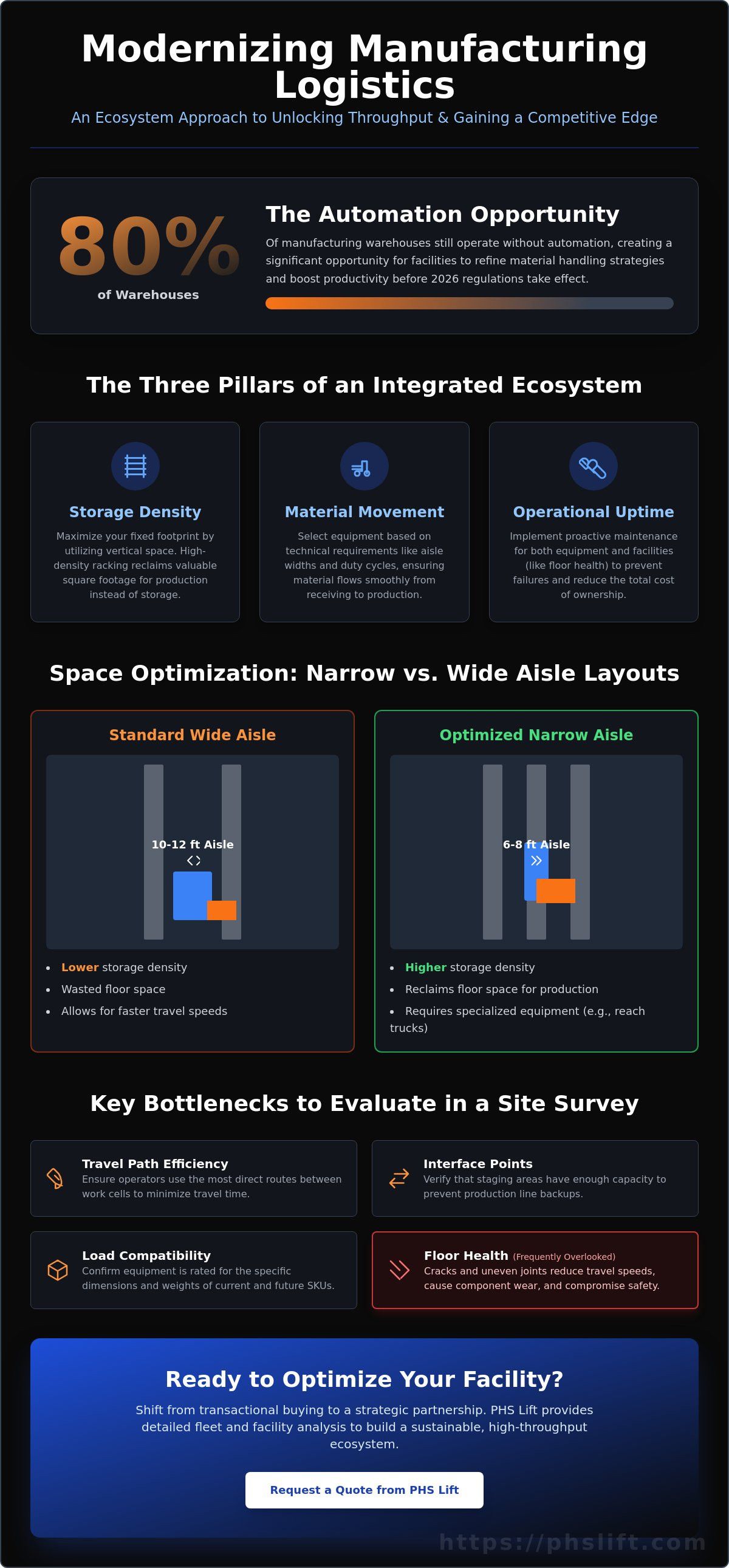
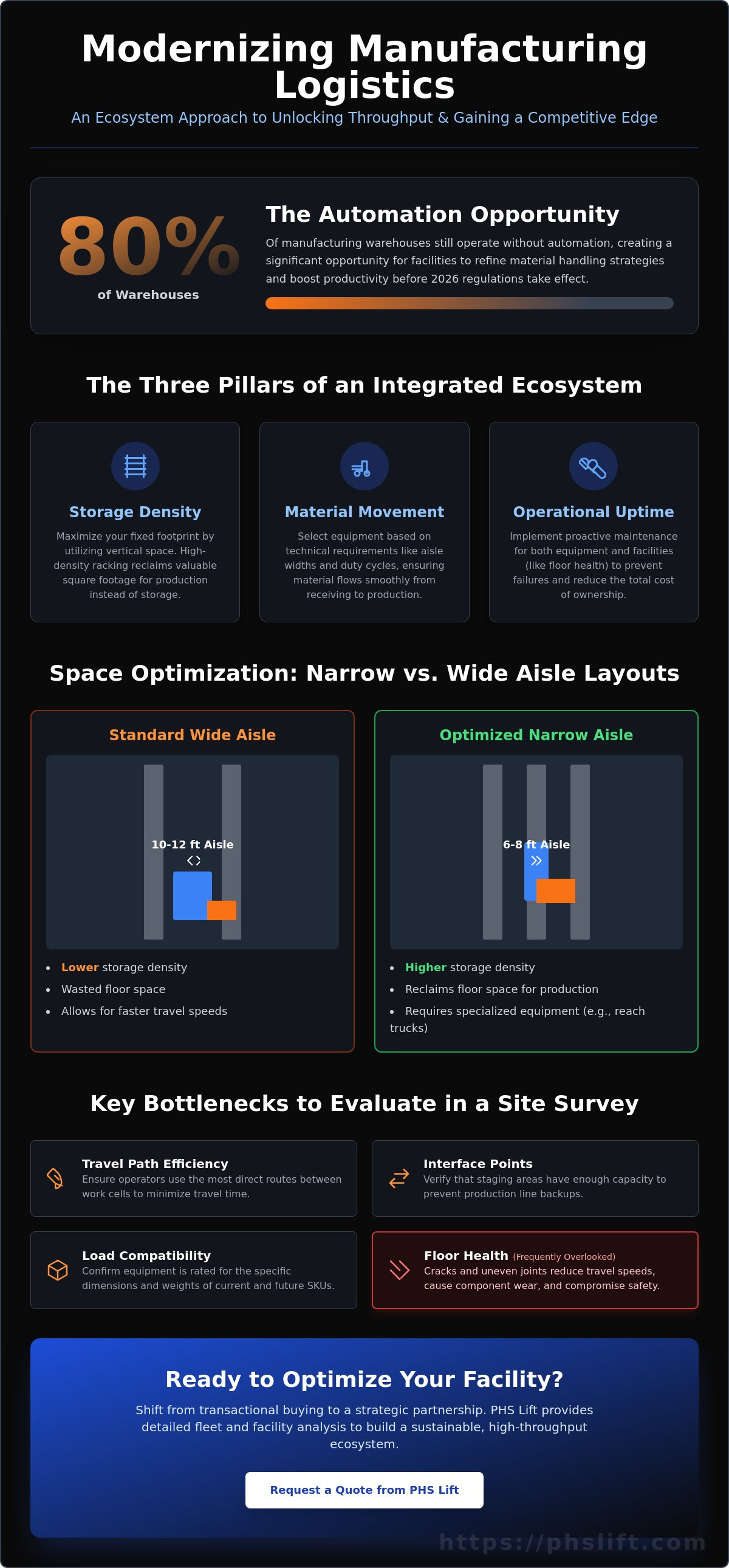
Eighty percent of manufacturing warehouses still operate without any form of automation despite a global material handling market projected to reach $230.44 billion in 2026. This gap represents a massive opportunity to refine your material handling equipment for manufacturing to gain a competitive edge. You likely recognize that production bottlenecks and rising maintenance costs aren't just inconveniences; they're direct threats to your bottom line. Mismatched equipment and poor floor health create a cycle of inefficiency that limits your facility's potential.
You need a strategy that prioritizes operational uptime and technical accuracy over marketing hype. This guide provides the frameworks needed to master modern logistics, helping you maximize cubic storage and drive down the total cost of ownership across your fleet. We'll examine the impact of upcoming 2026 zero-emission equipment regulations, explore high-density storage strategies, and outline how facility maintenance acts as a critical operational solution for throughput. It's time to move beyond standard procurement and toward a data-driven, integrated ecosystem.
Key Takeaways
- Define operational success through throughput by aligning storage, equipment, and maintenance into a single technical ecosystem.
- Utilize cubic velocity metrics to transition from standard layouts to narrow aisle configurations, reclaiming critical floor space for production.
- Optimize your fleet of material handling equipment for manufacturing by matching battery types and duty cycles to your specific shift requirements.
- Extend equipment life and improve safety by treating floor health as a technical requirement to prevent component wear and traction loss.
- Shift from transactional buying to strategic partnerships that prioritize parts availability and long-term fleet scalability.
Defining Integrated Warehouse Solutions for Manufacturing Environments
Integrated warehouse solutions are more than a collection of disparate machines. They represent the technical convergence of storage systems, material movement equipment, and facility maintenance. In high-output environments, warehouse solutions are the strategic application of MHE and facility systems to optimize operational flow. The primary success metric for these systems is throughput. This is the velocity at which materials move from receiving docks to production lines. If your Material-handling equipment (MHE) isn't synchronized with your racking and floor plan, throughput collapses. Modern manufacturing demands modularity. As SKU counts fluctuate and production lines shift, your logistics framework must scale without requiring a total facility overhaul.
The Three Pillars of Facility Optimization
Optimization relies on three distinct technical pillars. First, storage density. Manufacturing footprints are often fixed, making vertical space your most valuable asset. Utilizing high-density racking allows you to maximize square footage for production rather than just storage. Second, material movement. This involves selecting equipment based on specific aisle widths and line-side delivery requirements. For many facilities, moving to narrow aisle configurations is the most effective way to reclaim space. Third, operational uptime. You must implement maintenance protocols that treat the facility as a machine. This prevents equipment failure and ensures the flow remains constant. Effective uptime strategies reduce the total cost of ownership by extending the life of your fleet components.
Identifying Manufacturing Bottlenecks
Bottlenecks are often invisible until they cause a line stoppage. Identifying these restrictions requires comprehensive site surveys to map the flow between staging and production. One frequently overlooked factor is floor health. Poor floor conditions, such as cracks or uneven joints, reduce equipment travel speeds and compromise operator safety. These micro-delays accumulate, significantly slashing your daily throughput. Additionally, you must analyze load cycles. This data determines the specific fleet requirements for multi-shift operations. It ensures that your material handling equipment for manufacturing has the battery capacity and durability to survive 24/7 duty cycles. To ensure your facility remains competitive, request a quote from PHS Lift for a detailed fleet and facility analysis.
Key areas to evaluate during a site survey include:
- Travel Path Efficiency: Are operators taking the most direct routes between work cells?
- Interface Points: Do staging areas have enough capacity to prevent production line backups?
- Load Compatibility: Is the current equipment rated for the specific dimensions and weights of your 2026 production SKUs?
Maximizing Cubic Velocity: Space Optimization and Storage Strategies
Cubic velocity measures how efficiently you use the total volume of your manufacturing facility for staging and storage. Most facilities underutilize their vertical cube. They focus heavily on square footage but ignore the air above the production floor. By transitioning from standard layouts to narrow aisle configurations, you can reclaim significant floor space for production machinery. This shift requires a technical alignment between rack height and the specifications of your high-reach stackers. You can't design one without the other. High-turnover manufacturing components require a balance between SKU accessibility and storage density. If your equipment can't reach the top rack quickly, density becomes a bottleneck rather than a benefit.
Narrow Aisle vs. Wide Aisle Layouts
Choosing an aisle width involves technical trade-offs between storage density and equipment maneuverability. Wide aisles allow for faster travel but waste valuable real estate. Narrow aisles maximize pallet positions but require specialized equipment. You must calculate the minimum aisle width based on your equipment's actual turning radius. This prevents costly rack damage and ensures compliance with OSHA regulations for material handling equipment. Integrating reach trucks into these tighter spaces allows for high-density vertical storage without sacrificing the speed of line-side delivery. Precise measurements are the only way to avoid operational friction.
Vertical Growth and Ergonomics
Maximizing the cube isn't just about high racks. It's about how materials interact with the production line. Leveraging lift tables for ergonomic palletizing at the production line-side reduces operator fatigue and injury risk. This is critical in older facilities where floor loading capacities might limit heavy racking. Using vertical space keeps production floors clear of raw material clutter, improving safety and flow. It's often helpful to compare available PHS Lift options for vertical movement to ensure your equipment matches your structural limits. This technical synergy between material handling equipment for manufacturing and storage design is what differentiates a high-performance facility from a standard warehouse. Proper planning ensures that your investment in material handling equipment for manufacturing delivers the highest possible ROI by optimizing every cubic inch of your facility.
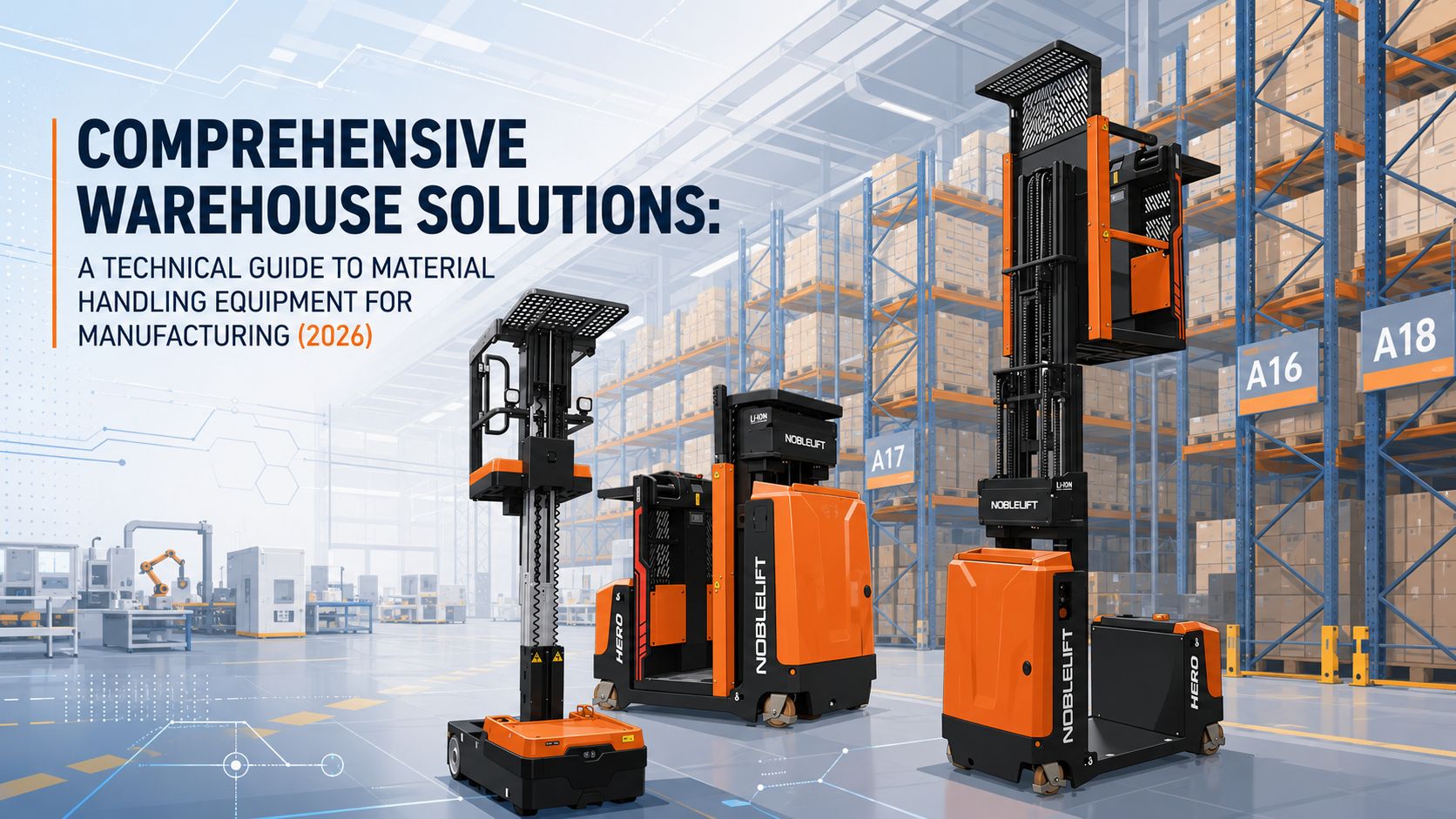
Fleet Selection Strategy: Aligning Material Handling Equipment with Duty Cycles
Effective fleet management starts with understanding your specific duty cycle. In a manufacturing plant, equipment doesn't just sit; it moves constantly. Selecting the right material handling equipment for manufacturing requires a deep dive into shift lengths and charging windows. For 24/7 operations, the transition to lithium-ion power is no longer optional. It's a technical requirement. Lithium-ion allows for opportunity charging during operator breaks, keeping the fleet on the floor without the need for dedicated battery rooms. This shift aligns with the 2026 trend toward electrification, where higher voltage lift trucks are becoming the standard for demanding industrial applications.
Large plant floors also demand efficient horizontal transport to maintain the throughput goals established in your facility design. Instead of using high-reach equipment for long-distance travel, integrate specialized tuggers to move material trains. This keeps your vertical-lift assets at the rack face where they are most productive. For broader context on how these systems integrate within a larger logistics framework, review our guide on material handling equipment in warehouse environments. High-performance logistics depend on this level of technical granularity to prevent production line starvation.
Manual vs. Electric: The TCO Perspective
Staging areas with low volume don't always need high-end automation. You can utilize manual pallet jacks for short-distance repositioning and low-frequency tasks. However, high-volume picking and loading require the productivity gains of electric pallet jacks. When calculating the total cost of ownership (TCO), you must factor in the charging station footprint and energy consumption. According to the Material Handling Industry (MHI), energy efficiency and smart charging infrastructure are primary drivers of fleet ROI in 2026. Electric units reduce operator fatigue, which directly correlates to fewer safety incidents and higher consistent travel speeds.
Specialized Equipment for Production Lines
Production corridors are often narrow, requiring equipment with a tight turning radius. Walkie stackers provide the necessary lift height without the large footprint of a standard forklift. If your facility handles hazardous materials or operates in cold storage, your equipment must meet specific regulatory classifications to ensure operational uptime. Don't forget overhead needs. Utilizing specialized aerial lifts ensures that line repairs and overhead facility maintenance don't cause extended downtime. This specialized approach ensures that every piece of material handling equipment for manufacturing is fit for its specific application, reducing mismatched equipment costs.
Facility Maintenance as an Operational Solution: The Impact of Floor Health
Facility maintenance is often dismissed as a janitorial concern. In high-stakes manufacturing, it's a technical requirement for fleet performance. Industrial debris and metal shavings act as abrasives that significantly increase the wear rate of pallet jack wheels. When wheels degrade, rolling resistance climbs. This forces your material handling equipment for manufacturing to work harder, draining batteries and stressing drive motors. Clean floors are essential for traction. They reduce tire slip and improve the braking efficiency of heavy units, especially when carrying maximum loads. A systematic floor care program is the most direct way to ensure your facility passes safety audits while maintaining peak operational speed. Dirty floors hide cracks and structural issues, making inspections less effective and increasing the risk of sudden equipment failure.
Automating Facility Hygiene
Choosing the right equipment depends on your manufacturing floor footprint. Walk-behind units excel in tight production cells and narrow aisles where maneuverability is critical. Ride-on models are necessary for expansive staging areas and long travel paths. When evaluating industrial floor scrubbers, prioritize technical specifications like brush pressure and tank capacity. High brush pressure is required to lift embedded oils and metal dust from porous concrete. Efficient squeegee systems and high-capacity vacuum motors ensure the floor is dry immediately after the pass. Poor drying leaves moisture that creates slip hazards for both operators and pedestrians. Consistent scrubbing also prevents the buildup of black tire marks. These marks eventually obscure safety striping and floor decals, leading to regulatory non-compliance and increased risk of pedestrian accidents.
Maintaining Equipment for Longevity
Floor health directly impacts your equipment's mechanical integrity. Debris trapped in axles or casters leads to premature bearing failure and steering friction. You should link your facility cleaning schedule to your lifting equipment safety checklist to ensure a holistic approach to uptime. Preventative maintenance schedules must be rigorous for high-use manufacturing assets. This proactive approach ensures that your material handling equipment for manufacturing remains operational during peak production cycles. When minor repairs are needed, having specialized tools on-site allows for rapid facility-level fixes without waiting for external technicians. To keep your operations running at full capacity, explore related PHS Lift equipment for facility maintenance and fleet support. Maintaining a clean environment is an investment in the reliability of your entire logistics ecosystem.
Procurement and Scaling: Building a Sustainable Warehouse Ecosystem
Procurement must shift from a transactional model to a strategic equipment partnership. This is critical for national operations where consistency across multiple sites is required. You need to evaluate dealer support capabilities and the availability of parts for equipment fleets before signing a contract. Expert guidance prevents equipment over-specification. This avoids unnecessary capital expenditure on features your application doesn't require. PHS Lift acts as a specialized technical resource for nationwide warehouse scaling, ensuring your equipment matches your growth trajectory.
Total Cost of Ownership (TCO) Analysis
A true Total Cost of Ownership (TCO) analysis goes well beyond the initial sticker price. You must factor in energy consumption, preventative maintenance schedules, and operator efficiency. High-quality equipment is engineered to lower long-term operating costs in demanding manufacturing environments through modular design and simplified serviceability. Calculating the ROI on fleet transitions from lead-acid to lithium-ion power is a key financial exercise. While the upfront cost for lithium is higher, the elimination of battery watering and the reduction in charging downtime results in significant savings. In multi-shift facilities, the productivity gains often offset the initial investment quickly. It's about looking at the life of the machine, not just the day of the purchase.
Next Steps in Facility Transformation
Transformation begins with a data-driven internal audit. You should track current equipment utilization rates and identify the primary causes of downtime. Consulting with a specialist helps align your fleet capabilities with current racking and production layouts. This ensures your material handling equipment for manufacturing is sized correctly for the task. You don't want to pay for capacity you'll never use, but you can't afford to be under-equipped during peak production cycles. To begin this process, you can request a quote from PHS Lift for an integrated equipment solution tailored to your operational metrics. Professional alignment is the only way to build a sustainable and scalable warehouse ecosystem.
Advancing Your Manufacturing Logistics Strategy
Operational excellence in 2026 demands a shift from isolated equipment purchases to an integrated technical ecosystem. You've seen how maximizing cubic velocity through narrow aisle layouts and prioritizing floor health can drastically improve throughput. Aligning your material handling equipment for manufacturing with specific duty cycles ensures that your fleet remains operational during peak production windows. By focusing on total cost of ownership rather than initial sticker price, you protect your margins and ensure long-term scalability across national operations. This technical precision is what separates high-turnover leaders from those plagued by bottlenecks.
PHS Lift provides the industrial expertise needed to navigate these technical complexities. As a specialized NobleLift dealer, we offer high-performance fleets backed by national support for multi-facility manufacturing operations. Our team delivers expert guidance on technical specifications and TCO analysis to ensure your facility operates at peak efficiency. It's time to transform your warehouse from a storage cost center into a high-velocity production asset. Compare available PHS Lift warehouse solutions and request a custom quote today. Your facility's next level of productivity is within reach.
Frequently Asked Questions
What are the most essential material handling equipment for manufacturing?
The most essential material handling equipment for manufacturing includes high-reach stackers for vertical storage, tuggers for horizontal transport, and electric pallet jacks for line-side staging. These assets form a technical ecosystem that supports continuous throughput. You should also integrate lift tables for ergonomic palletizing. To find the right fit for your facility, compare available PHS Lift options based on your specific load weights and duty cycles.
How do I calculate the correct aisle width for my forklifts and stackers?
You calculate the correct aisle width by adding the equipment's head length, the load length, and a standard maneuvering clearance of 12 inches. This total represents the minimum right-angle stack aisle width required for safe operation. Always consult the manufacturer's specification sheet for the specific turning radius of your unit. Proper calculation prevents rack impact and ensures compliance with facility safety standards.
When should I transition from manual to electric pallet jacks in production?
Transition from manual to electric pallet jacks when your travel distances exceed 50 feet or when shift volume requires constant movement. Electric units eliminate operator fatigue and maintain consistent travel speeds across long shifts. This move is a critical step in optimizing material handling equipment for manufacturing to meet high-demand production targets. It's often the most cost-effective way to improve line-side delivery velocity.
How does floor cleanliness affect the lifespan of my warehouse equipment?
Floor cleanliness directly affects equipment lifespan by preventing industrial debris from entering wheel bearings and axle assemblies. Metal shavings and dust act as abrasives that quickly degrade polyurethane wheels and casters. Implementing a floor care program with industrial scrubbers reduces rolling resistance and drive motor strain. This technical attention to detail extends the operational life of your fleet and reduces the frequency of component replacements.
What is the difference between a reach truck and a standard forklift for space saving?
The primary difference is that a reach truck utilizes a pantograph or moving mast to pick loads within narrow aisles, while a standard forklift requires more space for its counterweight. Reach trucks allow you to reduce aisle widths by up to 35 percent compared to traditional counterbalanced units. This technical advantage is essential for maximizing cubic velocity. You should explore related PHS Lift equipment to determine which configuration fits your racking height.
How can integrated warehouse solutions improve facility safety and OSHA compliance?
Integrated solutions improve safety by creating predictable travel paths and standardized equipment interfaces that align with OSHA requirements. When storage and movement systems are synchronized, you reduce the risk of collisions in high-traffic zones. Proper facility maintenance, such as clear safety striping and clean floors, further enhances operator visibility and braking response. These integrated frameworks ensure that your material handling equipment for manufacturing operates within a controlled environment.
What should I look for when choosing a material handling equipment dealer?
Look for a dealer that offers specialized NobleLift expertise and maintains a comprehensive inventory of replacement parts. A reliable partner provides national support for multi-facility operations and understands the technical nuances of TCO analysis. You need a dealer that acts as a technical resource rather than just a vendor. To start a strategic partnership, request a quote from PHS Lift for a detailed assessment of your specific manufacturing application.
Can integrated warehouse solutions help reduce my facility energy costs?
Yes, integrated warehouse solutions reduce energy costs by transitioning your fleet to high-efficiency lithium-ion power systems. Lithium-ion batteries offer higher energy density and support opportunity charging, which eliminates the need for energy-intensive battery rooms. Optimizing your floor layout also reduces travel distances, lowering the total kilowatt-hours consumed per shift. These technical refinements contribute to a more sustainable and cost-effective manufacturing environment.